
Pipedrive still advertises “from $14 a seat,” but that number describes a plan that cannot run a single automation, and sometime in 2025 the plan you were probably pricing stopped existing. Pipedrive repackaged its whole lineup: Essential became Lite, Advanced became Growth, Professional and Power merged into a single Premium tier, and Enterprise became Ultimate. If you were quoting Professional at around $49 a seat, the tier you now land on is Premium at $59, and most teams never got a plain-English note that their per-seat price moved. On top of the seat, lead capture, email campaigns, project tracking, and web-visitor data all bill as separate add-ons. So the real question is not “what is Pipedrive per seat,” it is “what will Pipedrive invoice me once I turn on the features I came for.” This teardown walks the 2026 math at three team sizes.
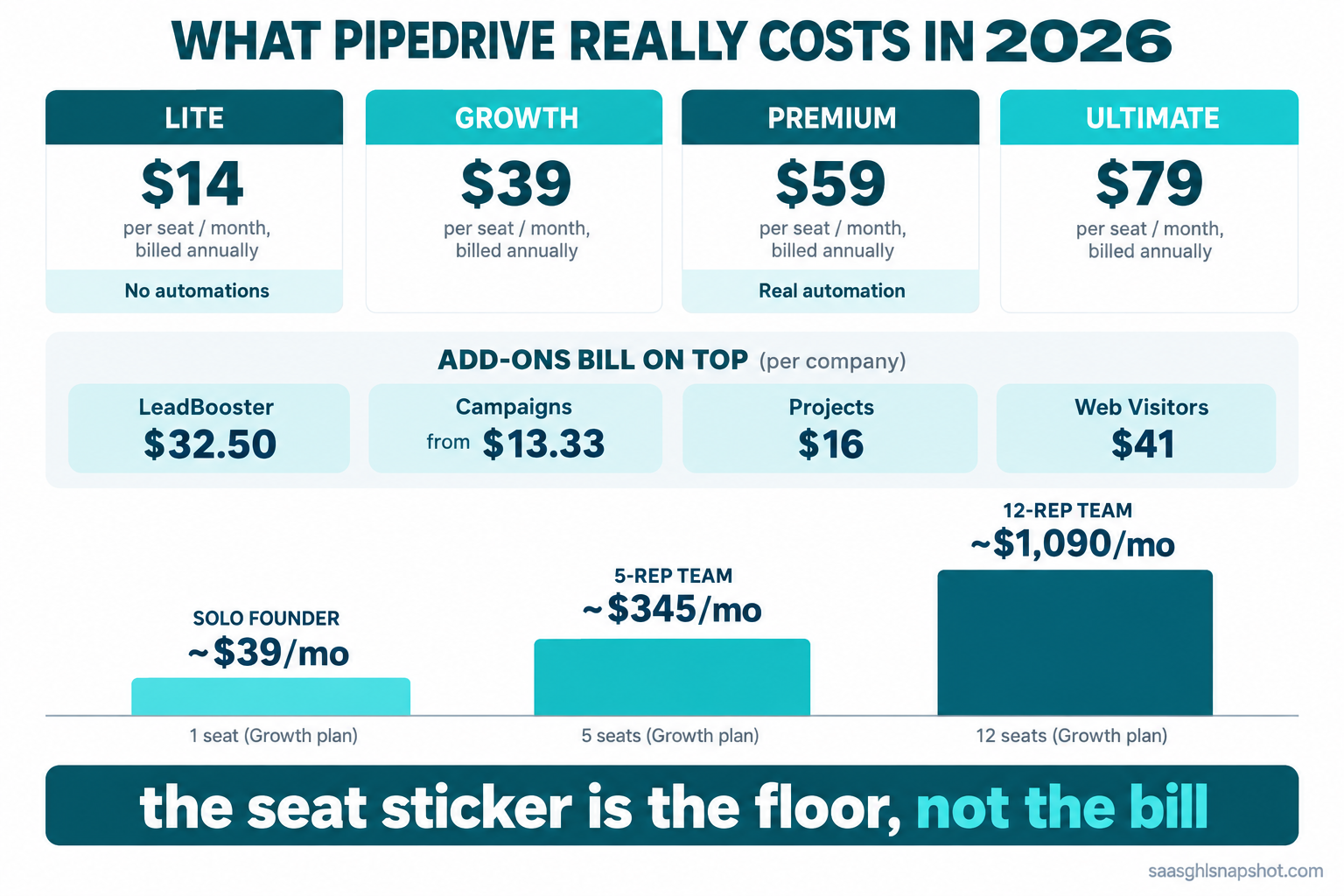
Table of contents
- The short answer
- How Pipedrive billing works now
- The real cost at three team sizes
- The three costs the quote hides
- Pipedrive vs Close vs HubSpot vs Attio
- Steal this: the true-cost worksheet
- The flat-platform alternative
- Objections · Compliance · FAQ
The short answer: the $14 plan is a contact list
Pipedrive publishes four plans now, billed per user. On annual billing they run Lite $14, Growth $39, Premium $59, and Ultimate $79 a seat a month (Pipedrive pricing; Orb pricing atlas, Pipedrive). That is the whole ladder, and next to HubSpot it looks gentle.
The sticker is not the bill for two reasons. First, the $14 Lite seat is effectively a shared contact list with a pipeline view, running zero workflow automations, so the sequences and triggers most founders buy a CRM to get start one tier up (Activepieces, Pipedrive pricing 2026). Second, the parts of Pipedrive that feel like table stakes, chatbot and web forms, email campaigns, project tracking, and web-visitor data, are not in any plan. They are paid add-ons that bill on top (Pipedrive pricing).
For a bootstrapped team this matters because every one of those levers scales with your ambition. Median growth for private B2B SaaS ran about 22% in the most recent SaaS Capital benchmark, down from 25% in 2024, with only 7.3% of companies reporting flat or negative growth (SaaS Capital, 2026 Private B2B SaaS Growth Rate Benchmarks). More growth means more seats and more add-ons switched on, so a tool priced this way turns every good quarter into a bigger invoice.
How Pipedrive billing actually works in 2026
Three things drive the number, and the slider shows only the first.
1. Seats, on the renamed ladder. You pay per user, every month, on the tier you pick. In 2025 Pipedrive moved everyone onto a new four-plan structure: Essential is now Lite, Advanced is Growth, Professional and Power collapsed into one Premium tier, and Enterprise became Ultimate (Pipedrive Knowledge Base, new plans). The mid-tier most small teams land on is Premium at $59 a seat, above the old Professional.
2. The automation ceiling climbs with price. Workflow automation is the reason a founder graduates from a spreadsheet to a CRM, and Pipedrive meters it by tier. Lite runs no active automations. Growth opens a modest allowance, Premium roughly doubles it, and Ultimate roughly doubles it again (Activepieces, Pipedrive pricing 2026). So the feature you most want is gated, and the moment your sequences outgrow Growth, the whole team moves up to Premium.
3. Add-ons, billed per company on top. This is the line that surprises people. LeadBooster (chatbot and web forms) is about $32.50 a month. Campaigns (email) starts around $13.33 and scales with your subscriber count. Projects is about $16, Smart Docs about $32.50, and Web Visitors, which de-anonymizes site traffic, about $41 (Pipedrive pricing; Orb pricing atlas, Pipedrive). Most are flat per-company fees rather than per-seat, which is fair, but they are still four or five separate meters bolted to the seat price.
There is a 14-day free trial but no permanent free plan (Pipedrive pricing). Every real decision starts at a paid seat plus whatever add-ons your motion needs, not at zero.
The real monthly cost at three team sizes
Every figure below is an illustrative estimate from list prices and a stated usage assumption, not a quote. Each scenario stacks add-ons on top of seats and assumes annual billing, the cheaper case.
| Scenario | Seats x tier | Seat cost / mo | Add-ons / mo | Modeled total / mo |
|---|---|---|---|---|
| Solo founder, real pipeline | 1 x Growth ($39) | $39 | $0 | ~$39 |
| 5-rep team, lead capture on | 5 x Premium ($59) | $295 | ~$49 (LeadBooster + Projects) | ~$345 |
| 12-rep team, full stack | 12 x Ultimate ($79) | $948 | ~$140 (LeadBooster, Web Visitors, Campaigns, Projects) | ~$1,090 |
Modeled total monthly Pipedrive cost by team size, seats plus add-ons, on annual billing. Illustrative estimates from Pipedrive pricing and the Orb pricing atlas, November 2026.
The solo band looks cheap, and for a founder who needs only a pipeline and basic sequences, Growth at $39 is fair. The catch shows up the first time you want a chatbot or a web form into the CRM. That is LeadBooster, another $32.50, and now your “$39 CRM” is $72.
The five-rep band is where the sticker stops telling the truth. Five Premium seats are $295, but turn on lead capture and project tracking and you clear $345 a month, about $4,140 a year, for a tool whose headline was $14. The twelve-rep band is worse: $948 in seats becomes near $1,090 a month, roughly $13,000 a year, once a full team adds web visitors and campaigns. None of that is hidden exactly. It is just never on the page you used to decide.
The three costs the quote hides
This is the part the pricing page does not write, and it is where the budget leaks. For each, the trigger and what to do about it.
1. The rename repriced your seat. The 2025 repackaging moved former Professional and Power customers onto a single Premium tier, and Pipedrive’s own help docs note Premium can cost more per month than the Professional plan it replaced (Pipedrive Knowledge Base, new plans). A team that budgeted around $49 a seat two years ago may now pay $59 for the renamed equivalent, a quiet 20% bump nobody flagged. The fix: pull your last invoice and confirm which new-plan name you are on.
2. The add-on stack you assumed was included. Lead capture, campaigns, projects, and web-visitor data read like core features, and in some competitors they are. In Pipedrive each is a separate line (Pipedrive pricing). Switch on three and you have added $60 to $120 a month before a single extra rep. The fix: list every feature you expect to use, then check each against the add-on list, not the plan.
3. The annual-contract headline. The $14 to $79 ladder is the price of a yearly commitment. Pay monthly to stay flexible, which is what an early-stage team should want, and you pay a premium Pipedrive builds in as “up to 42% savings” on annual (Orb pricing atlas, Pipedrive). The fix: if you are not sure you will still be here in a year, price the monthly rate and weigh flexibility against the discount.
The pattern across all three is the same. Pipedrive’s seat price is a floor that moves up the moment you do the work you bought the tool to do. Not a scam, just a packaging model, but it means the slider is the least useful figure for budgeting.
Affiliate disclosure: the link above is a GoHighLevel affiliate link. We may earn a commission at no extra cost to you. See our affiliate disclosure.
Pipedrive vs Close vs HubSpot vs Attio
Pipedrive is a genuinely good pipeline CRM: visual, fast to set up, and the drag-and-drop deal board is still one of the clearest in the category. The question is whether per-seat plus add-ons fits your stage. Here is how the common alternatives bill, because for a bootstrapped team the billing shape matters more than the feature checklist.
| CRM | Entry seat (annual) | Lead capture + email | Real cost driver | Best for |
|---|---|---|---|---|
| Pipedrive | $14 Lite, $59 Premium for automation (pricing) | Add-ons (LeadBooster, Campaigns) | Premium tier plus per-company add-ons | Visual pipeline teams that want simple deal tracking |
| Close | $9 Solo, $99 for the dialer (pricing) | Calling and SMS billed as usage | Dialer tier plus calling minutes | Phone-heavy outbound teams |
| HubSpot Sales Hub | $90 Pro per seat + $1,500 onboarding (pricing) | Included, then upsold across hubs | Pro tier, onboarding fee, seat creep | Teams standardizing on the full HubSpot suite |
| Attio | Free to 3 seats, ~$34 to ~$93 (pricing) | Native data model, email sync | Seat tier, integration stack | Data-model-first teams that email more than they dial |
| GoHighLevel | Flat platform fee, unlimited users (pricing) | Built in, no add-on | One platform fee plus telephony usage | Operators who want no per-seat charge across tools |
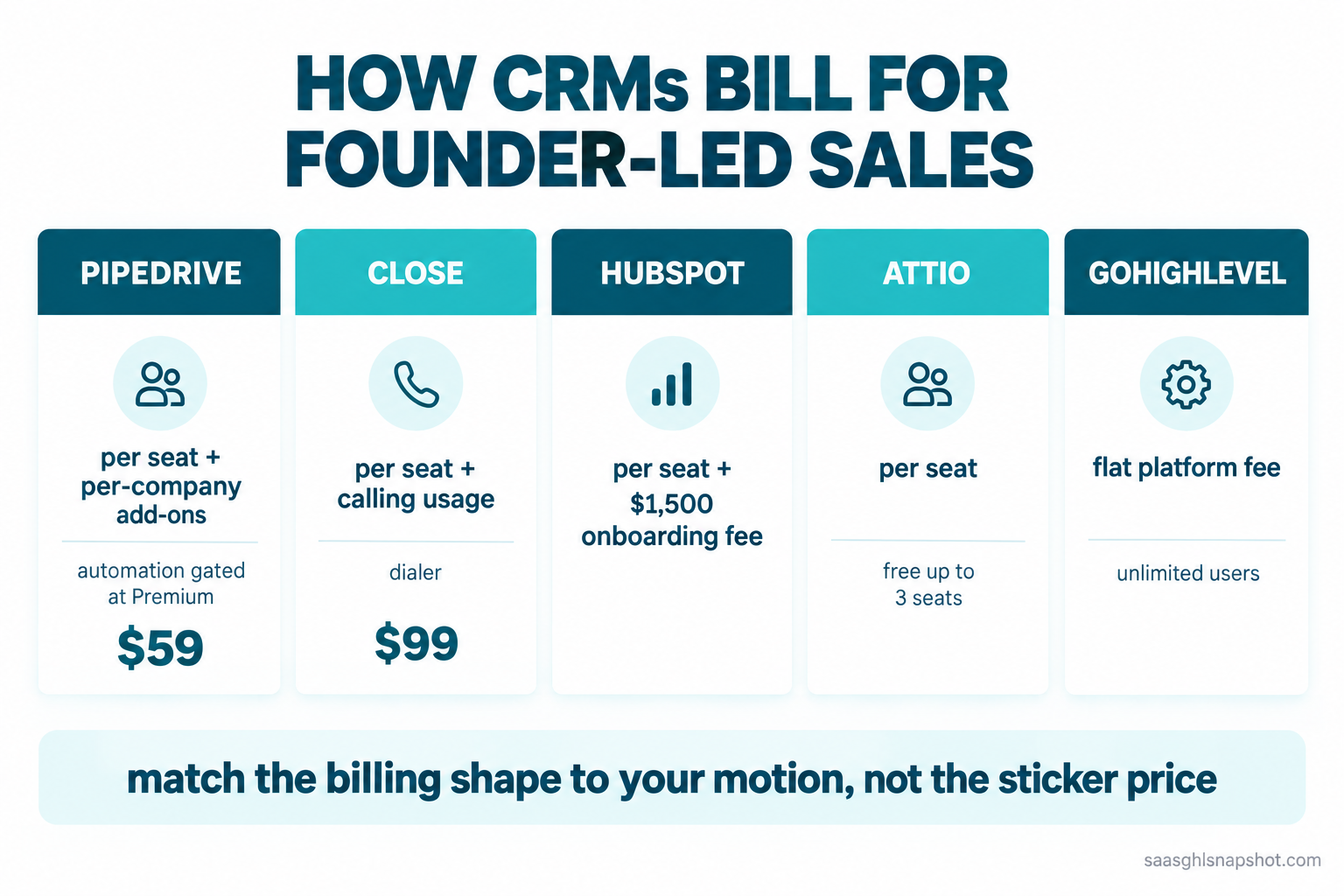
The honest read. If you want a clean visual pipeline and call rarely, Pipedrive at Growth or Premium is a reasonable buy. If you dial all day, Close is built for that (Close CRM pricing teardown). If you want the richest data model and email more than you call, Attio is worth a look (Attio vs HubSpot Sales Hub). The deeper split is per-seat versus flat: every per-seat CRM charges you more as you hire, which collides with CAC payback already stretched 12.5% longer at the median since 2022 (Benchmarkit, 2025 B2B SaaS Benchmarks). A fuller breakdown of all four is in our best CRM for founder-led sales comparison.
Steal this: the true-cost-of-Pipedrive worksheet
Pipedrive’s cost is predictable if you model the whole invoice, not the slider. Run this before you buy and once a quarter after.
The real monthly cost formula:
Monthly Pipedrive cost = (seats x tier price)
                       + LeadBooster ($32.50, if you capture leads)
                       + Campaigns (from $13.33, scales with subscribers)
                       + Projects ($16) + Web Visitors ($41) + Smart Docs ($32.50)

True cost per seat = total monthly bill / reps working deals
That last line is what matters for a sales budget. Add-ons spread across every rep whether or not each one touches that feature.
Ask Pipedrive before you commit, in writing:
- Which new plan name am I being quoted, and what was its old-plan equivalent and price?
- Which add-ons do I need for my motion, and what is each one’s monthly cost at my size?
- What is the month-to-month price versus the annual price, so I can see the flexibility premium?
The 10-minute quarterly audit: open the billing page and read every add-on line separately from seats, divide the total by reps actively working deals for your true cost per seat, then flag any add-on nobody used this quarter and any seat assigned to a person who no longer sells.
The same discipline across every tool is in our real cost of your GTM stack worksheet, and the payback math behind the per-seat problem is in our CAC payback period guide.
The flat-platform alternative to per-seat plus add-ons
Per-seat-plus-add-ons taxes you twice for progress: once when you hire a rep, again when you switch on a feature. Founder-led sales is still worth tooling well, and the pipeline design that keeps a CRM from becoming shelfware is covered in building a founder-led pipeline. But you do not have to buy the pipeline, the lead capture, the email, and the automation on five separate meters. A flat-platform GoHighLevel build puts CRM, pipelines, forms and chat, email and SMS, and lifecycle automation under one fee with unlimited users, so hiring does not add a seat charge and turning on a workflow does not add a line. It is not a drop-in Pipedrive clone, and if the drag-and-drop deal board is the thing you love, weigh that honestly. For most early-stage teams the flat model is cheaper and easier to forecast, and the deal-history migration off HubSpot applies just as well to a Pipedrive export.
Objections
“But $14 a seat is basically nothing. Why does this matter?” Because $14 buys Lite, which runs zero automations and works as a shared contact list. The realistic entry price for a team that wants sequences is Growth at $39, and real automation lives on Premium at $59, plus add-ons. Model the bill at the tier you will actually use, not the headline.
“We already run Pipedrive and like it. Should we rip it out?” Not automatically. If it fits your motion and the bill is predictable, a working CRM is worth keeping. The smaller action: confirm which renamed plan you are on, check you are not paying for add-ons nobody uses, and decide whether annual lock-in still suits you. Rip-and-replace only makes sense when the per-seat math is fighting your hiring plan.
“Aren’t add-ons fairer than bundling everything into one plan?” They can be, because you pay only for what you switch on. The trap is that the features that read as core, lead capture and email, sit behind the add-on wall, so most teams switch several on anyway. Fair in theory, surprising on the invoice.
One compliance trap the Campaigns add-on creates
The moment you switch on Campaigns and start sending marketing email from Pipedrive, you inherit rules the pricing page will not mention. CAN-SPAM governs every commercial and lifecycle message, which means a real physical address and a working unsubscribe in each send (FTC CAN-SPAM compliance guide). Since February 2024, Google and Yahoo have required bulk senders, anyone sending 5,000 or more messages a day, to authenticate with SPF, DKIM, and DMARC, keep the spam complaint rate under 0.30%, and offer one-click unsubscribe through the List-Unsubscribe-Post header (Google email sender guidelines). The day an EU trial signup lands, GDPR applies, and CCPA and CPRA cover California residents. SOC 2 is not a law, but for B2B SaaS it is a sales blocker buyers ask about. The full setup is in our SaaS email deliverability and compliance guide.
Frequently asked questions
How much does Pipedrive actually cost in 2026?
On annual billing the renamed plans run about $14 (Lite), $39 (Growth), $59 (Premium), and $79 (Ultimate) per user per month. Lite runs no automations, so most teams start at Growth or Premium, and lead capture, campaigns, projects, and web-visitor data are paid add-ons on top (LeadBooster about $32.50, Campaigns from $13.33, Projects about $16, Web Visitors about $41). Budget the real tier plus add-ons, not the $14 headline, and note monthly-contract pricing runs higher.
Did Pipedrive change its plan names?
Yes. In 2025 Essential became Lite, Advanced became Growth, Professional and Power merged into one Premium tier, and Enterprise became Ultimate. Pipedrive's help docs note Premium can cost more per month than the old Professional plan, so some existing customers now pay more per seat under the renamed equivalent.
Which Pipedrive plan includes automation?
Lite at $14 runs zero active automations. Automation starts on Growth with a modest allowance, Premium roughly doubles it, and Ultimate doubles it again. If sequences and triggers are why you want a CRM, your realistic entry point is Growth at $39, and automation-heavy teams land on Premium at $59 a seat.
Are lead capture and email included in Pipedrive's seat price?
No. Chatbot and web forms come through LeadBooster at about $32.50 a month, and email marketing through Campaigns from about $13.33 a month, scaling with subscribers. Both are separate per-company fees on top of the seat, so a team that expects them included sees a bigger invoice than the slider suggested.
Is Pipedrive cheaper than HubSpot or Close?
On the sticker, $14 Lite undercuts HubSpot Sales Hub Professional ($90 plus a $1,500 onboarding fee) and sits near Close Solo ($9). Compare like for like, though: Pipedrive's real price is Premium at $59 plus add-ons, Close's is $99 plus calling usage, and HubSpot adds the onboarding fee and seat creep. For a team worried about per-seat growth, a flat platform often beats all three.
Can I pay Pipedrive monthly instead of annually?
Yes, but the advertised prices are annual rates. Pipedrive markets up to 42% savings for paying yearly, so month-to-month is meaningfully higher. If staying flexible matters more than the discount, often the right call early, price the monthly rate honestly before committing to a year.
How do I keep a Pipedrive bill from running away from me?
Confirm which renamed plan you are on, read every add-on line separately from seats, and divide the total by reps actively working deals for true cost per seat. Audit quarterly, switch off any add-on nobody used, and reclaim seats from people who no longer sell.
Sources
- Pipedrive pricing (tiers, add-ons, trial, annual billing) and Pipedrive Knowledge Base, new plans (the 2025 rename)
- Orb pricing atlas, Pipedrive (per-seat prices, add-on list) and Activepieces, Pipedrive pricing 2026 (automation allowances)
- Close pricing, HubSpot Sales Hub pricing, Attio pricing, GoHighLevel pricing
- SaaS Capital 2026 Growth Rate Benchmarks and Benchmarkit 2025 B2B SaaS Benchmarks
- FTC CAN-SPAM compliance guide and Google email sender guidelines
About the author
Priya Venkatesan is a SaaS Growth and Revenue Analyst based in Seattle, WA. She lives in the numbers that decide whether a tool earns its line on the P&L, and writes about where software spend quietly outpaces revenue. Her work pairs hard math with plain language, so the analysis ends in a next step.
Want your sales and messaging stack costed and consolidated under one flat platform? Get the SaaS Snapshot or book a walkthrough. Related: what Close CRM actually costs, Attio vs HubSpot Sales Hub, and the real cost of your GTM stack.