

You can feel the pipeline lying to you. Fourteen deals are on the board, half have not moved in three weeks, and you cannot remember which ones are alive. You built it in a spreadsheet, then a Notion board, then a free CRM trial, and now the real history of every deal lives in your head and your sent folder. That holds up until the week you hire your first rep and realize almost nothing is written down. A founder-led sales pipeline is not a tool you buy, it is a structure you design: the stages, the exit rules, the fields, and the follow-up that fires on its own. Build it right and it carries you from your first ten deals to a small team with no painful migration. Here is how, stage by stage, with the copy to steal.
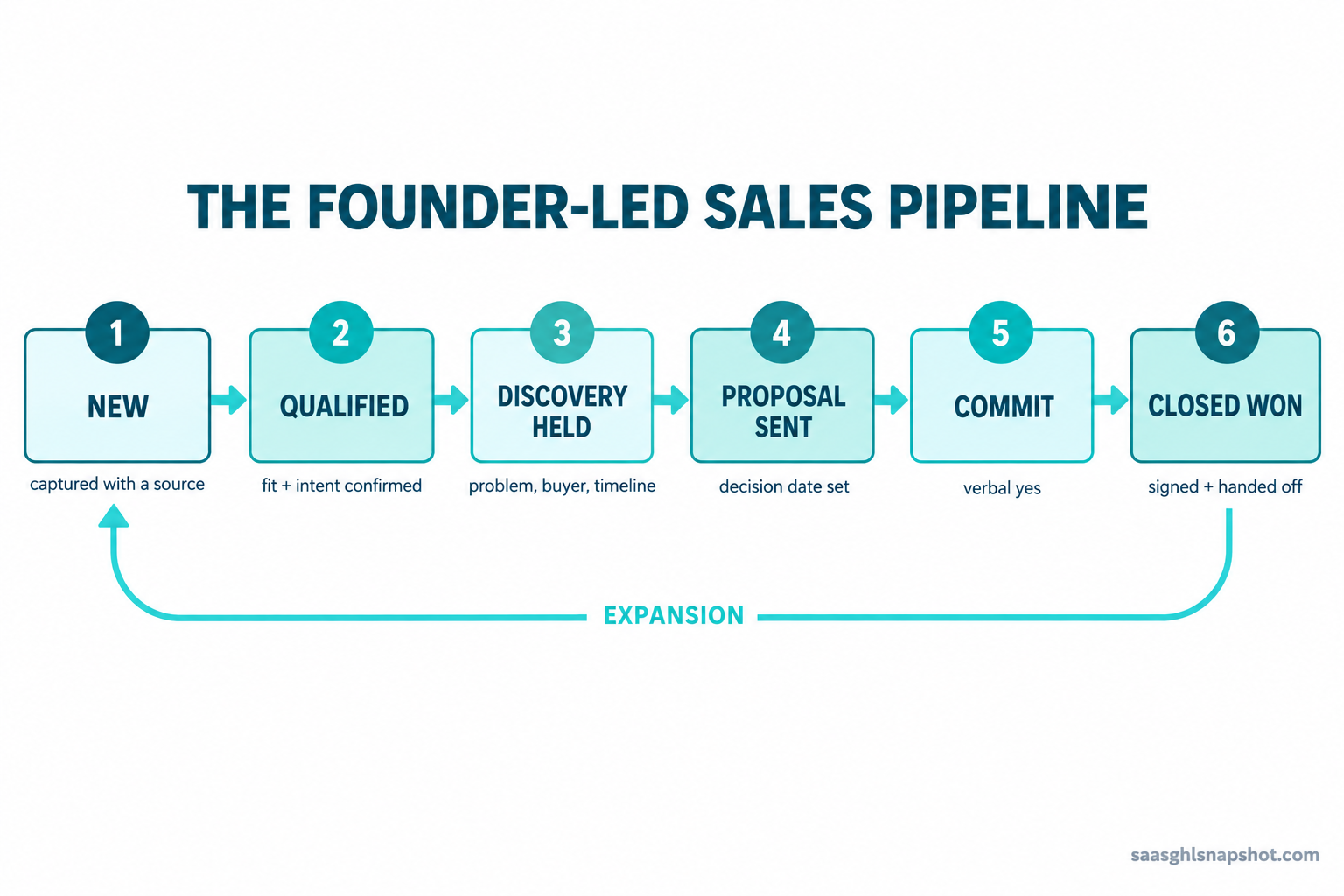
Table of contents
- The short answer
- What a pipeline you outgrow costs
- The design rules that keep you from outgrowing it
- The six stages, one by one
- The follow-up copy to steal
- Three scenarios by ARR band
- The per-seat trap
- Staying compliant as you automate
- Objections
- FAQ
- Sources
The short answer: a pipeline is a structure, not a tool
The mistake is thinking the pipeline is the software. It is not. The pipeline is the set of decisions you make before you pick any tool: how many stages a deal moves through, what must be true for it to advance, what you write down about every deal, and what happens automatically when a deal sits still.
Get that right and the tool barely matters, because you can run it in anything and move it later without losing the thread. Get it wrong and the best CRM on the market is just a tidier place to lose deals. So the order is: design the stages and rules first, wire the follow-up to the stages second, and only then argue about which CRM to buy. A clean structure is also what makes a tool migration survivable. The average B2B win rate is around 21 percent and climbs higher for qualified deals (SalesMotion, citing HubSpot, 2026): a pipeline that qualifies well and follows up without you spends your time only on deals that can close.
What a pipeline you outgrow actually costs
Three things go wrong when the pipeline lives in your head and your inbox, and each costs money.
First, deals rot in silence. A deal with no next step and no date attached is one nobody is working, and most dashboards hide time-in-stage by default, so the rot is invisible until a quarter closes light. The “stalled” line usually falls between 30 and 90 days of no activity; what matters is that nothing is flagging it (Outreach, 2025). Second, the first hire stalls: a rep inherits a pipeline they cannot read, so every deal needs a translation session with you, and a ramp that should take weeks takes months.
Third, growth is already hard, so wasted pipeline hurts. SaaS Capital’s 2025 survey of more than 1,000 private B2B SaaS companies put median growth at 22 percent, down from 25 percent the year before, and bootstrapped companies at just 20 percent (SaaS Capital, 2026). Win rates also fall off fast as deals get bigger, from a median 31 percent under $10K ACV to 15 percent over $100K (Optifai Pipeline Study, via SalesMotion, 2026), so a founder-led motion lives or dies on qualification and follow-up, not volume.
The design rules that keep you from outgrowing it
Before the stages, five rules. They separate a pipeline that scales from one you rebuild every year.
One source of truth. Every deal lives in one place, not split across a spreadsheet, your inbox, and your memory. If it is not in the CRM, it does not exist. A future hire depends on this most.
A deal advances when something is true, not when it feels further along. Every stage gets an exit criterion: a checkable condition. “Had a good call” is not one; “confirmed budget, authority, and a timeline” is.
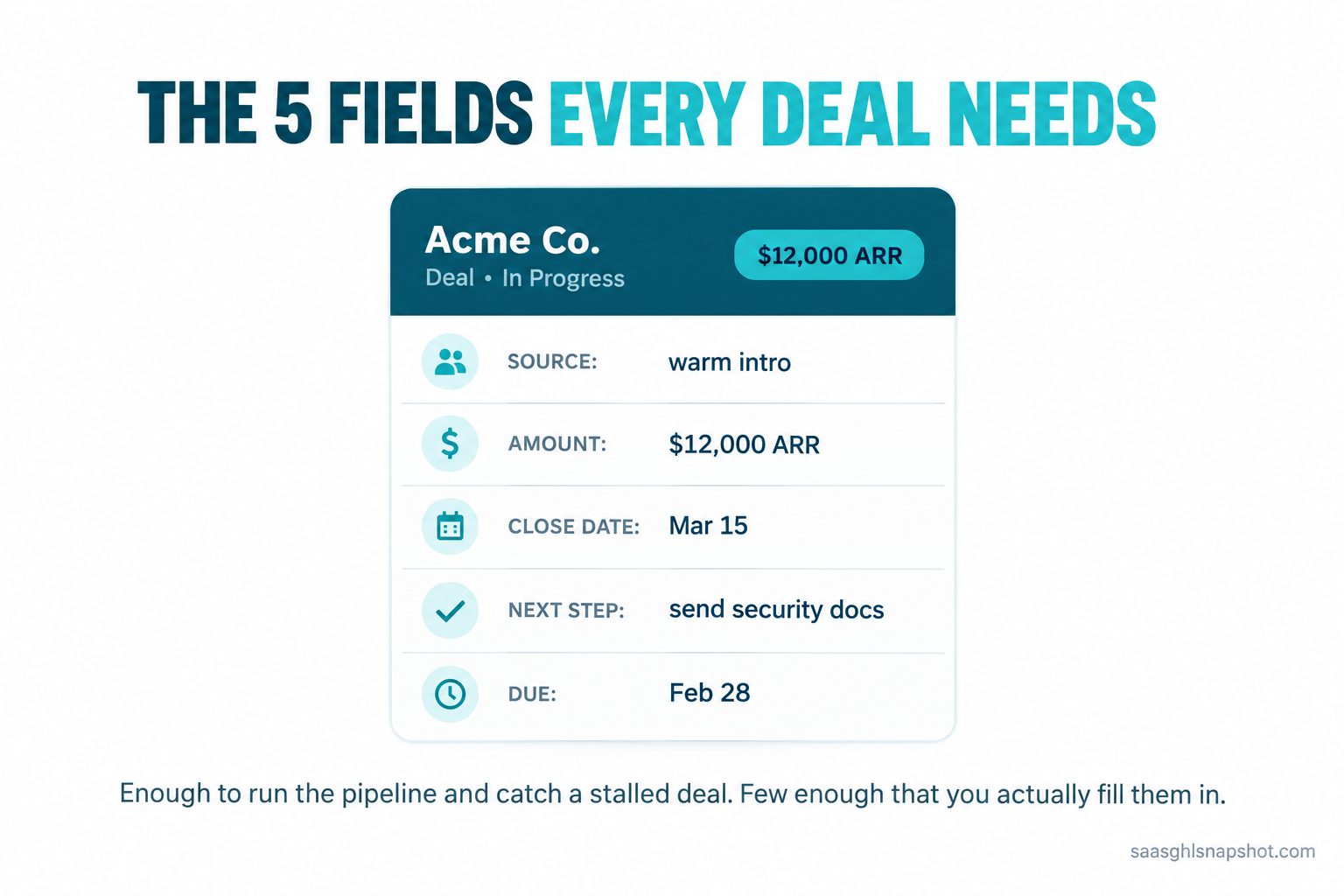
Five required fields, chosen on purpose. Source, deal amount, expected close date, the next step, and the date that step is due. Enough to run the pipeline and spot the rot, few enough that you actually fill them in. Pile on fifteen and a rep skips all of them.
Follow-up is attached to the stage, not to you, so the pipeline keeps working the week you are heads-down shipping.
The platform should not tax you for growing. A per-seat CRM charges you more every time you hire, the quiet reason founder-led teams get stuck on a tool they have already outgrown.
Here are the six stages, each with its exit criterion and the way it breaks.
Stage 1: New, capture every lead in one place
The first stage has one job: no lead ever lands anywhere except the pipeline. A demo request, a warm intro, a cold-email reply, all of it becomes a deal record with a source and an owner the moment it arrives. Point your demo form, calendar booking, and inbound email at the CRM so records are created automatically, and tag every manual add with a source so you learn which channels produce closed revenue.
How it breaks: the warm intro from a friend goes into your inbox, never becomes a deal, and is forgotten by Friday. The leads you enter by hand are the ones most likely to vanish, so automatic capture matters.
Stage 2: Qualified, fit and intent before you spend time
Not every lead deserves a meeting. Stage 2 is the filter, and the most important stage in the pipeline, because every unqualified deal you let through steals time from one that could close. Qualify on two axes. Fit is whether they are the kind of company you can help: size, use case, the problem you solve. Intent is whether they have a reason to move now: a trigger, a deadline, a budget line. A high-fit lead with no intent is a nurture, not a deal. For a product-led motion the strongest intent signal is usage, the idea behind a product-qualified lead. The exit criterion: if you cannot say in one sentence why this company would buy and why now, it is not qualified.
How it breaks: you treat every demo request as hot and burn your week on tire-kickers, or you over-qualify and talk yourself out of deals that just needed one good conversation. Write the fit and intent bar down once, so you are not re-deciding it per deal at 9pm.
Stage 3: Discovery held, the meeting that sets the close
The discovery call is where founder-led sales is actually won. You are not demoing features, you are finding the real problem, the person who can say yes, and the timeline. Two mechanics make it reliable. First, getting the meeting to happen: a no-show is a deal stalled on day one, and automated email and text reminders cut no-shows hard (set them up properly). Second, capturing what you learn in the five fields right after the call, because a discovery call you do not write down is one your future rep cannot use. The exit criterion: you can name the problem in the buyer’s words, you know who signs, and you have a rough timeline. Missing any of the three means a second call, not a proposal.
How it breaks: you give a great demo, feel good, and advance the deal without confirming who decides or when. Three weeks later it stalls and you cannot say why.
Stage 4: Proposal sent, where “send me pricing” goes to die
This is the stage where founder-led deals quietly die. You send pricing, they say “let me take this to the team,” and the deal enters a silence you mistake for a soft no. Most of the time it is not a no, it is a deal with no next step attached. The fix is structural. A proposal never leaves without two things: a specific decision date you agreed on the call (“you want this live before the quarter, so let us decide by the 15th”), and a scheduled next touch in the CRM that fires on its own. That is the only reliable cure, and there is a whole system for the send-me-pricing moment worth stealing. The exit criterion is pricing and scope in writing with a decision date on the calendar.
How it breaks: the proposal goes out, you tell yourself you will “check in next week,” next week is busy, and the deal goes cold while you still think it is warm.
Stage 5: Commit, verbal yes, paperwork not done
Between “yes, we want to do this” and money in the bank there is a gap where deals you thought were won slip a quarter. Security review, a procurement form, a legal redline, a SOC 2 questionnaire: none of it is a sale risk, all of it is a timing risk, and timing is what kills the forecast. The moment you have a verbal yes, write down what stands between here and signed, who owns each item, and a date for each, and send your security documentation before they ask. The exit criterion is a dated list of what remains, with an owner on each item.
How it breaks: you move the deal to “verbal yes” and mentally bank the revenue, then procurement takes six weeks you did not plan for. The yes was real; the timeline was fiction.
Stage 6: Closed won and the onboarding handoff
The deal is signed and paid, and this is where most founder-led pipelines just stop. That is the mistake. The handoff from sales to onboarding either starts the clock on a long, happy customer or sets up a messy first month that leaks straight back out as early churn. Make it a real step: everything you learned in discovery, the problem, the users, what success looks like, should flow into onboarding automatically, so the customer never re-explains themselves. Then the expansion loop starts, because the account that onboards well is the one you grow later, and net revenue retention is where efficient SaaS growth comes from (median NRR sits at 101 percent, and the best run well above it, per Benchmarkit, 2025).
How it breaks: the deal closes, the context stays trapped in your head, and the customer spends their first week re-explaining their problem. Waste that first impression and the renewal is already at risk.
The follow-up copy to steal
Here is the follow-up that lives on the stages and fires whether or not you remember. Swap the nouns for your deal.
Three scenarios: solo founder, first rep, small team
The six stages do not change. What changes is how much a human runs by hand, and that tracks your ARR band and funding more than your headcount.
Solo founder, pre-revenue to under $1M ARR. You are the whole pipeline. Keep it to the six stages and five fields, and let automation own only the two things you will genuinely drop: demo reminders and the post-proposal nudge. Everything else you run by hand, because those conversations are your best product research.
Founder plus your first rep, roughly $1-3M ARR. This is where the structure pays off. The rep inherits a pipeline with written exit criteria and filled-in fields, so they read a deal without a translation session, and no deal depends on who remembers what. If you are weighing whether it is even time to hire that rep, a pipeline that runs itself lets you wait longer.
Small team, $3M+ ARR. Now you add reporting on the same structure: win rate by source, time-in-stage to find the rot, conversion between stages so you know where to coach. A venture-backed team pushes volume; a bootstrapped team optimizes the automated path. Either way you are tuning a machine that already exists.
The per-seat trap: a CRM that taxes every hire
Here is the math founder-led teams discover too late. Almost every popular sales CRM charges per seat, so the tool gets more expensive every time you hire.
The real 2026 pricing, billed annually: Attio is free up to 3 seats, then $35 per seat on Plus and $79 on Pro. Close has no free plan, running $35 on Essentials and $99 on Growth, where the automation lives. Pipedrive runs $14 on Lite up to $79 on Ultimate. And HubSpot Sales Hub is $90 per seat on Professional, the tier most teams need, plus a mandatory $1,500 one-time onboarding fee the sticker price never mentions. Run those forward to a ten-person team and a tool that felt cheap at two seats becomes a four-figure monthly bill, while a flat-rate platform stays put.
Estimated monthly CRM bill at 10 seats, annual billing, before add-ons and HubSpot’s one-time $1,500 onboarding fee. Sources: Attio, Close, Pipedrive, and HubSpot pricing pages, October 2026.
This is the honest reason our system is built on GoHighLevel: flat pricing with unlimited users, so the pipeline does not punish you for hiring. A per-seat CRM is fine when it fits; just price the next three hires before you commit.
Staying compliant as you automate the follow-up
The moment your follow-up fires automatically, you are sending commercial messages at scale, which puts you inside a few rules. Build them in from the start; retrofitting consent is miserable.
Every follow-up email is commercial email, so CAN-SPAM applies: accurate subject lines, a physical address, and a working unsubscribe. At volume, the Google and Yahoo bulk sender rules in force since February 1, 2024 require SPF, DKIM, and DMARC, a spam complaint rate under 0.30 percent, and one-click unsubscribe for anyone sending 5,000 or more messages a day. If deals come from the EU or UK, GDPR applies the moment their data lands, and CCPA and CPRA give California contacts rights over what you hold. Text reminders need A2P 10DLC registration and prior express consent with a clear opt-out (CTIA). SOC 2 is not a law, but it is a Stage 5 gate.
Objections
“I track deals in a spreadsheet and it is fine.” It is fine until the day you hire, when the spreadsheet cannot explain a single deal without you. It has no exit criteria, no automated follow-up, and no memory of what was said on a call. It is a list, not a pipeline, and you can start the real structure in a free CRM tier tomorrow.
“I already pay for HubSpot, so I am covered.” Owning a CRM is not running a pipeline. Plenty of teams pay for HubSpot and still track the real deals in their head, because they never designed the stages or exit rules. If the per-seat bill is pushing you to leave, design the structure first so the migration keeps your deal history.
“Automating follow-up feels impersonal.” The automation is not the message, it is the reminder to send it. What is actually impersonal is forgetting to follow up for three weeks, then sending a guilty “just circling back.” A system that never forgets lets you be more human, not less.
Frequently asked questions
What stages should a founder-led sales pipeline have?
Six is enough for most B2B SaaS: New, Qualified, Discovery held, Proposal sent, Commit (verbal yes, only paperwork left), and Closed Won. Each stage needs a checkable exit criterion so deals advance on facts, not feelings.
What is the best CRM for founder-led sales?
The best one is whatever fits your stages and does not tax you for hiring. Attio, Close, Pipedrive, and HubSpot are all capable but charge per seat, so the bill grows with every hire; a flat-rate platform with unlimited users, like GoHighLevel, does not.
How do I stop deals from stalling after I send pricing?
Never send a proposal without a specific decision date agreed on the call and a scheduled follow-up in the CRM that fires on that date. The stall after a pricing request is almost always a deal with no next step attached, not a real no.
How many fields should a deal record have?
Five: source, deal amount, expected close date, the next step, and the date that step is due. Enough to run the pipeline and spot a stalled deal, few enough that you and a future rep will actually fill them in.
When should I move from a spreadsheet to a real CRM?
The signal is the first time someone other than you needs to read the pipeline, usually your first sales hire. A spreadsheet has no exit criteria, no automated follow-up, and no memory of calls, so it cannot be handed off. Move before the hire, not after.
Related reading
- The best CRM for founder-led sales: Attio vs HubSpot vs Close vs Pipedrive
- Every deal stalls at “send me pricing”: a follow-up system
- When to hire your first sales rep
- How to reduce SaaS demo no-shows
- How to migrate off HubSpot without losing your deal history
- Product-qualified leads for SaaS: define, score, and route
Sources
- SalesMotion, sales win rate benchmarks (HubSpot and Optifai Pipeline Study), 2026
- SaaS Capital, 2026 Private B2B SaaS Growth Rate Benchmarks
- Benchmarkit, 2025 B2B SaaS Performance Benchmarks
- Outreach, sales pipeline aging, 2025
- Attio, Close, Pipedrive, and HubSpot Sales Hub pricing pages
- FTC, CAN-SPAM compliance guide
- Google, email sender guidelines
- GDPR.eu, what is GDPR · California AG, CCPA
- CTIA, messaging principles