
For a two-to-fifteen person B2B SaaS running founder-led sales, the best CRM in 2026 is the one that helps you sell today without a five-figure bill or a contract you cannot leave. On real numbers that means Close if you live on the phone, Attio if you want a data model you will not outgrow, Pipedrive if you want a cheap visual pipeline, and HubSpot only if you are already inside its ecosystem and can stomach a mandatory $1,500 onboarding fee. That is the whole answer. The rest shows the 2026 pricing and the eight tradeoffs behind it.
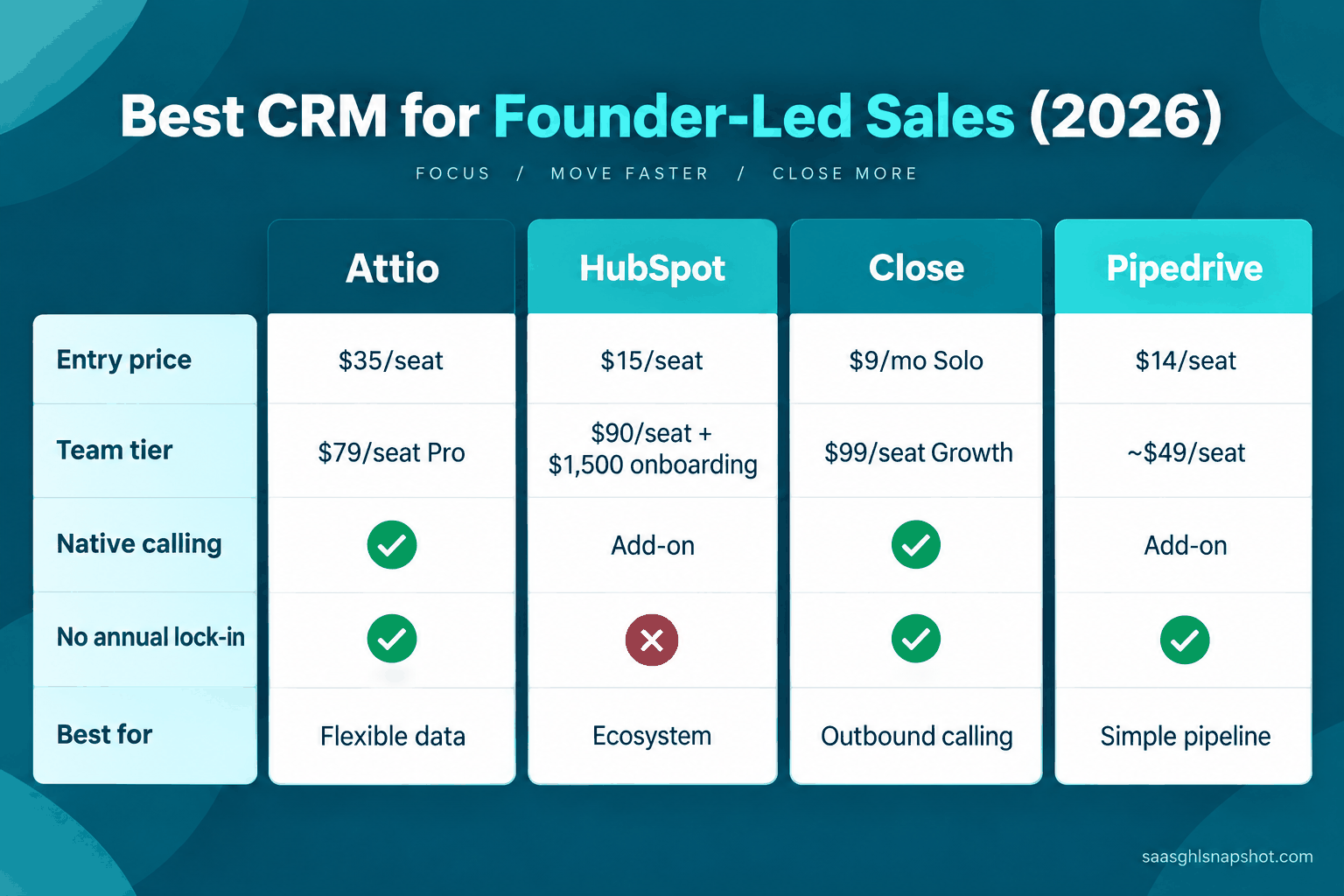
Table of contents
- Why this decision is worth getting right
- The four tools at a glance
- The eight things that actually differ
- Who each one is actually right for
- Run it for three real teams
- Steal this: scorecard and follow-up copy
- The consolidation option
- The compliance layer
- Objections
- FAQ
Why this decision is worth getting right
Founder-led sales has one scarce input, and it is your hours. A CRM either gives them back or eats them. Pick the wrong one and you pay twice: in the monthly bill, and in the deals that slip because your pipeline lived in your head.
The money side matters for a bootstrapped team. Median growth for private B2B SaaS ran about 22% in 2026, down from 25% in 2024 (SaaS Capital, 2026 Growth Rate Benchmarks), and CAC payback is up 12.5% since 2022 (Benchmarkit, 2025 B2B SaaS Benchmarks). A CRM that charges more per seat exactly as you hire is pulling the wrong way.
The trap is buying for the company you hope to be in three years instead of the one you run now. You do not need predictive lead scoring at eight people. You need to know who to call today, what you said last time, and which deals are stuck.
The four tools at a glance
Prices are list, per seat per month, billed annually unless noted, as of September 2026. Every vendor geo-localizes and reprices, so check the live page before you buy.
| Attio | HubSpot Sales Hub | Close | Pipedrive | |
|---|---|---|---|---|
| Free plan | Yes, up to 3 seats | Yes, limited free CRM | No, 14-day trial | No, 14-day trial |
| Entry paid | Plus $35/seat | Starter $15/seat | Solo $9 (1 user) | Essential $14/seat |
| Team tier | Pro $79/seat | Pro $90-100/seat + $1,500 onboarding | Growth $99/seat | Professional ~$49-59/seat |
| Native calling/SMS | No, via integrations | Add-on | Yes, core feature | Add-on |
| Forced annual contract | No | Common, plus onboarding fee | No | No |
| Best for | Flexible data model | Ecosystem and marketing | Built-in outbound | Simple pipeline |
Prices from each vendor’s own pricing page (linked in Sources).
List price per seat/month, billed annually. HubSpot Pro adds a one-time $1,500 onboarding fee not shown here. Source: vendor pricing pages, Sept 2026.
1. What each one really costs a month
The sticker prices split into two bands: a cheap band (Pipedrive and HubSpot Starter at $14 to $15 a seat) and the real band where the features you need live ($35 to $99 a seat).
Attio is free for up to 3 seats, then $35 a seat on Plus and $79 on Pro, billed annually (Attio pricing). The free tier is genuinely usable. Attio repriced in mid-2026 and geo-localizes, so a euro buyer sees different numbers.
HubSpot Sales Hub starts at $15 a seat on Starter, then jumps to $90 to $100 on Professional depending on annual or monthly billing (HubSpot pricing guide). Starter is thin; real sequences, automation, and reporting sit on Professional, which carries the onboarding fee covered next.
Close is the odd one out because its cheapest plan is a real single-user product: Solo at $9 a month, then Essentials $35 a seat, Growth $99, Scale $139 (Close pricing). You pay more per seat than Pipedrive, but calling and email sequences are built in.
Pipedrive is the value play at $14 a seat on Essential, rising through $49 to $59 for the mid tiers up to $99 at the top (Pipedrive pricing). The cheap tiers are cheap for a reason: the sales tools you want sit behind paid add-ons.
2. The contract and onboarding trap
Founder-led buyers hate annual lock-in for a good reason: a tool that made sense at five people can be wrong at twelve. Attio, Close and Pipedrive all let you pay monthly and walk away. You lose the annual discount, but you keep the option to leave, and for an early team that is worth real money.
HubSpot is the exception, and the cost is buried. Sales Hub Professional carries a mandatory $1,500 one-time onboarding fee in year one, and Enterprise a $3,500 one, charged whether you use it or not (HubSpot pricing guide). It never appears on the pricing slider. So a five-seat Professional team is not “five times a hundred.” It is $6,000 in seats plus $1,500 onboarding, $7,500 before the first email goes out. We walked the full math in our HubSpot pricing teardown.
3. Built-in calling and email, or just storage
A CRM that only stores contacts is a filing cabinet. The real question is whether the tool helps you reach people or just remembers that you meant to.
Close is built around this. Calling, SMS and email sequences are core, not add-ons, which is why founders who live on the phone pick it despite the higher price (Close pricing). One tool, one bill.
HubSpot has calling and sequences on Professional and up, plus the widest marketing toolset of the four, but you pay Professional prices and often bolt on paid add-ons for volume. Attio leans on integrations plus its newer calling and sequencing on Pro. Pipedrive sells outreach as paid add-ons (LeadBooster and Campaigns), which quietly raises the real cost above the $14 headline. Name your motion first: inbound demos favor Attio or Pipedrive on cost, outbound dials favor Close on not needing a second dialer.
4. The data model, and whether you will outgrow it
This is the criterion founders underrate and regret. A CRM’s data model is the set of objects it can hold: contacts, companies, deals, and whatever your business needs, like workspaces or usage records.
Attio wins here cleanly. It is built like a flexible database, so you model your own objects without a developer, which is why data-minded and product-led teams gravitate to it. HubSpot Enterprise supports custom objects, but only on the $150-a-seat tier with a $3,500 onboarding fee. Pipedrive and Close are opinionated: contacts, companies, deals, and that is mostly it. For a straightforward sales motion that is a feature. For a usage-based or multi-product SaaS, it is a ceiling.
5. Automation and sequences
What differs is how much you get before the paywall. HubSpot has the deepest automation but the workflows that matter are on Professional. Attio Pro is strong and modern. Close focuses on outreach cadences. Pipedrive automates from the Advanced tier up.
The trap is treating automation depth as the deciding factor at eight people. It rarely is. You need three or four workflows that fire: a new-lead assignment, a follow-up nudge, a stalled-deal alert, a won-deal handoff. All four tools do that. Buying HubSpot Professional for automation you will not build for a year is how the $1,500 onboarding fee sneaks onto your P&L.
6. Migration cost, in and out
Every CRM makes it easy to move in and quietly hard to move out. Moving in is a CSV import of contacts and companies, which all four handle. The friction is deal history and activity, the emails, calls, and notes attached to each record, which rarely migrates cleanly, so plan to rebuild some by hand.
Moving out is the real test. Attio, Close and Pipedrive all export cleanly, and their monthly plans mean you can leave without eating a year. HubSpot’s export is functional but its gravity is real: the more of your marketing and reporting inside it, the higher the cost of leaving.
7. Reporting and pipeline visibility
For a founder, reporting means one thing: can I see in ten seconds which deals are moving and which are stuck. Not a BI suite, a clear pipeline.
Pipedrive is strongest here because its whole interface is the pipeline: stages, values, and rot at a glance. Attio’s reports are clean and improving fast. Close reports on activity and outreach, which suits its calling-heavy users. HubSpot has the most powerful reporting and the most overhead. The common failure is not missing features; it is a dashboard nobody opens because the data going in is incomplete. A simple pipeline everyone updates beats a powerful one fed by half-entered deals.
8. Who each one is actually right for
Close for the founder who sells by phone and text and wants outreach and CRM in one tool. Attio for the technical or product-led founder who wants a CRM shaped like their business, the best free tier, and the freedom to leave. Pipedrive for the founder who wants a cheap, obvious visual pipeline and runs an email-and-demo motion, as long as you watch the add-ons. HubSpot for the team already living in its marketing tools, or one that will use the full platform soon and can absorb the onboarding fee. For a lean shop buying a CRM in isolation, it is usually the most expensive way to solve the problem.
Run it for three real teams
The right answer changes with the team.
The pre-revenue solo founder. No budget, no rep. Start on Attio’s free tier for up to 3 seats, or Close Solo at $9 a month if you are already dialing. Do not pay to store fifty contacts.
The $1M ARR, three-person team. A founder selling plus one or two helpers. Close Essentials at $35 a seat if you are outbound-heavy, or Attio Plus at $35 a seat if you are inbound. Both keep you on monthly billing with no lock-in, roughly $105 a month for three seats.
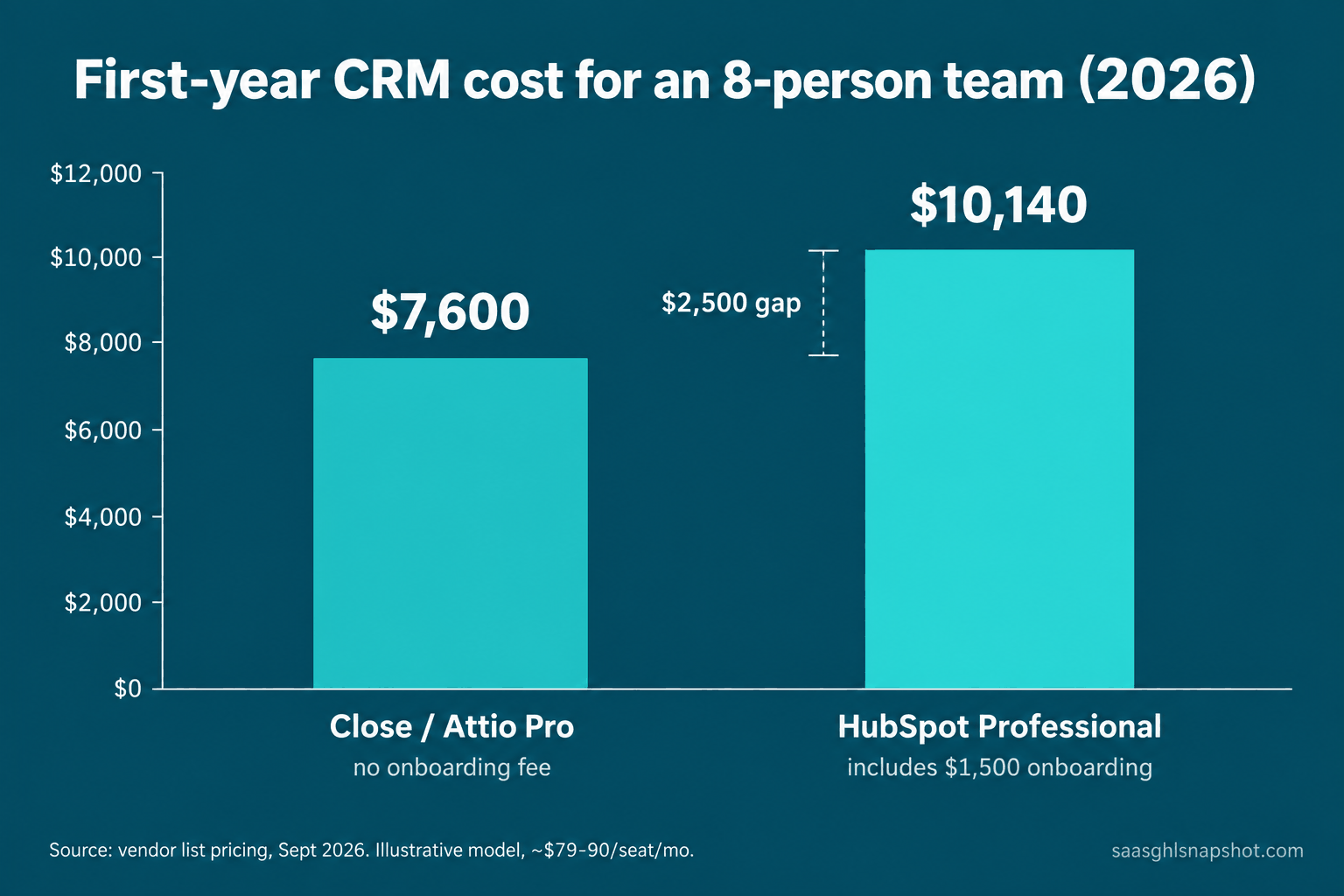
The $1-3M ARR, eight-person team. Now the CRM is load-bearing. This is where HubSpot’s pull is strongest and its cost is highest: eight Professional seats plus the onboarding fee runs about $10,140 in year one. Close Growth or Attio Pro at $79 a seat delivers the same sales tooling for about $7,600 with no onboarding toll, a $2,500 gap and no marketing platform lost. At this size, tool sprawl usually eats more than the CRM line, so the consolidation option below is worth a hard look.
Steal this: the CRM scorecard and follow-up copy
Two things you can use today. First, the scorecard: score each tool on the rows that matter, weight the load-bearing ones, and the winner is usually obvious once it is on paper.
Second, the copy. Every founder-led pipeline has one deal-killer: the prospect who says “just send me pricing” and vanishes. Load this three-touch sequence into your CRM.
The consolidation option
Here is the thing a four-way CRM comparison usually skips. For a lot of small SaaS teams the CRM is not the whole cost. It is the CRM, plus a separate dialer, plus an email tool, plus a scheduler, plus a reputation tool, each with its own per-seat price that creeps as you hire. The bill grows faster than revenue.
The alternative is consolidation: run CRM, calling, SMS, email sequences, and pipelines on one platform instead of five. GoHighLevel is built for that, which is why lean SaaS teams and agencies use it to collapse the stack. It is the platform our own system runs on, and our GoHighLevel plans and discount page lays out how the pieces fit. A team that only needs a simple pipeline should just buy Pipedrive, but at eight people with five tools it is worth the math.
The compliance layer nobody sets up first
The moment your CRM sends email or texts, it becomes a compliance surface. Do not skip it until something breaks.
CAN-SPAM governs every lifecycle and sales email: accurate “from” lines, a real physical address, and a working one-click unsubscribe on every message (FTC CAN-SPAM guide).
Google and Yahoo bulk sender rules have been in force since February 1, 2024. Send 5,000 or more messages a day and you need SPF, DKIM and DMARC, a spam rate under 0.30%, and one-click unsubscribe via the List-Unsubscribe-Post header (Google sender guidelines). That is the difference between follow-ups landing and your domain getting throttled.
GDPR applies the moment an EU trial signup lands, and CCPA and CPRA cover California. A2P 10DLC registration is required before you send business SMS in the US, which matters if you pick Close. SOC 2 is not a law, but enterprise buyers will ask.
Objections
“Switching CRMs is too painful, I will just keep what I have.” If your current tool works and the bill is sane, do not switch for sport. But “painful” is usually a story. The migration checklist above is a weekend for a small team, and the parallel week removes the risk.
“I already pay for HubSpot, is it worth leaving?” Depends on what you use. If you live in HubSpot’s marketing and reporting and it earns its keep, stay. If you bought Sales Hub Professional as a glorified contact database, you are paying $90 a seat plus an onboarding fee for something Attio or Close does for less.
“Do I need to be technical to run any of these?” No. Pipedrive and Close are usable on day one. Attio needs slightly more setup but no code. HubSpot is the most to learn, part of why it ships with a paid onboarding. If “technical” is your worry, that argues against HubSpot.
Frequently asked questions
What is the cheapest real CRM for a founder doing sales?
Attio is free for up to 3 seats and Close Solo is $9 a month for one user, both usable products. Pipedrive Essential at $14 a seat is the cheapest team plan, but its sales tools sit behind paid add-ons, so match the plan to the features you need, not the front-of-box price.
Does HubSpot really charge a mandatory onboarding fee?
Yes. Sales Hub Professional carries a one-time $1,500 onboarding fee and Enterprise a $3,500 one, charged in year one whether you use it or not, and it never appears on the pricing slider. For a five-seat Professional team the real first-year cost is about $7,500.
Which CRM is best for outbound calling and SMS?
Close. Calling, SMS, and email sequences are core features, not add-ons, so you avoid gluing on a separate dialer. For a phone-and-text motion it is usually cheaper once you count the tools it replaces. Register for A2P 10DLC before you send business texts.
Will I outgrow Pipedrive or Close?
You might, if your product needs the CRM to model workspaces, subscriptions, or usage rather than just contacts and deals. Attio is built like a flexible database and is the safest pick for an unusual data model. Model one real account inside the tool before you commit.
Should I just consolidate onto one platform instead?
If your CRM is one of five per-seat tools that also cover calling, email, and scheduling, consolidating onto a single platform like GoHighLevel can cost less than the sum of the parts and remove the per-seat creep. A team that only needs a simple pipeline should still just buy Pipedrive.
Sources
- SaaS Capital, 2026 Private B2B SaaS Growth Rate Benchmarks
- Benchmarkit, 2025 B2B SaaS Benchmarks
- Attio, HubSpot, Close, and Pipedrive pricing pages
- FTC CAN-SPAM compliance guide and Google email sender guidelines
Related reading: What HubSpot Sales Hub actually costs in 2026, what Intercom’s Fin AI really costs per resolution, and the CAC payback period explained.