
Close’s pricing page says “from $9 a user.” That number describes a plan almost no founder-led sales team can use, because the $9 Solo tier cannot dial a list, and the power dialer that makes Close worth buying is locked three tiers up at $99 a seat. On top of the seat, every outbound minute, every text, and the AI call assistant bill separately as usage, none of it on the slider. So the question is not “what is Close per seat,” it is “what will Close invoice me once my reps start dialing,” and that runs two to five times the sticker. This teardown walks the real 2026 math at three team sizes and the three costs the quote hides.
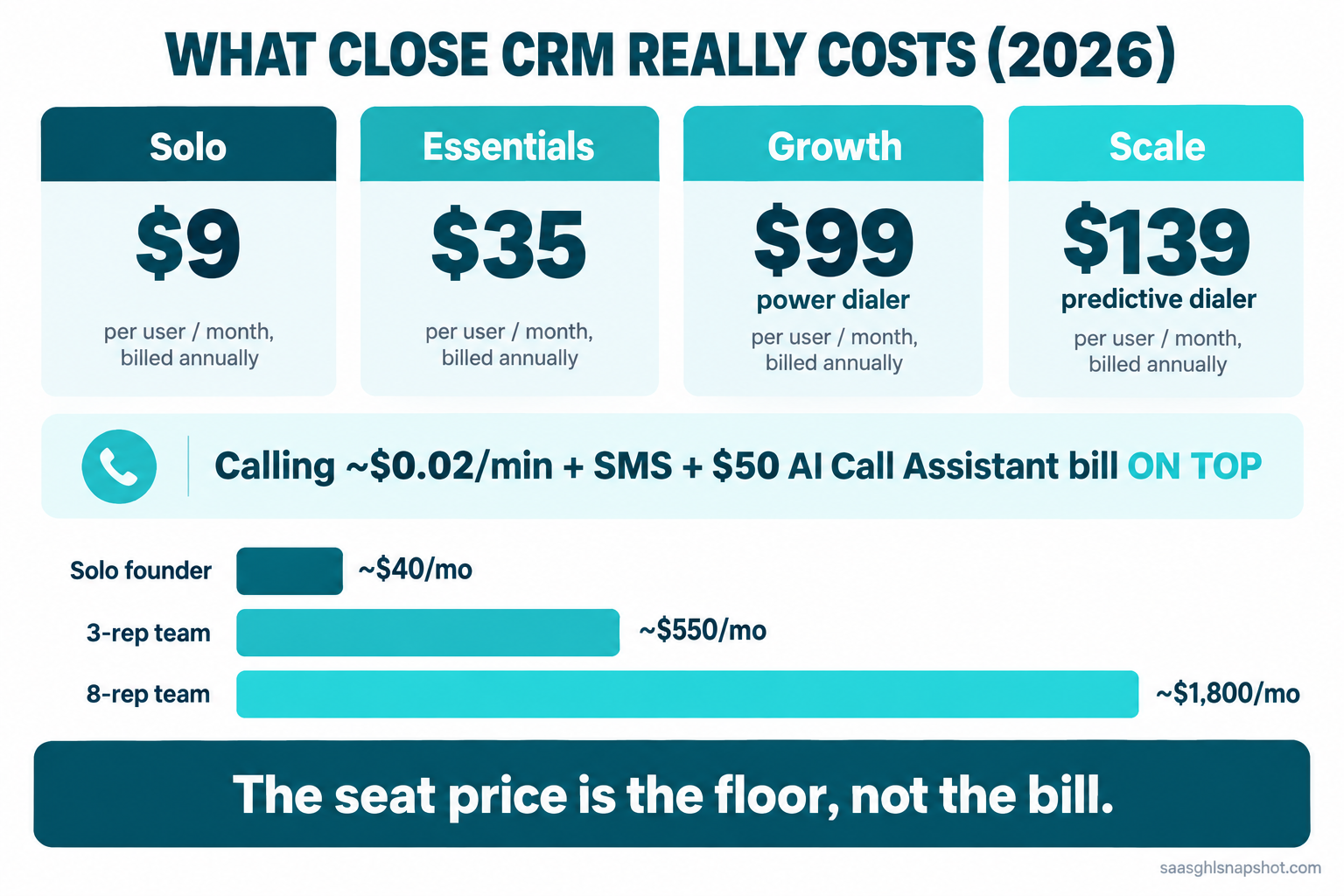
Table of contents
- The short answer
- How Close billing actually works
- The real cost at three team sizes
- The three costs the quote hides
- Close vs Pipedrive vs HubSpot vs Attio
- Steal this: the true-cost worksheet
- The flat-platform alternative
- Objections · Compliance · FAQ · Sources
The short answer: $9 is not your bill
Close publishes four plans, billed per user. On annual billing they are Solo $9, Essentials $35, Growth $99, and Scale $139 a user a month; monthly billing is $19, $49, $109, and $149 (Close pricing). That is the whole seat ladder, and next to HubSpot it looks cheap.
The seat price is not the bill for one reason: Close is a calling CRM, and calling is not in the plan. The pricing page states plainly that calling and SMS fees are not included and bill as usage on top (Close pricing). Outbound calls run about $0.02 a minute to most destinations, numbers start around $1 a month, and the AI Call Assistant is a separate $50 a month per account plus $0.02 per recorded minute. The thing you buy Close for, dialing prospects, is the thing the quote leaves out.
For a bootstrapped team this matters because every one of those meters scales with activity, and activity is the point of a sales tool. Median growth for private B2B SaaS ran about 22% in 2026, down from 25% in 2024, with only 7.3% of companies reporting flat or negative growth (SaaS Capital, 2026 Benchmarks). More growth means more dials, texts, and seats, so a tool priced this way turns every productive quarter into a bigger invoice.
How Close billing actually works in 2026
Three meters run at once; the slider shows only the first.
1. Seats. You pay per user, every month, on the tier you pick. Solo is capped at one user and 10,000 leads; Essentials, Growth, and Scale are unlimited (Close pricing). Add a rep, add a seat.
2. Calling and SMS usage. Separate from seats, metered by the minute and the message. Most outbound calling is about $0.02 a minute, inbound US and Canada roughly $0.013, and numbers cost around $1 each a month (Close pricing). SMS bills per message. None of this appears on the slider, and it bites a phone-heavy team hardest.
3. AI credits and the AI Call Assistant. Each tier bundles monthly AI credits per user, 500 on Solo up to 2,000 on Scale, with a shared team cap (Close pricing). The AI Call Assistant that transcribes and summarizes calls is a separate add-on at $50 a month per account plus $0.02 a recorded minute. Lean on AI and you either climb a tier or buy the add-on.
There is no permanent free plan, only a free trial (Close pricing). So every real decision here starts at a paid seat plus usage, not at zero.
The real monthly cost at three team sizes
Every figure below is an illustrative estimate from list prices and a stated usage assumption, not a quote. The point is the gap between the seat sticker and the invoice, so each scenario shows seats and usage stacked on top. Telephony estimates draw on Close’s per-minute rates and third-party budgeting ranges (DialSheet, Close calling cost).
| Scenario | Seats x tier | Seat cost / mo | Calling, SMS, AI add-on / mo | Modeled total / mo |
|---|---|---|---|---|
| Solo founder, light outbound | 1 x Solo ($9) | $9 | ~$30 | ~$40 |
| 3-rep team, real outbound | 3 x Growth ($99) | $297 | ~$250 (incl. AI add-on) | ~$550 |
| 8-rep team, heavy dialer | 8 x Scale ($139) | $1,112 | ~$700 (incl. AI add-on) | ~$1,800 |
Modeled total monthly Close cost by team size, seats plus usage. Illustrative estimates from Close list pricing and per-minute calling rates, November 2026. Usage assumes moderate to heavy dialing and the AI Call Assistant on the two team scenarios.
The solo band is genuinely cheap: a founder on the $9 Solo seat making a few calls a day pays maybe $40 all in. The catch is the dialer. The moment that founder wants to work a list of fifty prospects without hand-dialing, Solo cannot do it, and the entry price jumps to the $99 Growth seat.
The three-rep band is where the sticker stops telling the truth. Three Growth seats are $297, but three reps dialing for real add a few hundred dollars in minutes and texts, plus the $50 AI add-on, so the run rate lands near $550, about $6,600 a year. The eight-rep band is worse: $1,112 in seats becomes roughly $1,800 a month once a heavy team burns through minutes and recordings, close to $21,600 a year for a CRM advertised at $139 a seat.
The three costs the quote hides
This is the part the pricing page does not write, and it is where the budget leaks. For each, the trigger and what to do about it.
1. The power-dialer paywall. This is the big one. The dialer is the reason sales teams choose Close over a cheaper pipeline CRM, and it does not exist below Growth at $99 a seat (Close pricing). A team that priced Close at $35 Essentials discovers on day two that it cannot auto-dial a list and has to move everyone up to $99. The fix: price Close at the tier you will actually use, Growth or Scale for any outbound motion, and compare that number against alternatives, not the $9 headline.
2. Telephony usage that scales with effort. Calling and SMS are pure usage, so the harder your reps work, the bigger this line gets, with no ceiling in the quote. A quiet month hides it; a quarter-end push exposes it. Third-party budgeting puts moderate team calling around $100 to $300 a month and heavy dialer use at $400 to $800 (DialSheet, Close calling cost). The fix: pull the telephony report every month and track cost per connected call, as a variable line next to ad spend.
3. The AI tax. The AI Call Assistant is $50 a month plus $0.02 a recorded minute, and bundled AI credits are capped per tier. Record every call across a busy team and the per-minute line compounds; lean on AI summaries and you hit the credit cap, which pushes you up a tier. The fix: decide which calls actually need recording before turning the add-on on for everyone.
The pattern across all three is the same. Close’s seat price is a floor that only moves up once your team does the work you bought the tool to do. Not a scam, a usage model, but it means the slider is the least useful figure for budgeting.
Affiliate disclosure: the link above is a GoHighLevel affiliate link. We may earn a commission at no extra cost to you. See our affiliate disclosure.
Close vs Pipedrive vs HubSpot vs Attio
Close is a genuinely good calling CRM, fast, built for reps who live on the phone. The question is whether per-seat-plus-usage fits your stage and motion. Here is how the common alternatives bill, because for a bootstrapped team the billing shape matters more than the feature checklist.
| CRM | Entry seat (annual) | Built-in calling | Real cost driver | Best for |
|---|---|---|---|---|
| Close | $9 Solo, $99 for the dialer (pricing) | Yes, dialer on Growth+; minutes billed as usage | Dialer tier plus calling minutes | Phone-heavy outbound teams that will use the dialer |
| Pipedrive | ~$14, up to ~$89 (pricing) | Add-on, not core | Seat tier plus paid add-ons | Visual pipeline teams that call less |
| HubSpot Sales Hub | $7 Starter, $90 Pro + $1,500 onboarding (pricing) | Limited minutes, more as add-on | Pro tier, onboarding fee, seat creep | Teams standardizing on the full HubSpot suite |
| Attio | Free to 3 seats, ~$34 to ~$93 (pricing) | No native dialer; integrations | Seat tier, integration stack | Data-model-first teams that email more than they dial |
| GoHighLevel | Flat platform fee, unlimited users (pricing) | Yes, built in; telephony passthrough | One platform fee plus telephony usage | Operators who want no per-seat charge across tools |
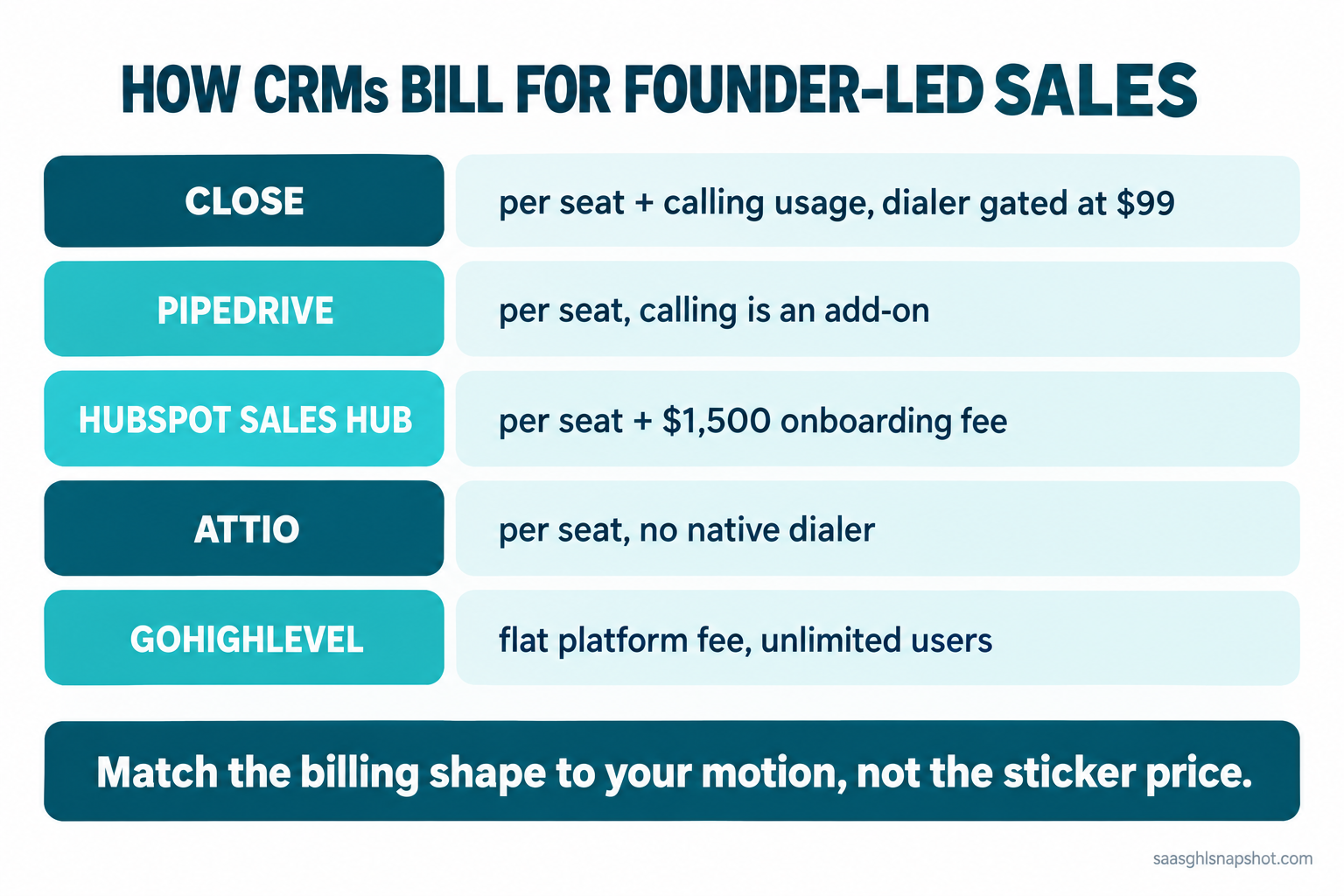
The honest read. If your team is phone-first and will use the power dialer daily, Close at $99 a seat plus minutes is a fair deal, and the dialer is excellent. If you call occasionally and live in email and pipeline, you are paying for a calling engine you barely touch, and Pipedrive or Attio costs less for the same deal tracking. The deeper split is per-seat versus flat: every per-seat CRM charges you more as you hire, which collides with CAC payback already stretched 12.5% longer at the median since 2022 (Benchmarkit, 2025 Benchmarks). A fuller breakdown lives in our best CRM for founder-led sales in 2026 comparison, and the HubSpot math in Attio vs HubSpot Sales Hub.
Steal this: the true-cost-of-Close worksheet
Close’s cost is predictable if you model the whole invoice, not the slider. Run this before you buy and every month after.
The real monthly cost formula:
Monthly Close cost = (seats x tier price)
                   + (outbound minutes x ~$0.02)
                   + (inbound minutes x ~$0.013)
                   + (phone numbers x ~$1)
                   + SMS sent/received usage
                   + ($50 AI Call Assistant, if on)
                   + (recorded minutes x $0.02)

True cost per seat = total monthly bill / number of reps
True cost per connected call = total monthly bill / connected calls
That last line is what matters for a sales budget: the denominator you care about is booked meetings and connected calls, not seats.
Ask Close before you commit, in writing:
- Which tier do we need for the power dialer, and does every rep need it or only the ones dialing?
- What did a team our size at our call volume actually spend on calling and SMS last quarter?
- What is the all-in cost of the AI Call Assistant across the team, and what happens at the credit cap?
The 10-minute monthly telephony audit:
- Pull the usage report and read the calling, SMS, and recording lines separately from seats.
- Divide total cost by connected calls and by booked meetings for your real unit economics.
- Flag any rep whose minutes spiked without more meetings, and scope the AI add-on to closers only.
The same discipline across every tool is in our real cost of your GTM stack worksheet, and the pipeline design that keeps a CRM from becoming shelfware is in building a founder-led pipeline.
The flat-platform alternative to per-seat plus usage
Per-seat-plus-usage taxes you twice for success: once when you hire a rep, again when that rep does more work. Founder-led sales is still worth tooling well, and when to add the first rep at all is its own call we cover in when to hire your first sales rep. But you do not have to buy the pipeline, the dialer, and the messaging on three separate meters. A flat-platform GoHighLevel build puts CRM, pipelines, calling, SMS, and lifecycle automation under one fee with unlimited users, so hiring does not add a seat charge and the only variable cost is telephony passthrough. It is not a drop-in Close clone, and if your edge is a world-class predictive dialer, weigh that honestly. For most early-stage teams the flat model is cheaper and far more predictable.
Objections
“But $9 a seat is basically free. Why does this matter?” Because $9 buys the one tier that cannot dial a list, which is the job most people hire Close to do. The realistic entry price for an outbound team is the $99 Growth seat plus calling minutes plus the AI add-on. Model the bill at the tier you will actually use, not the headline.
“We need a great dialer, so isn’t Close just the right tool?” Maybe, and if so, buy it with clear eyes at $99 or $139 a seat plus usage. The mistake is pricing it at $35 and being surprised. Dial hard every day and Close earns its keep; dial occasionally and you are renting a race car for the school run.
“Isn’t usage-based calling fairer than a flat fee?” It is fair, and also unpredictable. A flat fee you can forecast; a per-minute meter that rises with every quarter-end push you cannot. Cash-tight teams need forecastable as much as fair.
“Do I have to be technical to escape per-seat pricing?” No. Moving a founder-led pipeline onto a flat platform is a configuration job, not a coding one, and the deal-history migration is covered in migrating off HubSpot without losing deal history. The habit that saves money is reading the usage report monthly.
One compliance trap the dialer creates
The dialer that makes Close powerful also raises your legal exposure, and the pricing page will not mention it. Outbound calling in the US is governed by the TCPA, which restricts calling times, requires honoring do-not-call requests, and carries real per-violation penalties, with tighter consent rules the more automated the dialing becomes (FCC TCPA rules). A predictive dialer invites particular scrutiny, so the Scale tier that unlocks it also raises the compliance bar. If your reps text, SMS needs A2P 10DLC registration first or carriers filter your messages (CTIA messaging principles). On email, CAN-SPAM governs every lifecycle message and Google and Yahoo have required SPF, DKIM, DMARC, a spam rate under 0.30%, and one-click unsubscribe for bulk senders since February 2024 (Google sender guidelines). The full setup is in our SaaS email deliverability and compliance guide.
Frequently asked questions
How much does Close CRM actually cost in 2026?
On annual billing, seats are $9 (Solo), $35 (Essentials), $99 (Growth), and $139 (Scale) per user per month; monthly billing is $19, $49, $109, and $149. But calling and SMS bill as usage on top (about $0.02 a minute outbound, numbers from $1 a month), and the AI Call Assistant is a separate $50 a month per account plus $0.02 per recorded minute. For an outbound team, budget the Growth or Scale seat plus usage, not the $9 headline.
Which Close plan includes the power dialer?
The power dialer first appears on Growth at $99 a user per month (annual). Solo and Essentials can make and receive calls but cannot dial a list for you. The predictive dialer and live call coaching are Scale-only at $139. If auto-dialing a list is why you want Close, your real entry price is $99 a seat.
Are calling and texting included in Close's seat price?
No. Close's pricing page states calling and SMS fees are not included and bill as usage. Outbound calls run about $0.02 a minute, US and Canada inbound roughly $0.013, numbers about $1 a month each, and SMS per message sent and received. A phone-heavy team can add a few hundred dollars a month on top of seats.
What does the Close AI Call Assistant cost?
It is an add-on at $50 a month per account plus $0.02 per recorded minute, separate from the seat. Each plan also bundles monthly AI credits per user (500 on Solo up to 2,000 on Scale) with a shared team cap, so heavy AI use can push you to a higher tier.
Is Close cheaper than HubSpot or Pipedrive?
On the sticker, Close Solo ($9) undercuts HubSpot Sales Hub Professional ($90 plus a $1,500 onboarding fee) and sits near Pipedrive's entry ($14). But Close's real outbound price is the $99 Growth seat plus calling usage, so compare like for like: the tier you will use plus expected minutes, against Pipedrive or Attio if you call less, and a flat platform if per-seat growth worries you.
How do I keep a Close bill from running away from me?
Price it at the tier you will use, pull the telephony usage report monthly, and track cost per connected call and per booked meeting rather than per seat. Scope the AI Call Assistant to reps who need it, watch the credit cap, and ask Close for a real spend figure from a team your size before you commit.
Sources
- Close pricing (seat tiers, dialer gating, AI credits, calling and SMS billed as usage, AI Call Assistant)
- DialSheet, Close calling cost (third-party telephony budgeting ranges)
- Pipedrive pricing, HubSpot Sales Hub pricing, Attio pricing, GoHighLevel pricing
- SaaS Capital 2026 Private B2B SaaS Growth Rate Benchmarks
- Benchmarkit 2025 B2B SaaS Performance Benchmarks
- FCC telemarketing and robocall rules and CTIA messaging principles (TCPA, A2P 10DLC)
- Google email sender guidelines (bulk-sender rules)
About the author
Devon Asante is a GHL Automation Architect based in Denver, CO. A former agency operator who resold GoHighLevel to software clients, he now designs systems that drop in clean and fire on day one, and he writes about the plumbing behind founder-led sales: pipelines, dialers, and the real cost of the tools underneath them.
Want your sales and messaging stack costed and consolidated under one flat platform? Get the SaaS Snapshot or book a walkthrough. Related: the best CRM for founder-led sales, Attio vs HubSpot Sales Hub, and the real cost of your GTM stack.