
The renewal was never in doubt, until it was. The account went quiet in month nine, the champion changed jobs in month ten, and in month twelve a two-line email said they had decided not to renew. You never had a conversation. You found out the deal was lost on the day it was already lost. For most early-stage SaaS the money leaks in the ninety days nobody works. Here is the system that turns renewal day into a formality instead of a surprise: seven stages, the runway emails to steal, and the ways each one breaks.
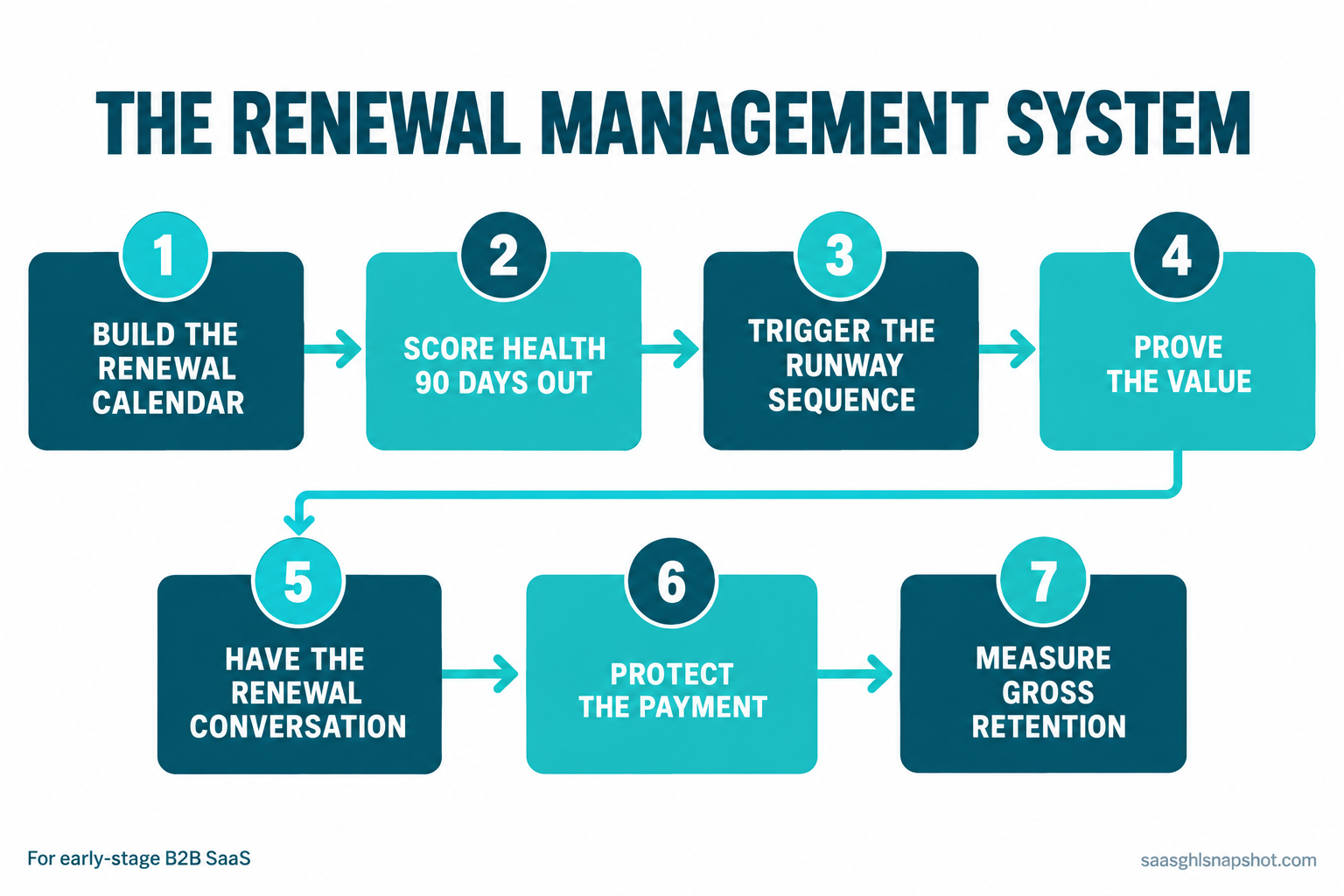
Table of contents
- The short answer
- What a lapsed renewal costs you
- Stage 1: Build the renewal calendar
- Stage 2: Score account health 90 days out
- Stage 3: Trigger the runway sequence
- Stage 4: Prove the value before you ask
- Stage 5: Have the renewal conversation
- Stage 6: Protect the renewal payment
- Stage 7: Measure gross retention and tune
- The copy to steal
- Three scenarios by billing model
- Running renewals without breaking the law
- Objections
- FAQ
- Sources
The short answer: work the renewal before renewal day
A renewal is a decision your customer makes weeks before the invoice, not the moment it arrives. By the time the auto-renew charge fails or the “we’re not continuing” email lands, the decision is old. So the useful question is not how to win more renewals, it is how to see the renewal coming and work it while you still can. None of it needs a customer success hire or a renewals platform, just a calendar, a health rule, and a sequence that fires on its own.
What a lapsed renewal actually costs you
Retention is where the median SaaS is bleeding, and it is getting worse. Benchmarkit’s 2025 B2B SaaS benchmarks put median gross revenue retention at 88 percent, down from 90 percent in 2022, with net revenue retention at 101 percent. Read the gap: the median company keeps only 88 cents of every revenue dollar through the year on its own, and top-line NRR looks healthy only because expansion from a few accounts papers over everyone else lapsing. If your expansion is thin, which it is for most teams under 3 million in ARR, gross retention is the number you live on.
Median B2B SaaS retention, 2025. The 13-point gap between GRR and NRR is expansion revenue hiding the renewals that lapse. Source: Benchmarkit 2025 B2B SaaS Benchmarks.
Losing an account at renewal is not the same as never winning it: you already paid the acquisition cost and the months of onboarding, and Harvard Business Review’s summary of the research estimates winning a new customer costs five to 25 times more than keeping one. New logos are slow, too, with SaaS Capital putting 2026 median private B2B SaaS growth at 22 percent, down from 25 percent in 2024. Every renewal you keep is cheaper than any deal you can close.
Stage 1: Build the renewal calendar
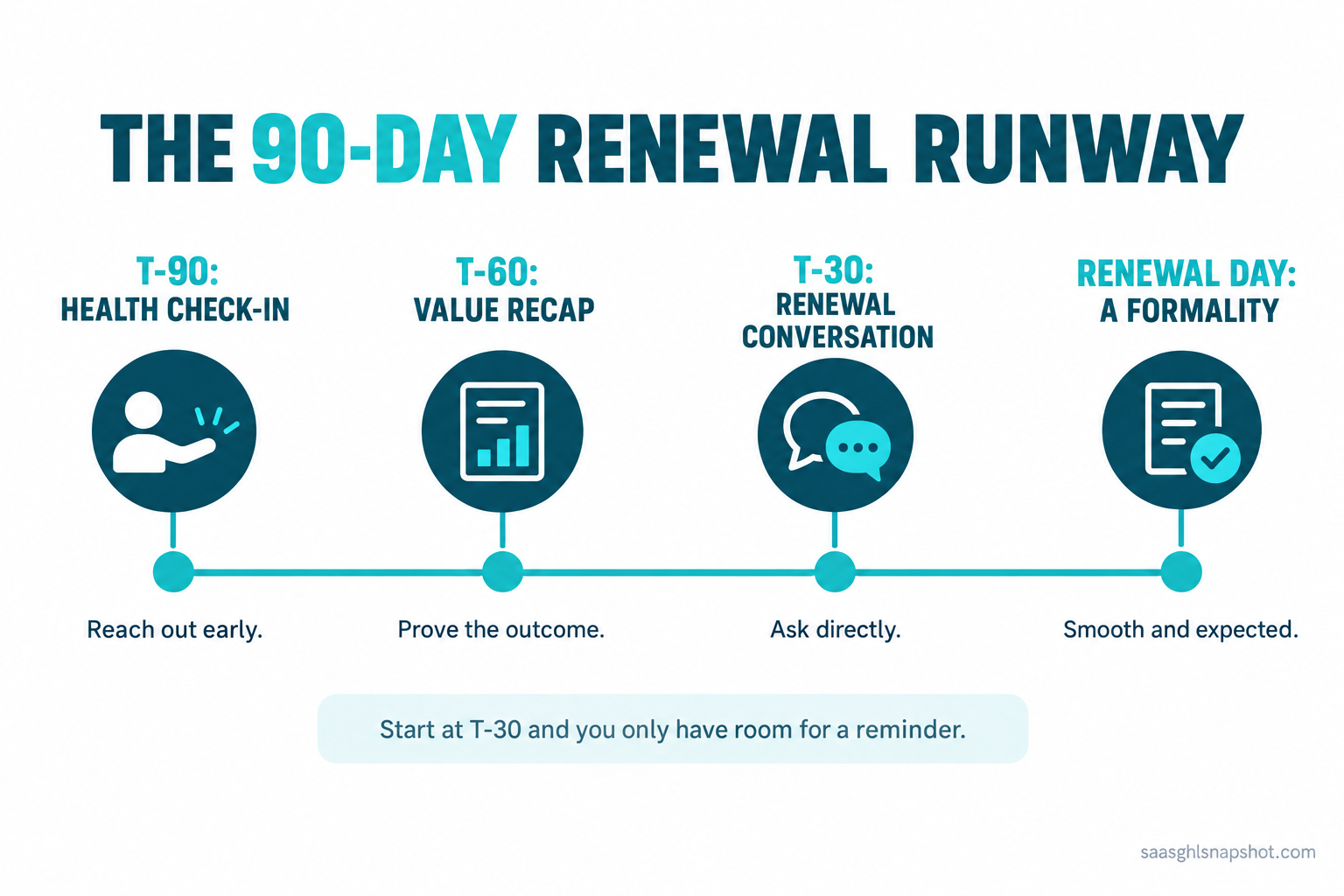
You cannot work a renewal you did not see coming. For each paying account, record the renewal date, the plan and its value, the billing cadence, and the primary contact. The rule that matters: a renewal enters the working window ninety days out, not thirty, and never on the day the card is charged. Ninety days lets you spot a problem, fix it, and still have a conversation before anyone has moved on. Thirty days is enough for a reminder and nothing else, which is why most teams who “do renewals” still get surprised.
How it breaks: the dates live in your billing tool and nowhere you look. Stripe knows the renewal date, but it will not nudge you to call the account that stopped logging in. Pull the date into your CRM so it triggers tasks and sequences instead of sitting in a quarterly export.
Stage 2: Score account health 90 days out
When an account crosses the ninety-day line, score it before you do anything, because the play for a healthy account differs from the play for an at-risk one. You do not need a model, just three or four signals you can see:
- Usage against baseline. Are logins and core-action counts at, above, or below six months ago? A sustained drop is the loudest signal there is, which is the heart of the silent-churn early-warning system.
- Seat or usage trend. Five active seats down to one is a renewal in trouble no matter how happy the one remaining user is.
- Support and sentiment. A spike in tickets, an unresolved escalation, or a flat “it’s fine” on the last check-in.
- Champion status. A champion who changed jobs is the most common quiet renewal killer.
Sort every renewal into green, yellow, or red. Green renews with a light touch. Yellow needs the value work in Stage 4. Red needs a human now, not at day thirty.
How it breaks: you grade everyone green because nobody has complained. As our guide to instrumenting churn shows, churn is quiet, and the absence of complaints is often an account that stopped caring enough to complain. Score on observed behavior, not vibes.
Stage 3: Trigger the renewal runway sequence
Now the account gets a sequence tied to its renewal date: a touch at ninety, sixty, and thirty days, with content set by the health score. Green accounts get a light, value-forward cadence ending in a simple renewal confirmation. Yellow and red accounts get the same timeline, but the ninety-day touch is a real check-in from a human and the thirty-day touch is a conversation, not an email. The point is that it fires whether or not you remember: a founder running sales, support, and product has no spare attention to notice that Acme renews in nine weeks, so the system notices, creates the task, and sends the first email.
How it breaks: the sequence reads like billing spam. “Your subscription renews on the 14th” is a notification, not a renewal play, and it trains the customer to treat you like a utility they could swap. Every touch has to carry something they want to open, which is Stage 4.
Stage 4: Prove the value before you ask
Before you ask anyone to renew, remind them what they got. For a renewal to feel obvious, the customer has to connect your invoice to an outcome they can name. The sixty-day touch is where you do that, with a short value recap: what they used, what it produced, and where they stand now versus the start. For a self-serve account that is an automated usage recap, a number that maps to money; for a higher-value account it is a fifteen-minute business review where you walk the numbers together and surface anything not working while there is still time to fix it. The recap justifies the renewal and flushes out the quiet objection before it becomes a cancellation.
How it breaks: you only have vanity numbers. “You logged in 40 times” is activity, not value. If you cannot tie usage to an outcome the customer cares about, the renewal becomes a pure price decision.
Stage 5: Have the renewal conversation
At thirty days, yellow and red accounts get a conversation, not a renewal button. This is where founder-led retention beats any automated flow, because you can hear the real objection and respond. The script is short: confirm the outcome from the value recap, ask directly whether they plan to continue, and then listen. You usually learn the true state of the account in the first thirty seconds. Handle the three objections you will hear most:
- “We’re evaluating alternatives.” Do not discount on the spot. Ask what prompted the look, because it is almost always one unmet need. Solve the one thing, or credibly plan to, and the evaluation usually stops.
- “Our budget is frozen.” Move to the cost of switching and the outcome they would lose. If they genuinely must cut, a short-term downgrade keeps the logo and the data.
- “Our champion left.” Treat it as a fresh sale to the new owner, who never saw the original decision and will cut what they do not understand.
How it breaks: you lead with a discount and teach every account that renewal is a negotiation. Price is the last lever, not the first.
Stage 6: Protect the renewal payment
A won renewal still has to become a landed payment, and this is where revenue leaks for no good reason. The renewal charge hits an expired card, fails silently, and three days later the account is deactivated and annoyed at you for something a dunning sequence would have caught. Treat the renewal charge like any at-risk payment: retry on a schedule, notify through more than one channel, and give a one-click way to update the card. We walk the full flow in the failed-payment dunning playbook. The other half is honest auto-renewal terms, which the compliance section covers.
How it breaks: auto-renew fires on a dead card with no retry and no notice, so a customer who wanted to stay gets cut off and churns as an involuntary loss you never see. Involuntary churn is the most fixable churn there is.
Stage 7: Measure gross retention and tune
The loop that makes this improve is one weekly review and one number: gross revenue retention, the share of recurring revenue you kept from existing accounts before any expansion, because that is the honest renewal scorecard. ChartMogul’s benchmarks (2023 edition) put median monthly customer churn at 3 to 4 percent, top-quartile SaaS at 1 to 2 percent, and best-in-class net retention at 110 to 125 percent, so you have real bands to measure against.
Monthly SaaS customer churn benchmark bands. Lower is better; best-in-class runs around 1 percent a month. Source: ChartMogul SaaS Benchmarks, 2023 edition.
Each week, look at renewals in the next ninety days, the ones flagged yellow or red, and the ones you lost. For every loss, write the real reason in one line. After a dozen you will see the pattern, and it tells you which stage to fix: if accounts keep going red on the champion signal, your Stage 2 scoring is late; if they renew but at a discount, your Stage 4 value recap is weak.
How it breaks: you track net retention only, and expansion from a couple of growing accounts hides a renewal problem until it is a crisis. Manage on gross retention.
The copy to steal
Here is the runway sequence, verbatim. Swap the brackets for your product and numbers. Keep it short, keep it about them, and never let a touch read like a billing notice.
Three scenarios: monthly self-serve, annual self-serve, sales-assisted
The framework is the same, but the weight shifts with your billing model and account size.
Monthly self-serve, bootstrapped, under 1 million ARR. You do not have renewal dates, you have a rolling monthly decision, so “the renewal” is really continuous retention. Run Stages 1, 2, and 6 hard: track health, fire an automated value recap monthly, and nail dunning so involuntary churn does not masquerade as a decision. Skip the human conversation except for your top accounts.
Annual self-serve, 1 to 3 million ARR. Now the ninety-day window is real and worth the full sequence. Automate the 90/60/30 touches for every account, score health to decide who gets a human at sixty and thirty days, and build the value recap as an automated usage report with a personal note for anything yellow. This is the band where a renewal system pays for itself fastest.
Annual sales-assisted, venture-backed, 3 to 10 million ARR. Renewals here are relationships, and the system exists so none slips while a small team covers many accounts. Keep automation for the calendar, scoring, and triggers, but every yellow or red account gets a named human and a business review at sixty days. The money question here is expansion, so your Stage 4 value recap doubles as the setup for an upsell, the point of the NRR expansion playbook. Protect gross retention first, then grow net.
Running renewals without breaking the law
Renewal reminders are commercial email and auto-renew is a regulated billing model, so a few rules apply. None is hard, but getting it wrong turns a renewal into a chargeback or a complaint.
Email (CAN-SPAM and deliverability). Every renewal reminder and value recap sent to a list needs a working unsubscribe, an honest subject line, and a real postal address, per the FTC’s CAN-SPAM guide. A trial signup from the EU brings you under GDPR the moment that data lands, and Google’s sender guidelines, in force since February 2024, require SPF, DKIM, DMARC, a spam rate under 0.30 percent, and one-click unsubscribe for bulk senders.
Auto-renewal disclosure. Auto-renew is legal and good for retention, but it has to be honest. The federal picture is in flux: the FTC’s “click-to-cancel” rule was vacated by the Eighth Circuit in July 2025, but ROSCA still applies and the FTC has signaled it will try again. State law is stricter and already live: California’s auto-renewal law, updated by AB 2863 effective July 1, 2025, requires clear up-front consent, a reminder before an annual charge, and online cancellation as easy as signup. The safe build everywhere: explicit consent, remind before you charge, make cancellation one click. A customer who feels trapped churns louder.
Objections
“We bill monthly, renewals aren’t really a thing for us.” They are, you just face them every month instead of once a year. The monthly charge is a renewal decision in miniature, which is why the self-serve scenario leans so hard on health scoring and dunning. The leak is the same, spread across twelve small decisions.
“Won’t reaching out before renewal just remind them to cancel?” Backwards. A customer who was going to leave has already decided; your silence does not protect the renewal, it removes your last chance to change their mind while you can still fix the problem.
“Isn’t this just customer success? We can’t afford a CSM.” The system is designed so you do not need one. The calendar, scoring, sequence, and dunning all run as automation, and the only human time it asks for is the conversation with yellow and red accounts, a short list. Most early-stage stacks already have the raw material, the renewal date in Stripe and usage in the product, with nothing connecting them to a task on your calendar. The work is the wiring, not a hire.
Frequently asked questions
What is SaaS renewal management?
It is working a subscription renewal before it happens instead of reacting to it: tracking every renewal date with runway, scoring account health 90 days out, running a value-forward sequence at 90, 60, and 30 days, having a real conversation with at-risk accounts, and protecting the payment with dunning. The goal is that renewal day is a formality, not a surprise.
How far before renewal should I reach out to a customer?
Start the working window at 90 days, not 30. Ninety days gives you time to spot a problem, fix it, and still have a renewal conversation before the customer has moved on. A 30-day window only leaves room for a reminder, which is why teams who 'do renewals' still get surprised.
What is a good gross revenue retention rate for B2B SaaS?
Median gross revenue retention is around 88 percent per Benchmarkit's 2025 benchmarks, down from 90 percent in 2022, and strong companies run in the low-to-mid 90s. Watch gross retention rather than net retention to manage renewals, since net retention can look healthy at 101 percent while expansion from a few accounts hides a renewal problem underneath.
Should I offer a discount to save a renewal?
Price should be the last lever, not the first. Leading with a discount teaches every account to treat the renewal as a negotiation. Lead with the outcome the customer got and the cost of switching, and keep the discount for the account that is genuinely budget-constrained.
Is auto-renewal legal for SaaS subscriptions?
Yes, but it is regulated. The FTC's click-to-cancel rule was vacated in July 2025, though ROSCA still applies. State law is stricter: California's auto-renewal law, updated by AB 2863 effective July 1, 2025, requires clear up-front consent, a reminder before an annual charge, and online cancellation as easy as signup. Build to that standard everywhere and auto-renew helps retention instead of causing chargebacks.
Related reading
- Silent churn: catch customers who quietly stop logging in before they cancel
- How to instrument SaaS churn so you know why customers leave
- Failed-payment dunning: recover the revenue you are already owed
- Churn prediction with health scores: see the risk before the cancel
- The SaaS expansion revenue and NRR playbook
- SaaS cancellation flow: the save screen that keeps revenue
Sources
- Benchmarkit, 2025 B2B SaaS Performance Metrics Benchmarks
- SaaS Capital, 2026 Private B2B SaaS Growth Rate Benchmarks
- ChartMogul, SaaS Benchmarks Report (2023 edition)
- Harvard Business Review, The Value of Keeping the Right Customers (2014)
- FTC, CAN-SPAM Act compliance guide
- Cooley, Eighth Circuit vacates the FTC’s click-to-cancel rule (2025)
- California Legislature, SB 313 / auto-renewal law
- Google, email sender guidelines
- GDPR.eu, what is GDPR