
An account you spent nine months closing just cancelled. The exit survey says “too expensive,” so you note to revisit pricing and move on. That note is the most dangerous thing in your churn data, because “too expensive” is almost never the real reason. It is the polite thing a human types into a box to close the tab. The real reason is usually that they never got the core workflow running, or their champion left, or a competitor shipped the integration you kept deprioritizing. You only get that when you ask a person, in a short structured call, with questions built to get past the polite answer. This is the full system: who to talk to, the words to reach them, the question script to steal, and how to turn ten conversations into one fix that moves retention.
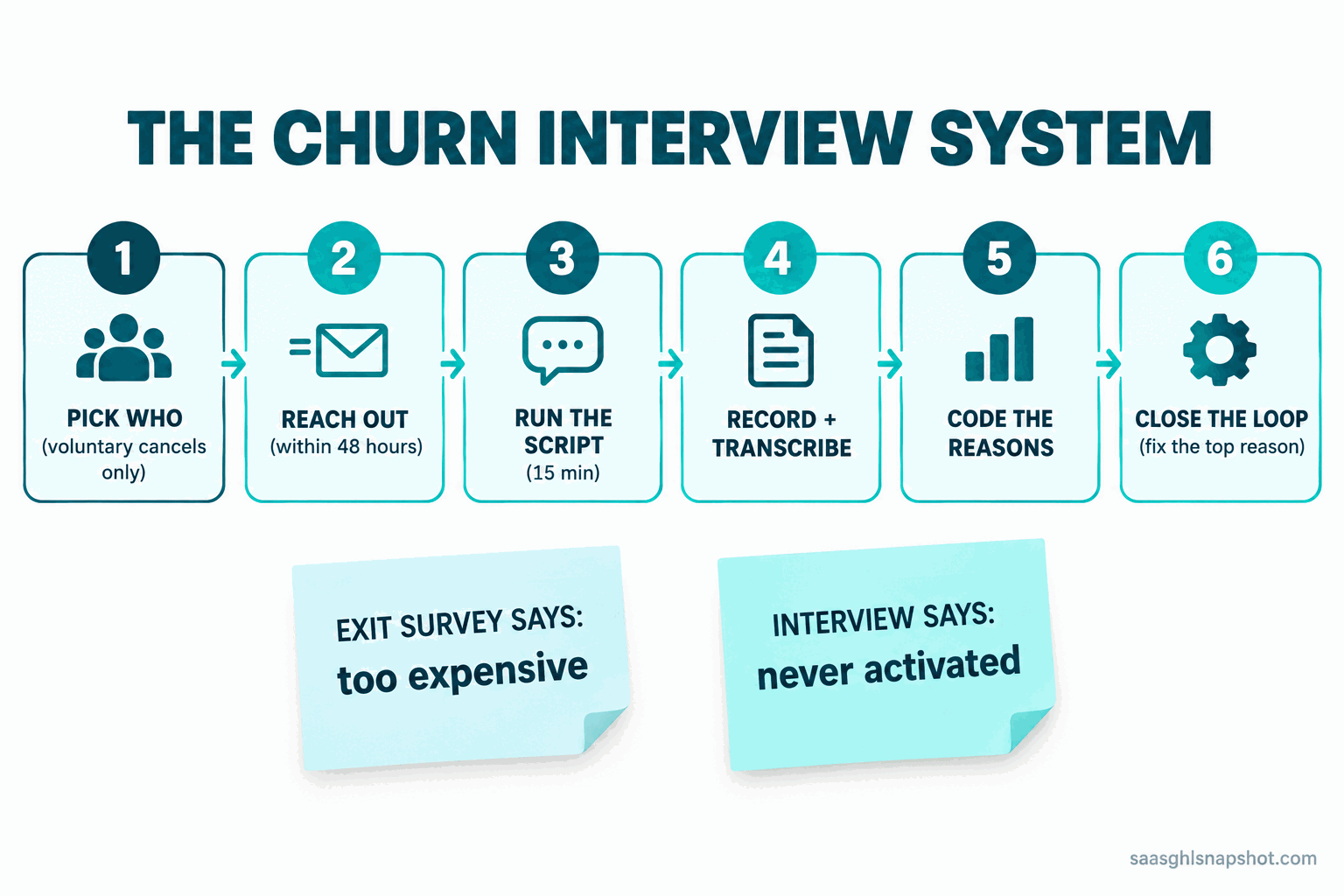
Table of contents
- Why your exit survey lies to you
- The one number that makes this worth doing
- The churn interview system
- Stage 1: Pick who to interview
- Stage 2: The outreach copy (steal this)
- Stage 3: The interview script (steal this)
- Stage 4: Running the call
- Stage 5: Coding answers into a taxonomy
- Stage 6: Closing the loop
- Run it for three company sizes
- The compliance line
- Objections
- FAQ
- Sources
Why your exit survey lies to you
It is not that customers lie on purpose. A dropdown forces a messy decision into a neat category, and people reach for the least awkward box. “Too expensive” is safe, because it does not require them to admit “I never figured out how to use it” or “my boss told me to cut tools.”
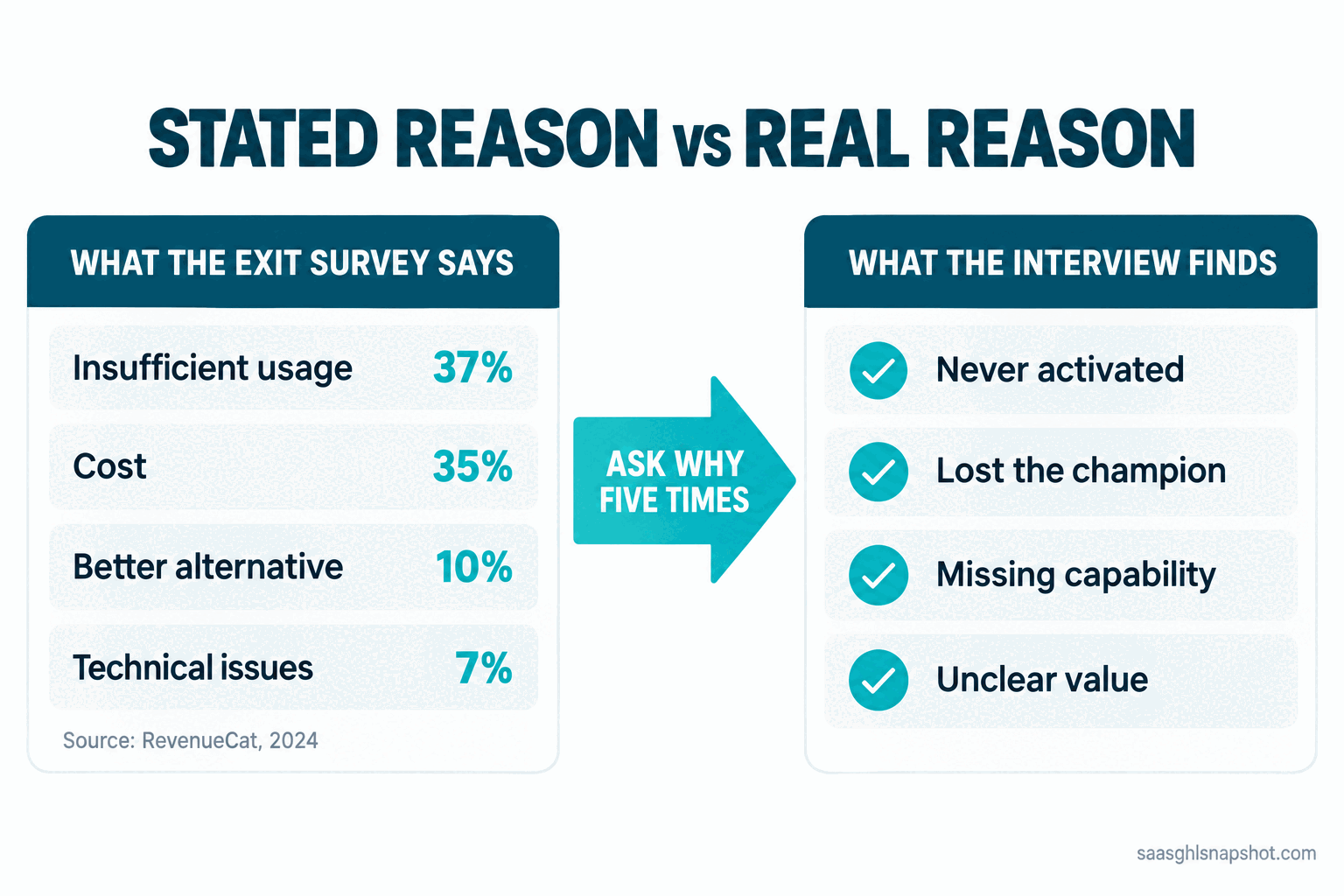
The data backs the suspicion. In RevenueCat’s cancellation analysis, the top reason given was insufficient usage at 37%, cost second at 35%, a better alternative at 10%, and technical issues at 7% (RevenueCat churn reasons). Most people leave because they were not getting value, and many “cost” answers are really “not worth it to me,” a value problem wearing a price mask. Those are consumer-app numbers, but the pattern holds: the stated reason and the real reason are two different things, and a form can never ask the follow-up.
Stated cancellation reasons, share of respondents. Source: RevenueCat subscription churn data, 2024. Directional for B2B SaaS; the top line is almost always low perceived value.
The one number that makes this worth doing
Recurly’s July 2026 network data puts median SaaS annual churn at 3.22%, split into 2.16% voluntary and 1.06% involuntary (Recurly churn benchmarks). Roughly two thirds of the customers you lose leave on purpose, the slice an interview can touch. The other third, the failed payments, is a billing problem you fix with dunning (failed-payment dunning).
Median annual SaaS churn split, voluntary vs involuntary. Source: Recurly, July 2026.
Two thirds is big because churn compounds. Median private B2B SaaS growth was 22% in 2026, down from 25% in 2024 (SaaS Capital 2026), and median net revenue retention sits around 101% (Benchmarkit 2025). When NRR is barely above 100, a single point of voluntary churn you could have caught is the difference between compounding up and treading water. Pair this with silent churn.
The churn interview system
Six stages, run as a quarterly loop with no new tool: pick who to interview, reach out within 48 hours, run the 15-minute script, record and transcribe, code the answers, close the loop. The first round is the hard one; after that it is a 90-minute ritual that quietly reshapes your roadmap.
Stage 1: Pick who to interview
The wrong list wastes the whole exercise. Three rules.
Voluntary cancels only. Someone whose card failed made no decision about your product. Mix them in and you will “learn” that pricing is a problem when half your sample never meant to go.
Prioritize accounts that activated, then left. A trial that never activated is an onboarding story you handle differently (free trials that never activate). The highest-value interview is the customer who used you, paid you, and still chose to go. They know exactly what was missing.
Aim for ten per quarter, not a hundred. Qualitative research saturates fast, so by the eighth or ninth call the same stories repeat, and that repetition is the signal.
Stage 2: The outreach copy (steal this)
Short and honest beats polished and corporate. Send it from a real person’s address, within 48 hours while the decision is fresh, with no pitch attached.
Subject: the real reason you left [Product]?

Hi [First name],

I saw you cancelled [Product] this week. No pitch, I promise.

I'm [Your name], I run the company, and I'm trying to understand
why customers leave so we can actually fix it. Your canned
"reason" in the cancel flow doesn't tell me much.

Would you give me 15 minutes on a call this week? I'll ask what
you were trying to do, where we fell short, and what you use now.
That's it. No save attempt.

As a thank you I'll send a $25 gift card either way.

Here's my calendar: [link]

Thanks,
[Your name]
Two details carry it. “No save attempt” and “no pitch” are promises you must keep, because the moment you try to win them back on the call they stop telling the truth. And the small incentive roughly doubles reply rates. For the ones who will not take a call, send the same email with three open questions instead of a link: what were you hoping it would do, where did it fall short, what are you using now.
Stage 3: The interview script (steal this)
The script walks backward through the decision, because people remember stories better than they rationalize reasons. It borrows the four forces from the jobs-to-be-done switch interview: push away from your product, pull toward the alternative, anxiety about switching, habit holding them in place. Find which force won. The bold lines are the spine; everything else is you asking “why” and “tell me more.”
1. Frame it (30 seconds). “There are no wrong answers, I just want the real story. Mind if I record it so I can listen instead of typing?”
2. The before. “Take me back to when you signed up. What was going on in your business that made you go looking?” You are finding the job they hired you to do.
3. The honeymoon. “In the first few weeks, what did you get set up and using? What never got off the ground?” This is where you find the activation gap, the most common hidden cause.
4. The turning point. “Think about the moment you first thought ‘maybe this isn’t working.’ What happened right before that?” This question does the heavy lifting, and the answer is almost never price.
5. The alternative. “What are you using now, and what does it do that we didn’t?” A competitor names the exact gap; a spreadsheet is a louder signal.
6. The trade-off. “If we had fixed one thing, would you have stayed? What was it?” The cleanest line to your roadmap.
7. The money question, last. “Was price actually the issue, or was it the value for the price?” Watch how often “too expensive” becomes “it wasn’t worth it to us yet.”
Stage 4: Running the call without leading them
How you hold the call decides whether you hear the real story or a flattering version. Three habits.
Record and transcribe. Ask permission, then stop writing. You cannot probe and scribble at once, and the gold is in the follow-up you catch only when fully listening. A free transcription tool turns the call into searchable text for Stage 5.
Shut up. The biggest skill is silence. Ask the turning-point question, then wait. Those awkward seconds of quiet are when people stop giving the rehearsed answer and start thinking out loud.
Never defend the product. The instant you say “well, actually you could do that in settings,” the interview is over, and they are managing your feelings instead of telling the truth. Say “tell me more” and move on.
Stage 5: Coding answers into a taxonomy
Ten transcripts are not insight yet. Insight comes from coding them into a short, consistent set of categories so you can count what repeats. Keep it to six or seven.
| Churn reason code | What it really means | The usual fix |
|---|---|---|
| Never activated | Paid, never got the core workflow running | Onboarding and time-to-value |
| Lost the champion | The buyer left or changed roles | Multi-threading, admin handoff |
| Missing capability | A specific feature or integration gap | Roadmap, or honest disqualification |
| Outgrew / under-grew | Wrong plan for their size | Pricing and packaging |
| Budget cut | Real money pressure, not value | Downgrade path, pause option |
| Value unclear | Used it, never saw the ROI | Reporting, success check-ins |
Tag each transcript with one primary code and at most one secondary; the point is to find the biggest single bucket, not to be complete. After ten interviews you get a count like “six never activated, two lost the champion, two missing capability,” and that count is your whole quarter’s retention priority in plain language. The data side of this is instrumenting churn in your product: transcripts tell the story, the data tells the scale.
Stage 6: Closing the loop
This is where almost every team fails, and the only stage that returns money.
Fix the single biggest bucket. Not all of them, the biggest one. If six of ten were “never activated,” your next sprint is onboarding, full stop. A team that tries to fix six reasons at once fixes none.
Win back where the fix applies. When you ship the thing that lost a specific customer, email that exact person. “You told me we were missing X. We just shipped it. Want to see?” is the highest-converting win-back message there is, because it proves you listened (more in SaaS win-back campaigns and the cancellation flow).
Report the number back to yourself. Each quarter write one line: top churn reason, what you shipped, did it shrink. That forces you to prove the fix worked.
Affiliate disclosure: the link above is a GoHighLevel affiliate link. We may earn a commission at no extra cost to you. See our affiliate disclosure.
Run it for three company sizes
The system is the same, but the volume, the interviewer, and the cadence change with your stage.
| Stage | Who interviews | Cadence | Sample per round | What changes |
|---|---|---|---|---|
| Solo / under $1M ARR | The founder, always | Monthly | 3 to 6 | You can talk to nearly everyone who leaves |
| Growth / $1–3M ARR | Founder or first CS hire | Quarterly | 10 to 12 | Sampling starts; keep the founder on half the calls |
| Scaling / $3–10M ARR | CS team, founder reviews | Quarterly, segmented | 10 per segment | Split by plan and segment so one cohort does not drown the rest |
Under $1M ARR you can interview nearly every voluntary cancel, because the founder learning the pattern firsthand beats any dashboard. In the growth band founders wrongly delegate it; stay on at least half the calls. Only in the scaling band do you systematize, segmenting by plan tier so a blended taxonomy does not hide distinct cohorts (2026 SaaS benchmarks has the retention math by band). The whole loop, cancel tag to interview outreach to win-back, is four automations any CRM with workflows can run, which is the case for consolidating lifecycle, CRM, and messaging onto one flat-rate platform (the real cost of your GTM stack).
The compliance line
The outreach is still email, so the usual rules apply. CAN-SPAM wants a real physical address and a working unsubscribe even on a founder note sent at scale (FTC CAN-SPAM guide), and since 1 February 2024 Google and Yahoo require bulk senders to authenticate with SPF, DKIM, and DMARC and keep spam complaints under 0.30% (Google sender guidelines). GDPR applies the instant an EU customer is in your list, and texting cancelled customers needs A2P 10DLC and prior consent. Run it through the same authenticated pipes as your lifecycle email and compliance setup.
Objections
“My customers won’t get on a call after they cancelled.” More will than you think, with a small incentive and an honest no-pitch email from the founder. Expect 20 to 40 percent of a warm list to say yes, and you need ten.
“Isn’t this what the exit survey is for?” No. The survey tells you what box people click; the interview tells you why. Keep a one-question survey to sort cancels, then interview to find the truth behind the top box. The survey alone points your roadmap at the wrong problem.
“I don’t have time for this every week.” Then run it quarterly, ten calls in one afternoon. If you can read a churn dashboard, you can call the people on it.
Finish the story
Go back to that account whose survey said “too expensive.” If you had called, you would probably have heard that their power user left in August, the new owner never learned the product, and by October nobody logged in, so at renewal the easy call was to cut the tool nobody used. Price was the words. “We never re-activated after our champion left” was the reason. One is a pricing project you would have gotten wrong; the other is a champion-handoff workflow you could ship in a week.
That gap, between the words and the reason, is where your retention is hiding. The survey will never close it. Ten honest conversations a quarter will. Start with the next customer who leaves: send the email, book the call, and listen.
Want the whole churn loop, from cancel tag to interview outreach to win-back, built and installed in your CRM in 24 hours? Get the SaaS Snapshot or book a walkthrough.
Frequently asked questions
What questions should I ask in a SaaS churn interview?
Walk backward through the decision. Ask what was happening when they signed up, what they got working versus what never got off the ground, the moment they first thought it was not working, what they switched to, and the one thing that would have made them stay. Ask about price last, framed as value for the price, because asked first it becomes the easy excuse that hides the real reason.
Why are churn interviews better than a cancellation survey?
A survey captures the answer someone types in ten seconds, so the top reason is almost always the safe one, usually 'too expensive.' An interview lets you ask why repeatedly until you reach something you can change, like a missed activation or a lost champion. Keep a one-question survey to sort cancels, but interview to learn the truth behind the top box.
How many churn interviews do I need to run?
Ten per quarter is plenty for an early-stage SaaS. Qualitative research saturates fast, so by the eighth or ninth call you hear the same stories repeating. Under $1M ARR you can interview nearly every voluntary cancel. You are hunting for the dominant pattern, not statistical significance.
Should I interview customers whose payment failed?
No. Failed payments are involuntary churn, roughly a third of all SaaS churn per Recurly's 2026 data, and those customers made no decision about your product. Interviewing them muddies your reasons and makes pricing look like a problem when it is not. Route failed payments into dunning.
How do I get churned customers to agree to a call?
Send a short, honest, plain-text email from the founder within 48 hours, promise no pitch and no save attempt, keep it to 15 minutes, and offer a small incentive like a $25 gift card. Expect 20 to 40 percent of a warm list to say yes. The no-pitch promise is load-bearing.
Sources
- Recurly churn rate benchmarks (median SaaS annual churn 3.22%, voluntary 2.16% / involuntary 1.06%, July 2026)
- RevenueCat, subscription churn reasons (stated cancellation reasons breakdown)
- SaaS Capital 2026 Private B2B SaaS Growth Rate Benchmarks (median growth 22%, down from 25% in 2024)
- Benchmarkit 2025 B2B SaaS Performance Benchmarks (median NRR 101%)
- ChartMogul SaaS Benchmarks Report (2023 edition: median monthly churn 3-4%, top quartile 1-2%)
- Jobs-to-be-Done switch interview (the four forces: push, pull, anxiety, habit)
- FTC CAN-SPAM compliance guide
- Google email sender guidelines (bulk-sender rules in force since 1 February 2024)
About the author
Mara Castellano is a Lifecycle & Retention Strategist based in Austin, TX. She has spent a decade inside product-led SaaS teams turning trial signups into retained accounts, and rebuilding the churn loop inside GoHighLevel so founders hear the real reason customers leave.
Want your cancel-to-win-back loop built and installed for you? Get the SaaS Snapshot or book a walkthrough.