
The signups look fine. Then you check what those trials actually did and your stomach drops: a third created an account, clicked around for ninety seconds, and never came back. They did not cancel, because there was nothing to cancel. The gap between the account that gets created and the account that reaches real value is where most of your trial revenue leaks, and more signups never fix it. What fixes it is getting the signups you already have to the moment the product is obviously worth paying for. Here is the system that does it, stage by stage, with the nudge copy to steal.
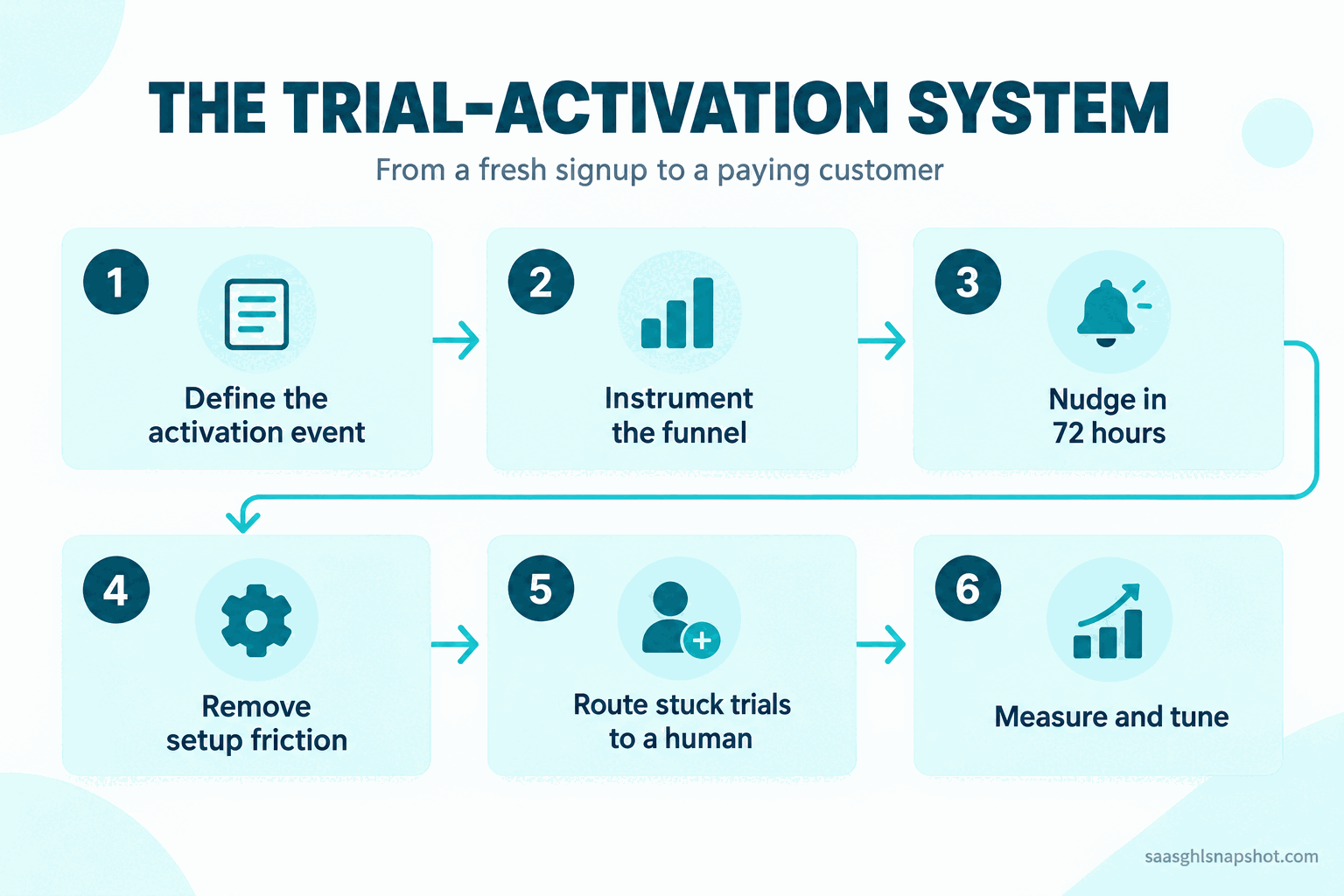
Table of contents
- The short answer
- What a dead trial costs you
- The trial-activation system
- Stage 1: Define the activation event
- Stage 2: Instrument the funnel
- Stage 3: Nudge inside 72 hours
- Stage 4: Remove setup friction
- Stage 5: Route stuck trials to a human
- Stage 6: Measure and tune
- The copy to steal
- Three scenarios by ARR band
- Running nudges without breaking the law
- Objections
- FAQ
- Sources
The short answer: activation is the real conversion event
A trial signup is a promise, not a purchase. The decision gets made at the moment the user does the thing your product is for and feels it work, the activation event, or aha moment.
So the useful question is not how to convert more trials, it is how to get more trials to their first real win, faster. Kyle Poyar’s February 2026 analysis of 200 B2B software products, run with ChartMogul and ProductLed, put the median free-to-paid conversion at just 8 percent, with almost no product actually at 8 percent because the median hides a huge spread (Growth Unhinged, 2026). The products at the top of that spread activate a larger share of the trials they already have, with a system, not a hero email: name the event that means “this user got it,” watch where trials fall short, nudge them toward it while intent is hot, strip the setup that blocks it, and put a human on the trials that stall.
What a dead trial actually costs you
Every signup costs money to get. When one never activates, that spend is pure waste, and it compounds because growth is slow: SaaS Capital’s 2026 benchmarks put median private B2B SaaS growth at 22 percent, down from 25 percent in 2024, and just 20 percent for bootstrapped companies. When new logos are slow and expensive, that trial is the cheapest growth you have.
The activation gap is wider than most founders think. One benchmark puts the median B2B SaaS activation rate near 52 percent, with top-quartile products at 65 to 75 percent (Flint, citing 1Capture, 2025). Read it the other way: for a typical product, close to half of trial users never hit the event that predicts they will stay.
Day-one activation rate by performance quartile for B2B SaaS. Source: Flint, citing 1Capture free-trial benchmarks, 2025.
Activation also predicts retention, not just conversion. The user who reaches real value in the trial is the one who renews, and with median net revenue retention at 101 percent and monthly churn at 3 to 4 percent (Benchmarkit, 2025; ChartMogul, 2023), the account that activates well is the one still paying you next year.
The trial-activation system
Six stages, built in order, because skipping an early one makes the later ones fire blind.
| # | Stage | What it answers | Where it lives |
|---|---|---|---|
| 1 | Define the activation event | What “this user got it” means | Product events |
| 2 | Instrument the funnel | Where trials fall short | Analytics or CRM |
| 3 | Fire the first-value nudge | How to pull them to the win | Email, in-app, SMS |
| 4 | Remove setup friction | What blocks the first win | Product + onboarding |
| 5 | Route stuck trials | Who needs a human | A workflow + a task |
| 6 | Measure activation to paid | Whether any of it worked | A monthly review |
Stage 1: Define the one activation event
Pick the single action that means a new user has felt the product work, not signup or a finished feature tour. The real event is the first time they did the core job your product exists to do and got something back: the first meeting booked through a shared link, the first dashboard a second person opens, the first invoice sent and paid.
The test is simple: if the user did this one thing and then your product vanished, would they be annoyed? If yes, that is your activation event. Write it as one sentence, because a vague definition (“the user is engaged”) gives you nothing to measure or nudge toward. Keep it one outcome, not a seven-step checklist.
How it breaks: teams define activation as “signed up and verified email” because it is easy to measure, then wonder why their activation rate looks great and conversion looks terrible.
Stage 2: Instrument the signup-to-value funnel
You cannot fix a leak you cannot see. Lay out the short funnel between signup and the activation event (account created, first core action started, data connected, activation event reached) and put a number on each transition.
This does not need a data warehouse. A small product can pipe a handful of events into a spreadsheet and count weekly. What you want is the biggest single drop: almost every product has one step where half the trials quietly fall off, and the step that feels hard to you is rarely the one that stops a stranger. Watch the timing too: if activators get there in a day and ghosts stall on day one, your nudge window is the first 24 to 72 hours, not day ten.
How it breaks: you track signups and paid conversions but nothing in between, so the funnel is a black box, and you tweak the pricing page while the real leak sits at step two.
Stage 3: Fire the first-value nudge inside 72 hours
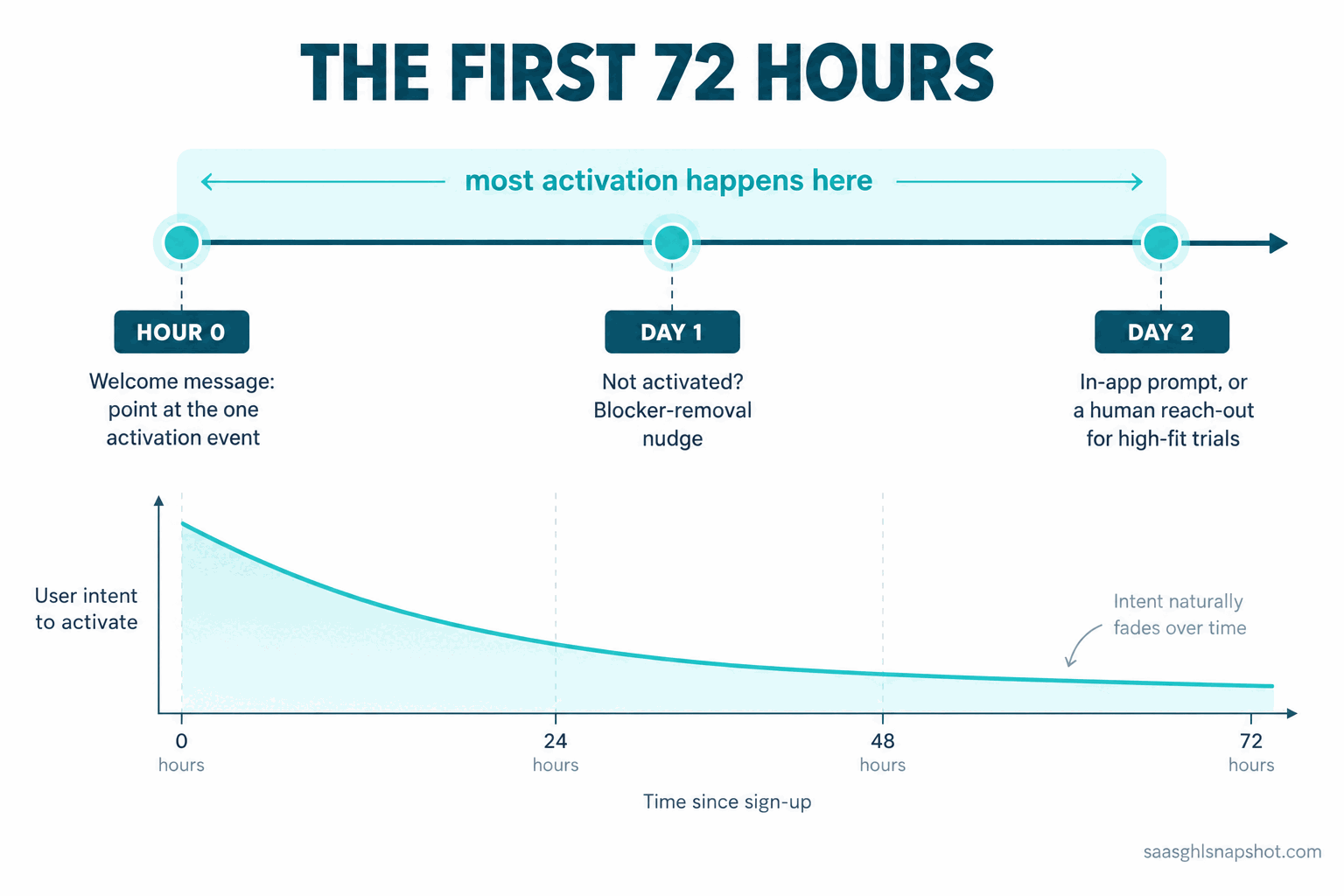
Intent decays fast. A trial is never more motivated than the hour they signed up, and the most common trial is only 14 days, used by 62 percent of products (Growth Unhinged, 2026). The first 72 hours carry most of the activation you will ever get, so the nudge cadence lives there.
Build a short, branching sequence keyed to behavior, not a fixed drip. At signup, the welcome message points at the one activation event and nothing else. Not reached it by the next day? A second touch removes the likely blocker (“most people get stuck importing their list, here is the 2-minute version”). Reached it? The sequence switches to depth: a second use case, an invite-a-teammate prompt. In-app messages catch the user still in the product, email catches the one who left, and every message leads with the user’s outcome.
How it breaks: the sequence is a time-based drip that ignores what the user did, so it emails “here is how to get started” to someone who already started, and “upgrade now” to someone who never activated.
Stage 4: Remove the setup friction that blocks activation
No nudge survives a broken first step. If the path to your activation event runs through an empty state, a data import, or an integration, that is almost certainly where your Stage 2 funnel showed its biggest drop, and the best activation work is usually deleting a step, not writing a cleverer email.
Three friction killers do most of the work. Kill the empty state: seed a new account with sample data or a template so it is never a blank page. Make hard setup optional for the first win. And cut the fields, because every required field at signup is a place a trial quietly quits.
This is also where the credit-card question lives. A card up front raises conversion sharply, First Page Sage puts card-required trials at 48.8 percent versus 18.2 percent for no-card (First Page Sage, 2025), but it filters hard at the top so you get far fewer trials. If trials never activate, a card wall just hides the symptom.
Organic trial-to-paid conversion by trial type. Card-required trials convert a higher share, but produce far fewer trials. Source: First Page Sage, 2025.
How it breaks: you pour nudges into a funnel with a dead step in it. The email says “create your first report” and the builder errors on an empty account, so your most motivated users hit a wall and leave.
Stage 5: Route stuck trials to a human
Automation gets most trials to value, but not the ones worth the most. A high-fit trial sitting at step two on day two with no movement is worth a human reaching out, and Stage 2 tells you which trials those are.
So add a routing rule on top of the sequence. Score trials on two axes: fit (company size, role, source) and progress (how far through the funnel). A high-fit trial that has stalled creates a same-day task for a real person; a low-fit self-serve trial stays automated. It is the same logic as a product-qualified lead model, applied to the stuck trials.
The human touch is not a pitch. It is a short, specific offer: “I saw you started setting up X and stopped, want me to finish it with you in ten minutes?” Almost no competitor does this, and the trial that gets unblocked by a real person remembers it at renewal.
How it breaks: either nobody owns the stuck-trial list and tasks pile up, or everything routes to a human and the founder drowns. Route by fit and stall, not by signup.
Stage 6: Measure activation to paid and tune the trigger
Close the loop or the system drifts. Each month, answer two questions: of the trials that activated, what share converted to paid, and of the trials that converted, what share activated first? If activators convert far better than non-activators, your event is real and the job is to raise the rate. If activation barely moves conversion, your event is a vanity milestone, so redefine it around a deeper outcome and tune the timing against the activation curve from Stage 2.
Route the misses by cause. Trials that activate and still churn are a time-to-value problem, not an activation one; trials that convert on a card plan and cancel at the first bill are often a trial-length mismatch. Activation is the first lever, not the only one.
How it breaks: you ship the sequence, watch signups, and never check whether activation moved conversion. Six months later the nudges are stale and nobody trusts the numbers.
The copy to steal
Here is the behavior-triggered sequence that pulls a trial to its activation event. Swap the nouns.
Three scenarios: pre-revenue, under $1M, $1-3M ARR
The system is the same shape at every stage. What changes is how much a human runs by hand, and that tracks your ARR band and funding more than your headcount.
Pre-revenue or pre-seed, founder-led. You are the activation engine. Watch every signup, send the welcome message from your own inbox, and reach out personally to every stall. It does not scale, and that is fine: those conversations are the best product research you will get. Track the event in a spreadsheet and do Stages 3 and 5 by hand.
Under $1M ARR, bootstrapped. The volume now hurts to handle by hand, so automate Stages 2 and 3. Product events flow into one platform, the sequence fires on its own, and only high-fit stalled trials create a task for you. This is where a done-for-you GoHighLevel build earns its keep, because wiring product events to a nudge engine by hand is a developer-week you do not have.
$1-3M ARR, bootstrapped or venture-backed. The pipeline runs itself and the work becomes segmentation: a product-led signup and a sales-assisted trial need different nudge paths, so split and route them. A venture-backed team puts a human on more trials and pushes volume; a bootstrapped team optimizes the automated path. Either way, feed activation data into your trial-to-paid sequence so the two systems compound.
Running activation nudges without breaking the law
Watching product usage and sending trial nudges puts you inside a few rules, so build them in from day one.
If any trials come from the EU or UK, GDPR applies the moment their data lands, so usage tracking needs a lawful basis and a line in your privacy policy, and CCPA and CPRA give California users rights to know and delete what you store. Trial nudges are commercial email, so CAN-SPAM applies: accurate subject lines, a physical address, and a working unsubscribe. At volume, the Google and Yahoo bulk sender rules in force since February 1, 2024 require SPF, DKIM, and DMARC, a spam rate under 0.30 percent, and one-click unsubscribe for anyone sending 5,000 or more messages a day. SMS reach-outs require A2P 10DLC registration and prior express consent with a clear opt-out.
Objections
“Our product is complex, activation takes weeks, not 72 hours.” Then your activation event is too big. Split it: find the smallest real win a trial can feel early (not the full deployment, the first useful output) and make that your Stage 1 event. If a trial feels nothing in the first few days, the 14-day clock runs out before your deep value lands.
“We require a credit card, so trials are already committed.” A card raises the share that convert, but it does not make them activate. Plenty of card trials get billed without ever using the product, then cancel. You still need the activation system behind the card, or you are converting trials into refunds.
“Isn’t this just onboarding emails? We have a welcome drip.” A time-based drip is the thing that breaks in Stage 3. This is a behavior-triggered system tied to one measured event, with the friction removed and a human on stalled high-value trials. The difference is whether the messages react to what the user did.
“We are too small for this.” The pre-revenue version is a spreadsheet and your own inbox, and three activated trials a month that would have ghosted can be the difference between a flat month and a growing one.
Frequently asked questions
What does it mean when a trial user does not activate?
They created an account but never reached your activation event, the single action that signals real value (first invoice sent, first dashboard shared). Roughly half of B2B SaaS trial users never activate, which is why activation, not signup volume, is usually the real conversion lever.
What is a good SaaS activation rate?
One benchmark puts the median B2B SaaS activation rate near 52 percent, with top-quartile products at 65 to 75 percent. But the right target is relative to your own baseline: measure the share of trials that reach your activation event, then raise it. A clean definition of the event matters more than any industry number.
How do I get free trials to activate faster?
Define one activation event, instrument the funnel to find the biggest drop-off, then do two things: remove the friction at that step (kill the empty state, cut required fields) and fire a behavior-triggered nudge sequence in the first 72 hours. Route high-fit stalled trials to a human.
Why do most free trial users never come back after signing up?
Usually they hit a wall before any value: a blank empty state, a required data import, an integration, or a signup form with too many fields. Intent is highest at signup and decays within days, so a trial that cannot feel the product work quickly just leaves. Shorten the path to the first win.
Should I require a credit card for a free trial?
A card raises trial-to-paid conversion sharply (First Page Sage puts card-required trials at 48.8 percent versus 18.2 percent for no-card), but it cuts the number of trials. If trials never activate, a card wall hides the problem rather than fixing it; fix activation first, then decide whether a card gate fits your motion.
Do I need a data warehouse to track trial activation?
No. A pre-revenue founder can track one event in a spreadsheet and send nudges from their inbox. A small team can pipe product events into one platform like GoHighLevel and automate the sequence and the routing. You only need a warehouse when segmenting across thousands of trials.
Related reading
- Trial-to-paid: the 14-day activation sequence that actually converts
- Time to value in SaaS: how to measure it and cut it in half
- SaaS free trial length: 7 vs 14 vs 30 days (what actually converts)
- Product-qualified leads for SaaS: define, score and route
- Freemium vs free trial: which converts better for SaaS in 2026
- Silent churn: catch customers who quietly stop logging in
Sources
- Growth Unhinged (Kyle Poyar), free-to-paid conversion, 2026
- Flint, B2B SaaS free trial conversion statistics (citing 1Capture, 2025)
- First Page Sage, SaaS free trial conversion benchmarks, 2025
- SaaS Capital, 2026 Private B2B SaaS Growth Benchmarks
- Benchmarkit, 2025 B2B SaaS Performance Benchmarks
- ChartMogul, SaaS Benchmarks Report (2023)
- FTC, CAN-SPAM compliance guide
- Google, email sender guidelines
- GDPR.eu, what is GDPR
- California AG, CCPA