
When a prospect says “just send me pricing” and then goes dark, the deal is usually not lost to a competitor. It is stalled, and most stalled deals die from silence, not from a “no.” The fix is a written follow-up system: answer the price the same day, tie it to the outcome they care about, get a second person into the thread, run a three-week cadence of short specific messages, then send a clean break-up note that gives them permission to say no. Below are the six stages, the messages to steal, the timing, and how each breaks.
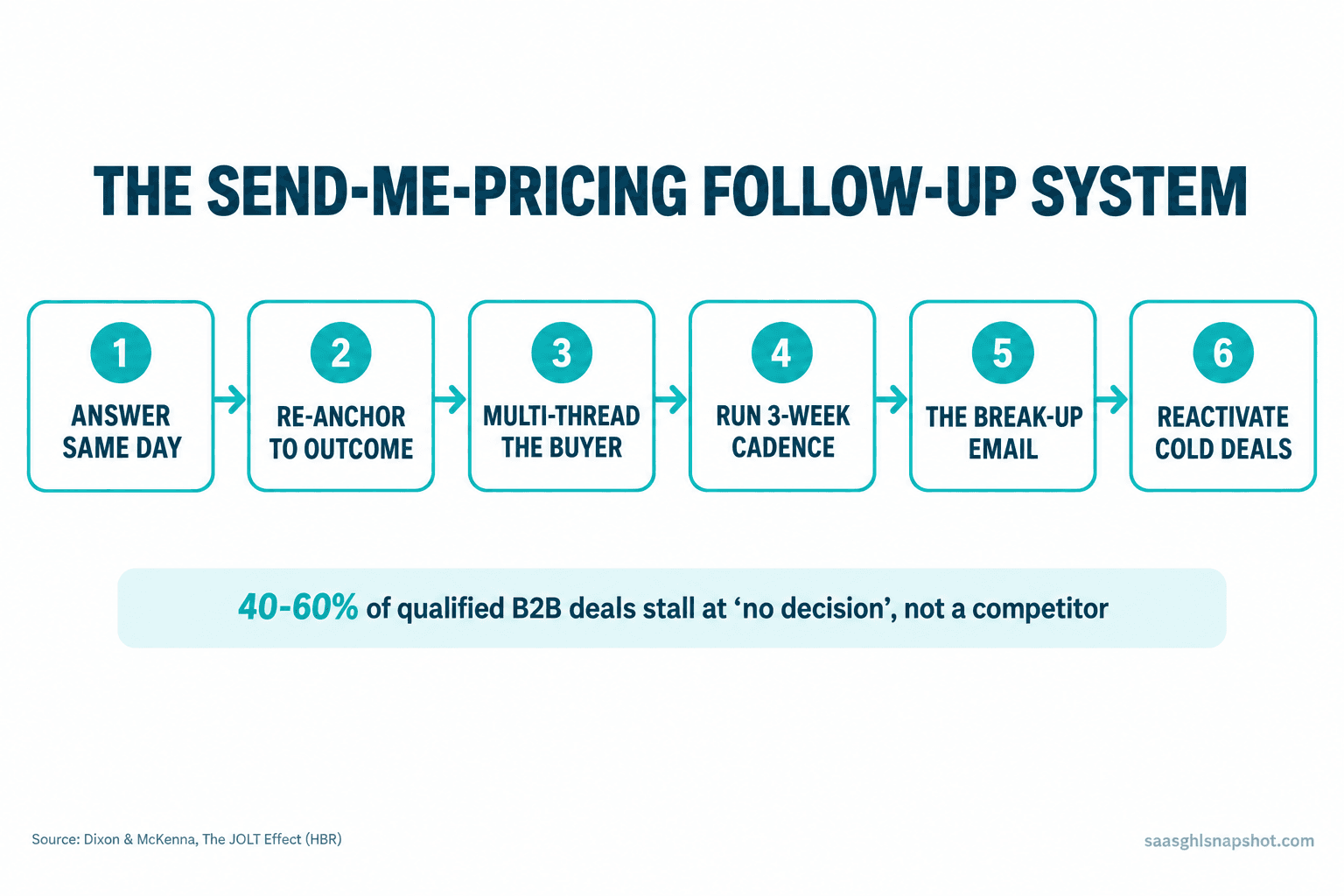
Table of contents
- What a stalled pipeline costs you
- Why “send me pricing” kills deals
- Stage 1: Answer same day
- Stage 2: Re-anchor to the outcome
- Stage 3: A second person in the thread
- Stage 4: The three-week cadence
- Stage 5: The break-up email
- Stage 6: Reactivate cold deals
- Run it for three teams
- The compliance layer
- Objections
- FAQ
What a stalled pipeline actually costs you
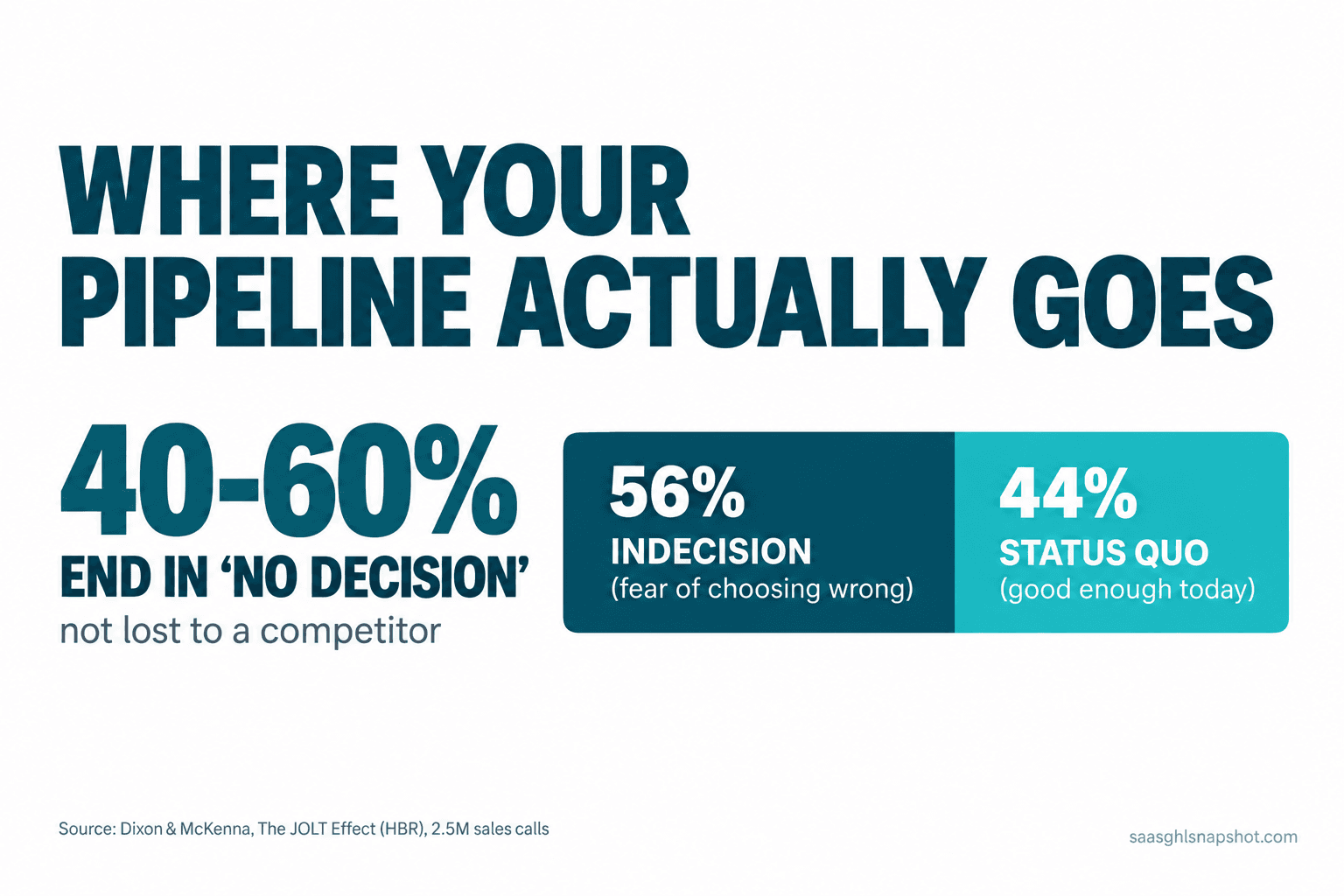
Start with the number that reframes the problem. In B2B, the biggest source of lost pipeline is not a competitor. It is “no decision,” the deal that just never happens, and it runs roughly 40 to 60 percent of qualified opportunities, from Dixon and McKenna’s analysis of 2.5 million sales conversations (HBR, “Stop Losing Sales to Customer Indecision”). As many as half the deals you count as real go nowhere, right after the pricing conversation.
For a founder-led team that is money you already spent. Your CAC on those deals is fully loaded whether they close or not, and CAC payback for B2B SaaS is up about 12.5 percent since 2022 (Benchmarkit 2025). A deal that stalls after pricing is the most expensive loss: you paid the whole acquisition cost and got none of the revenue. When you are bootstrapped, each stalled deal is a bigger share of your quarter than for a funded rival whose growth ran a median 22 percent in 2026 (SaaS Capital, 2026 Benchmarks). You cannot out-hire this. You out-system it.
Why “send me pricing” is where deals die
“Send me pricing” feels like progress. It is often the opposite: the polite way a buyer ends a live conversation and moves the decision somewhere you cannot see it, a Slack thread, a budget meeting, a spreadsheet stacking you against two rivals. The moment the number lands, three things stall the deal.
First, the buying group gets bigger. Gartner finds six to ten people typically shape a B2B purchase, and buyers spend only about 17 percent of their time meeting with suppliers (Gartner, The B2B Buying Journey). Your contact now has to sell your price internally, to people who never saw the demo, using a PDF. Second, price with no context reads as expensive. Third, “let me know” puts all the work on the busiest person.
There is a deeper insight in the Dixon and McKenna data: of deals lost to no-decision, about 56 percent stalled from active indecision, the fear of choosing wrong, and 44 percent from a preference for the status quo. Most stalled deals are not people who dislike your product. They are afraid to be wrong, so you do not push harder, you lower the risk of yes. The system below does that: it keeps the outcome on the number, pulls a second person into the open, and always ends with a specific next step.
Stage 1: Answer the price question the same day
Speed is your cheapest advantage. When someone asks for pricing, they are the most engaged they will ever be, and a classic study found firms that contact an inbound lead within an hour were about seven times more likely to reach a decision-maker than those who waited even 60 minutes longer (HBR, “The Short Life of Online Sales Leads”). Keep a pricing reply saved as a snippet: the price, one line on what it covers, and a next action with a date. Never send a bare number, and never send a calendar link with no price.
The failure here is a slow, hedged reply two days later: “pricing depends on a few things, can we grab time?” That answers nothing and signals you are not confident in your price. If it varies, give the range and an anchor.
Stage 2: Re-anchor the number to the outcome
Once the price is out, make sure it never travels alone. Every follow-up ties the number to a dollar outcome the buyer told you they wanted, which shifts the internal conversation from “can we afford this” to “can we afford to keep losing this.” In the demo, write down one number they gave you: trials lost per month, hours on manual follow-up, revenue in failed payments. Then restate the price as a fraction of it. If they lose $6,000 a month to failed payments and you cost $1,200, you do not cost $1,200. You cost one-fifth of a problem they have.
The failure mode is anchoring to a made-up number. Invent “you’ll 3x your revenue” and a sharp operator stops trusting you, so the deal dies for a real reason. Only anchor to numbers they gave you or you can source.
Stage 3: Get a second person into the thread
Remember the six-to-ten-person buying group. If your whole deal lives in one inbox, you are one reorg or one vacation away from a dead deal, because a single champion cannot carry an internal sale alone. Make the second contact easy: ask who else touches the decision, then offer something useful to loop them in, like a one-page summary or a recorded walkthrough. The goal is to give your champion ammunition, not go over their head.
The failure is going around the champion without permission. Copying their boss on a “just checking in” email is the fastest way to burn your one ally. Always route through your contact and frame it as helping them.
Stage 4: Run a fixed three-week cadence
Here is where founders lose deals: they follow up twice, feel like a pest, and quit. The buyer is not annoyed, just busy. RAIN Group found it takes an average of about eight touches to land a first meeting, and even top performers need around five (RAIN Group, touchpoints to make a sale). Two emails is a warm-up. Run a written cadence the same way every time so it is not an emotional decision each day: four touches over three weeks, each adding a new reason to reply.
Illustrative: reply likelihood decays fast after pricing is sent, which is why a fixed cadence of specific touches beats a couple of vague bumps. Curve is illustrative, not measured.
Put the cadence somewhere it runs itself. The messages, roughly: Day 2 is the re-anchor email above. Day 5 is one proof point (“a team your size recovered [$4,100/month] in 60 days”). Day 10 is a new angle, not a bump: address the objection you suspect is stalling them, usually setup time, switching cost, or contract length. Day 17 is a check-in with an easy out: “Is this still on for this quarter, or should I circle back?”
The failure mode is sending “just following up” four times. Repetition with no new information trains the buyer to ignore you. That is what feels like spam.
Stage 5: The break-up email that reopens deals
The message that reopens the most stalled deals is the one where you offer to close the file. When you stop asking for a yes and instead ask for a clean no, you remove the pressure keeping them silent, and a surprising share of quiet buyers reply to say they are still interested. Send it around day 21, when the nudges have not landed. It is short, warm, and offers to stop, not a threat.
The failure is making the break-up a guilt trip or a fake deadline. “Last attempt, the price goes up Friday” is a bluff a good operator sees instantly. It works precisely because it is sincere.
Stage 6: Reactivate the ones that still went cold
Some deals go silent through the whole cadence and the break-up. Do not delete them. A dead deal is a warm lead with context, far cheaper to reactivate than a cold prospect is to acquire. Tag each one with why it stalled, then reactivate on a genuine event: you shipped the feature they asked about, you have a new proof point in their vertical, or their incumbent contract is up for renewal. One good trigger beats ten bumps.
The failure is reactivating with nothing new. “Just bumping this back to the top” after three months is worse than saying nothing, because it confirms you have no reason to be in their inbox. Wait for the trigger, and stay quiet until then.
Run it for three real teams
The system is the same; how you run it changes with headcount.
| Solo founder | 2-5 person team | 10-15 person team | |
|---|---|---|---|
| Who follows up | You, from templates | You plus one closer | A rep, founder on exceptions |
| How the cadence runs | Snippets + CRM tasks | Shared sequence in the CRM | Automated sequence + alerts |
| Multi-threading | You ask for the second name | Closer owns the second contact | Rep maps the buying group |
| Biggest risk | You forget to follow up | Two people, no shared record | Leads rot between handoffs |
| The fix | One automation for the cadence | One CRM, one shared pipeline | Stage rules + no-deal-left alerts |
Solo, the enemy is your own memory, so automate the cadence to fire without you. At 2-5 people, two reps touch one deal with no shared record, so use one CRM and one pipeline. At 10-15, deals stall in the gaps between people, so add stage rules and alerts that surface a quiet deal, with the founder on exceptions only.
The compliance layer you set up once
Follow-up runs on email and sometimes text, and both are regulated. Set this up once and it protects every message the system sends. None of this is legal advice.
CAN-SPAM covers your sales email: a real physical address, a working unsubscribe, no deceptive subject lines, and prompt opt-out handling (FTC CAN-SPAM guide). A one-to-one reply is lower risk than a blast, but your cadence still counts. Google and Yahoo rules have been in force since February 1, 2024: at 5,000+ messages a day you need SPF, DKIM and DMARC, a spam rate under 0.30 percent, and one-click unsubscribe (Google sender guidelines). Below that you are not forced, but authenticate anyway, because it keeps your follow-up out of spam. If any stage texts, US carriers require A2P 10DLC registration and clear consent first (FCC). GDPR applies the moment an EU trial signs up, and CCPA/CPRA cover California residents, so capture consent honestly and make opt-out easy.
Objections
“Won’t all this follow-up annoy the prospect?” Not if each message is short and carries something new. What annoys buyers is the vague “just bumping this.” With 40 to 60 percent of pipeline lost to no-decision, quitting too early is the bigger risk.
“What if I already pay for HubSpot or a CRM?” Use it. This system is a process, not a product, and any CRM that saves a sequence and sets reminders runs all six stages today. If you are also drowning in per-seat tools that each do one piece, that is a separate problem worth solving.
“Isn’t the break-up email risky?” A deal that has ignored four specific messages has already left in every way that matters. The break-up does not lose deals, it surfaces their real state and reopens more than it closes.
Run the whole motion on one system
Every stage works in tools you already have. What breaks is running six stages, across email and text, for dozens of deals by hand: it fails exactly when you are busiest, which is when the deals are best. Consolidating the pipeline, messages, cadence, and alerts into one place is what makes it run.
It is Thursday. The quote you sent last week is still in a prospect’s inbox, unanswered, and you were about to mark it lost. Instead, send the re-anchor email, then the break-up note next week if it stays quiet. Half your “losses” are just deals waiting for one more specific message.
Frequently asked questions
Why do most B2B SaaS deals stall after I send pricing?
Because the number leaves the live conversation and enters a bigger, slower group. Gartner finds six to ten people typically shape a B2B purchase, and your contact now has to sell your price internally using a PDF. Price with no outcome attached reads as expensive, and 'let me know' puts all the work on the busiest person. Keep the outcome attached to the number, pull in a second person, and always end with a specific next step.
How many times should I follow up before giving up?
Run about four specific touches over three weeks, then a break-up email, then move the deal to a reactivation list rather than deleting it. RAIN Group found it takes an average of about eight touches to land a first meeting, so two emails is a warm-up. Each touch must add something new, not just 'checking in.'
What is a break-up email and does it actually work?
It is a short, sincere message offering to close the file: timing is off, not a priority, or a no, and all three are fine. It works because it removes the pressure keeping the buyer silent, and a real share of quiet prospects reply to say they are still interested. It only works if it is genuine; a fake deadline kills it.
Can I run this without a fancy sales tool?
Yes. The system is a process, not a product. Any CRM that saves a sequence and sets reminders runs all six stages, as long as the cadence lives somewhere reliable instead of in your memory. If you juggle several per-seat tools that each do one piece, consolidating onto one platform removes the gaps where deals fall through.
Is automated sales follow-up legal, and what about texting?
Yes, within the rules. CAN-SPAM requires a real address, a working unsubscribe, and honored opt-outs on commercial email. Google and Yahoo bulk sender rules (since February 2024) require SPF, DKIM, DMARC and one-click unsubscribe at 5,000+ messages a day. If you text, US carriers require A2P 10DLC registration and clear consent first, and GDPR applies the moment an EU trial signs up. Authenticate your domain and keep the unsubscribe visible before you automate.
Sources
- HBR / Dixon and McKenna, “Stop Losing Sales to Customer Indecision” (The JOLT Effect): 40-60% of qualified deals lost to no-decision; 56% indecision vs 44% status-quo
- HBR, “The Short Life of Online Sales Leads”: ~7x more likely to reach a decision-maker within the hour
- RAIN Group, touchpoints it takes to make a sale: average ~8 touches
- Gartner, The B2B Buying Journey: six to ten stakeholders
- Benchmarkit, 2025 B2B SaaS Benchmarks: CAC payback up ~12.5% since 2022
- SaaS Capital, 2026 Growth Rate Benchmarks: median ~22% growth
- FTC CAN-SPAM guide and Google sender guidelines
Related reading: what HubSpot Sales Hub actually costs in 2026, the best CRM for founder-led sales, how to reduce SaaS demo no-shows, and the CAC payback period explained.