You gave a good demo. The prospect asked about pricing and promised to “loop in the team and get back to you.” That was eleven days ago, the thread is cold, and you are telling yourself they were never serious. They probably were. You let the deal walk out with no next step, no recap, and no second contact, and the week swallowed you. Your demo-to-close rate is the cheapest number in a founder-led SaaS to fix: no more leads, no sales hire, just a system that runs the same steps every time. Here it is, stage by stage, with the copy to steal.
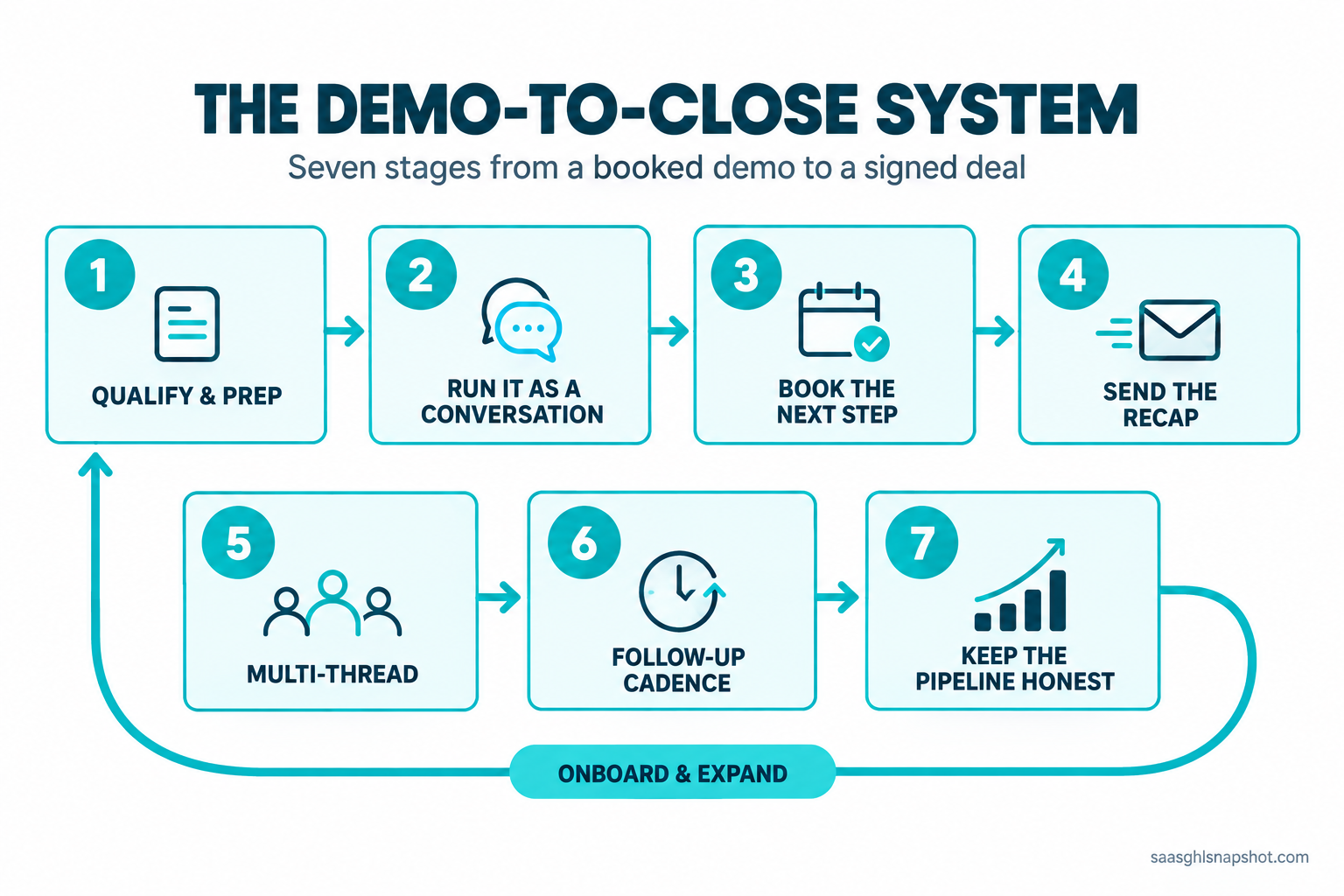
Table of contents
- The short answer
- What a leaky demo-to-close rate costs you
- The seven-stage system
- Stage 1: Qualify and prep
- Stage 2: Run it as a conversation
- Stage 3: Book the next step
- Stage 4: Send the recap
- Stage 5: Multi-thread
- Stage 6: The follow-up cadence
- Stage 7: Keep the pipeline honest
- Three scenarios by team size
- Staying compliant
- Objections · FAQ · Sources
The short answer: closing happens after the demo, not during it
The demo is the middle of the deal, not the close. The money is made in the two weeks around it: who you agreed to demo, whether you booked a next step before hanging up, whether a recap landed within the hour, and whether a second and third person from the buying side ever joined.
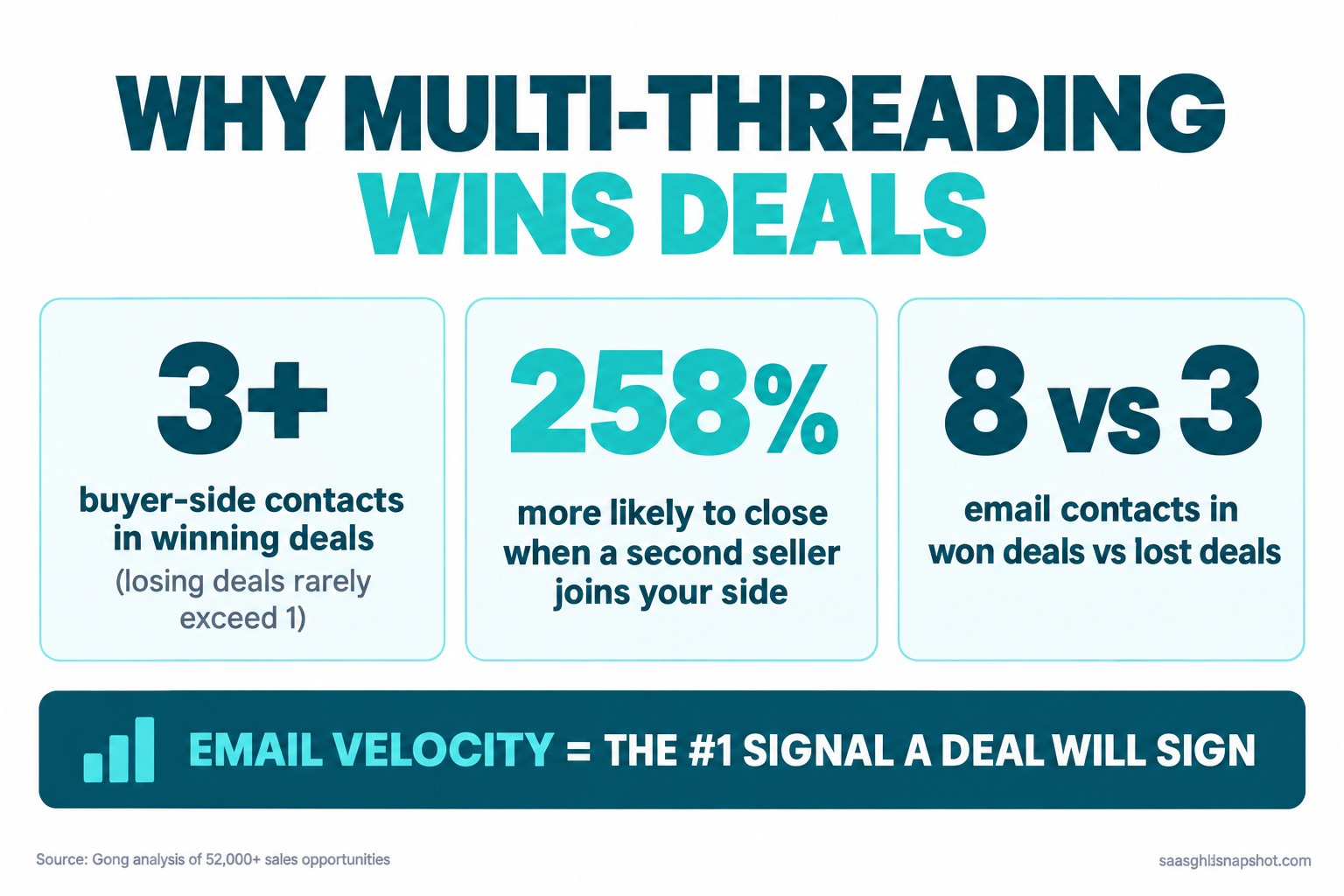
Gong analyzed more than 52,000 sales opportunities and found winning deals carry at least three people from the buyer’s side across the cycle, while losing deals “often struggle to get more than one” (Gong Labs). The deal you lost to silence was not lost on the demo; it was lost because the demo was the last thing that happened. The fix is a repeatable motion, so a tired founder on a Thursday cannot skip the step that closes the deal.
What a leaky demo-to-close rate actually costs you
The number that matters is how many demos turn into customers. There is no single national median, but the win-rate data by deal size is solid. An Optifai study of 939 B2B SaaS companies, Q2 2025 to Q1 2026, found median win rates of 31 percent under $10K ACV, 24 percent at $10K to $50K, 18 percent at $50K to $100K, and 15 percent above $100K (Optifai via SalesMotion, 2026). The widely repeated 21 percent B2B average comes from older HubSpot data and is a rough anchor at best.
Median B2B SaaS win rate by annual contract value. Source: Optifai Pipeline Study of 939 companies, Q2 2025 to Q1 2026, via SalesMotion. Win rate falls as deals grow, so follow-up discipline matters most on your biggest ones.
Now the math on a leak. Run 20 qualified demos a month at a 15 percent close rate and you get three customers; lift that to 25 percent and you get five, every month, with zero new spend, for a bootstrapped SaaS growing at the 2026 median of 20 percent (SaaS Capital, 2026). With CAC payback already around 16 months (Benchmarkit via Pavilion, 2026), you cannot acquire a demo and let it die of neglect.
The system in one picture
Seven stages take a booked demo to a signed deal, shown in the diagram above: qualify and prep, run the demo as a conversation, book the next step, send the recap, multi-thread, run the follow-up cadence, keep the pipeline honest. Each is a decision you make once and then run on autopilot. The order is the point: skip stage 3 and you rely on the prospect to remember you, skip stage 5 and one champion changing jobs kills the deal. Build all seven and your demo-to-close rate stops being luck.
Stage 1: Qualify and prep before you demo
The biggest win happens before the call: stop demoing to people who cannot buy. A bad-fit demo is an hour you will never get back and a win-rate number dragged down by deals that were never real.
Qualify fit before you accept the meeting. For a founder-led SaaS that means a short confirmation step after they book: company size, the problem, what they use today, and who else needs to be in the room. A pre-demo form does most of this. Then prep around their words: write down the one outcome they want, and build the call to show it in the first five minutes. A prospect sitting through a standard feature walkthrough has already started drafting the “we went another direction” email.
How this breaks: you demo to a junior researcher who booked to “check a box,” with no authority and no urgency. You cannot always avoid it, but asking on the confirmation “who else should join so we only do this once?” starts the multi-threading in stage 5 before the demo happens.
Stage 2: Run the demo as a conversation, not a feature tour
Your buyer is technical, skeptical, and has sat through dozens of demos. The fastest way to lose them is a scripted walk through every tab. Open with the outcome they want, show it working, then let them react: a demo is a dialogue, and the prospect talking is the prospect buying.
Tie every feature to a problem they named in stage 1. “You said your team loses track of trial signups, so watch what happens when one lands here” sells; “here is our dashboard, and over here is settings” does not. Demo the one path that matters; leave the rest. Mid-call, confirm you are solving the right thing: “Is this the problem that keeps you up, or is the real issue somewhere else?”
How this breaks: running long. A demo that uses all 60 minutes leaves no room for the part that matters, so finish the product tour with 10 minutes to spare.
Stage 3: Book the next step before you hang up
This is the highest-ROI habit in the system, and the one founders skip most. Never end a demo without a next action on both calendars: a technical call, a trial kickoff, a pricing conversation. A deal with a scheduled next step stays alive because there is a reason to talk again on a known date; one without relies on the prospect, whose day job is not buying your software, to remember you exist. Gong’s data shows the second meeting is where buyer participation nearly triples (Gong Labs): no second meeting, no momentum.
Book it live: “The logical next step is a short working session with your technical lead to pressure-test this. Tuesday at 2 or Thursday at 10, and who should I add?” That books the meeting and starts the multi-thread in one sentence. If they will not book anything, that is your cleanest early signal the deal is not real.
Stage 4: Send the recap within the hour
The recap email is your deal in writing: it reminds the prospect what they liked and gives them something to forward to people who were not on the call. Send it within the hour. Gong found email velocity, the back-and-forth tempo between buyer and seller, is the single strongest signal a deal will sign, and that won deals average eight points of email contact against three for lost deals (Gong Labs). The recap is the first beat of that tempo. Keep it short and forwardable, and attach the one-pager or security doc so the champion has ammunition when they sell you internally.
This should fire from a template the moment you move the deal to the “demo done” stage: you write the three bullets while the call is fresh, the system handles the rest. In GoHighLevel that is a pipeline-stage trigger plus an email template, so the discipline does not depend on your memory at 7pm.
Stage 5: Multi-thread the deal before it stalls
A single-threaded deal, where only one person at the buyer knows you exist, is the most fragile thing in your pipeline. That person gets busy or leaves, and the deal dies with no warning. Gong’s analysis is stark: winning deals involve at least three buyer-side contacts, losing deals rarely get past one, and sellers are 258 percent more likely to close when a second person from their own side joins too (Gong Labs).
Make getting a second contact a deliberate step. Attach the ask to a value offer: “The person who’ll run this day to day usually has sharp questions. Want me to do a 20-minute technical walkthrough so you’re not stuck relaying answers?” You are not going around your champion, you are making their life easier. For bigger deals, name the roles you need, the person who feels the pain, the person who signs, and the person who lives with the tool, and get two of the three engaged before final pricing.
How this breaks: your champion will not introduce you, usually because they are nervous about looking like they already decided. Lower the stakes: “No commitment, I just want your engineer to catch any blocker before you champion this.” Frame the introduction as protecting them, not pressuring them.
Stage 6: Run the follow-up cadence until a decision
Most deals need several more touches before a decision, and most founders quit after one. The fix is a written cadence over two to three weeks, each touch adding a new reason to reply, ending in a clean break-up note. The failure mode to avoid is sending “just checking in” four times: repetition with no new information trains the buyer to ignore you, and it is the thing that actually feels like spam. Every touch must carry something new, a proof point, an answer to their objection, a customer story. For the pricing-stall case, lift the sequence from the follow-up system for deals that stall at ‘send me pricing’.
The day-12 mutual close plan is worth building carefully: a short, shared list of the steps left before a signature, with dates: technical review, security questionnaire, internal approval, start date. It turns a vague “we’re thinking about it” into a concrete path and surfaces hidden blockers early. Prospects who will not co-sign one are telling you something now.
Stage 7: Keep the pipeline honest
A cadence only helps if deals cannot quietly fall out of it. The last stage is hygiene: any post-demo deal with no activity for seven days surfaces on your task list, plus a one-line definition of what must be true for a deal to sit in each stage. That stops a deal rotting in “demo done” while you assume the automation has it handled. This motion lives inside your wider pipeline, so if you have not designed that yet, build it first: see how to build a founder-led sales pipeline in a CRM you won’t outgrow.
How this breaks: you build the alerts, then ignore them because everything feels urgent. Treat a stalled-deal alert like a support ticket, same-day response, even if that response is marking the deal dead. A pipeline of zombie deals is worse than an empty one, because it lies to you about your forecast.
Three scenarios: solo founder, founder plus one, first rep
The system is the same, but who runs each part changes with team size.
| Stage | Solo founder (pre-$1M) | Founder + 1 ($1-2M) | First rep ($2M+) |
|---|---|---|---|
| Qualify + prep | Pre-demo form you read first | Ops screens, flags bad-fit | Rep qualifies; you take late-stage |
| The demo | You run every one | You run it, teammate takes notes | Rep runs it, pulls you in to close |
| Book next step | Book live, every time | Same, teammate adds invite | Rep owns it; alert if none set |
| Recap email | Template fires; you fill bullets | Teammate drafts, you approve | Rep sends from the template |
| Multi-thread | You ask for the intro | You are the “second seller” | Rep + founder is a natural thread |
| Follow-up cadence | Automated; you reply | Teammate monitors objections | Rep owns, escalates stuck deals |
| Pipeline hygiene | Weekly 20-min review | Teammate runs the stalled list | Rep’s job; you review forecast |
The lesson: the automation carries the discipline, the human carries the judgment. The “founder plus one” column quietly unlocks the 258 percent multi-threading lift, with a natural second seller on every deal. For the broader “do I hire yet” question, see when to hire your first sales rep.
Staying compliant as you automate the follow-up
Once your follow-up fires from software, a few rules apply, and getting them wrong can get your sending domain blocked, which quietly tanks every deal. The FTC’s CAN-SPAM rules require a real physical address, a working unsubscribe you honor, and honest subject lines (FTC CAN-SPAM guide). Since February 2024, Google and Yahoo’s bulk sender rules require SPF, DKIM, and DMARC, a spam rate under 0.30 percent, and one-click unsubscribe for anyone sending 5,000+ messages a day (Google sender guidelines). Most founder-led cadences sit under that volume, but set up the authentication anyway, because it also keeps your recap emails out of spam. If you text, US carriers require A2P 10DLC and prior consent; GDPR applies the moment an EU prospect enters your pipeline. For the full picture, see the SaaS email compliance rules.
Objections
“Isn’t booking the next step on the call pushy?” It is the opposite. Framed as “let’s not make you chase me,” it reads as organized. The pushy move is leaving the prospect to do the follow-up, then pestering them later.
“I already pay for a CRM. Do I need another tool?” No. This is a motion you design, not a tool you buy; it runs in whatever pipeline you have; the automation fires the recap and cadence on schedule. If your CRM taxes you per seat on every hire, that is a separate problem, covered in the best CRM for founder-led sales in 2026.
“My deals are too small to multi-thread.” Then the system gets simpler, not skipped. For a sub-$10K deal it might mean one extra contact and a shorter cadence. SMB deals close at 31 percent against 15 percent for enterprise because they are less complex, so lean into speed.
“I’m technical, not a salesperson. Won’t this feel fake?” It is built for exactly that. No manipulation, just a demo that answers a real problem, a clear next step, a recap, and follow-up that stops when the answer is no. It respects the buyer’s time, which a technical founder is naturally good at offering.
Run the system and the quiet threads stop
Go back to the prospect who went dark for eleven days. With the system there is no eleven days: you booked a technical call before hanging up, the recap hit their inbox within the hour, their engineer joined on Tuesday, and a close plan with dates replaced “we’ll get back to you.” Same demo. What changed is everything around it, the part you build once and run forever.
Frequently asked questions
What is a good demo-to-close rate for B2B SaaS?
It depends mostly on deal size: median win rates run about 31% under $10K ACV, 24% at $10K-$50K, 18% at $50K-$100K, and 15% above $100K (Optifai, 2025-26). Measure your own by segment and watch the trend.
What should I do immediately after a SaaS demo?
Book a specific, dated next step before you hang up, then send a recap email within the hour with three bullets, the next step, and a forwardable one-pager. Email tempo is the strongest signal a deal will close (Gong), and the recap is its first beat.
Why do my demos go quiet afterward?
Usually because the deal left single-threaded with no next step: one busy person carries it in their head, gets pulled elsewhere, and it dies silently. Book the next meeting on the call and get a second contact involved, since winning deals carry 3+ buyer contacts (Gong).
How many times should I follow up after a demo?
Run a fixed cadence of about four touches over two to three weeks, each adding new information, then a clean break-up note. Never send 'just checking in' repeatedly.
Can I automate post-demo follow-up without annoying people?
Yes, if every message carries something new and you honor opt-outs. Follow CAN-SPAM, the 2024 Google and Yahoo sender rules, A2P 10DLC for texts, and GDPR for EU contacts.
Sources
- Gong Labs, 3 truths that will change how you sell: 52,000+ opportunities; 3+ buyer contacts in winning deals, a second seller makes a close 258% more likely, email velocity the top signal.
- Optifai via SalesMotion, 2026 Win Rate Benchmarks: win rate 31% / 24% / 18% / 15% by ACV band (939 companies); ~21% B2B average.
- SaaS Capital, 2026 Private B2B SaaS Growth Benchmarks: median growth 22%, bootstrapped 20%.
- Benchmarkit via Pavilion, 2026 B2B SaaS Benchmarks: CAC payback ~16 months.
- FTC CAN-SPAM guide and Google sender guidelines.
Related reading: how to reduce SaaS demo no-shows, the follow-up system for deals that stall at ‘send me pricing’, how to build a founder-led sales pipeline in a CRM you won’t outgrow, and when to hire your first sales rep.