
It is 9:50am. A “Book a demo” form fires while you are heads-down on a hotfix. You see it at 1:30pm, reply warmly, and get a one-line answer two days later: “Thanks, we went with someone else.” You did not lose that deal on price or product. You lost it to a four-hour gap. Three forms went out that morning; whoever replied first got the call. This is the cheapest leak in a founder-led SaaS: no more traffic, no new hire, just a system that answers in seconds. Here is the whole thing, with the copy to steal.
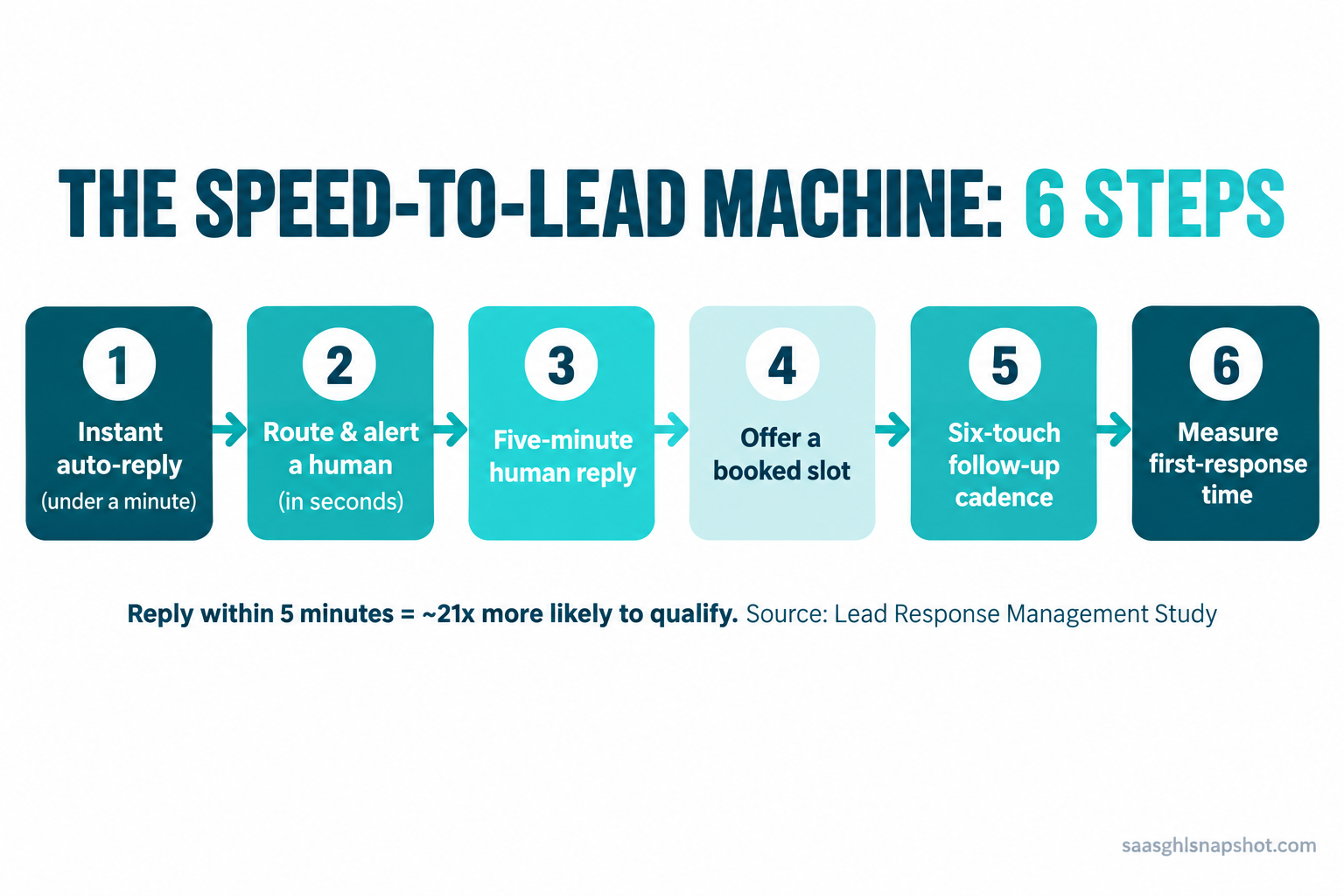
Table of contents
- The short answer
- What a slow reply actually costs
- The six-step system
- Step 1: Instant auto-reply
- Step 2: Route and alert
- Step 3: The five-minute human reply
- Step 4: Offer a booked slot now
- Step 5: The six-touch cadence
- Step 6: Measure first-response time
- Three scenarios
- Staying compliant
- Objections · FAQ · Sources
The short answer: speed is the cheapest edge you have
When two companies compete for the same inbound lead, the one that replies first usually wins, almost regardless of product. The buyer who filled out your form also filled out two others, and attention decays fast. A reply in five minutes catches them while the problem is still on their screen; a reply in four hours catches them after a competitor already has.
The research is old but has never been overturned. A Harvard Business Review audit of thousands of US companies found that firms contacting a lead within an hour were nearly 7 times more likely to have a meaningful conversation than firms that waited even an hour longer, and more than 60 times more likely than those who waited a full day (HBR, 2011). The earlier Lead Response Management Study put the gap at the five-minute mark: a lead called within five minutes was about 21 times more likely to qualify than one called at 30 (Oldroyd, Lead Response Management Study). Optimums vary by sector, but the direction never does: faster wins. You do not need to out-feature HubSpot or outspend a funded competitor, you need to answer first, and “answer first” is a system you build once.
What a slow reply actually costs you
Slow response burns money in three places founders never see on the P&L.
Wasted acquisition spend. Every lead cost you something to generate. With median CAC payback already stretched to around 16 months for B2B SaaS (Benchmarkit via Pavilion, 2026), letting a paid-for lead go cold is the most expensive kind of waste. You paid for the raised hand; the reply is the cheapest part, and the part you drop.
A lower demo-to-close rate before the demo happens. A lead you reach in five minutes shows up warm and still in the problem. One you reach in two days shows up skeptical, half-committed to a competitor, or ghosts. Slow response drags down every conversion number downstream.
Momentum you never recover. Most companies are genuinely slow: in that same HBR audit, only 37 percent responded within an hour and 23 percent never responded at all. The bar is on the floor, so replying fast is not a standard you must match, it is a gap almost nobody closes, which makes closing it cheap edge.
How fast companies actually respond to an inbound lead, share of audited firms. Source: Harvard Business Review, “The Short Life of Online Sales Leads,” 2011. Nearly half the market responds slowly or not at all, which is where your edge is.
The six-step system in one picture
Six steps, in order. Steps one, two, and four are automation you build once. Steps three, five, and six are the habits and copy that make it convert instead of just fire.
- Instant auto-reply so the lead hears back inside a minute, day or night.
- Route and alert so the right human knows in seconds.
- The five-minute human reply from a real person.
- Offer a booked slot in that first message.
- The six-touch cadence for the many who do not reply the first time.
- Measure first-response time and tighten the slow step.
This is not one thing (“reply faster”). It is six, and the auto-reply alone closes no one; it buys the minutes a human needs to do the work.
Step 1: Answer in sixty seconds with an auto-reply
The instant auto-reply is the highest-impact step, because it is the only one impossible to do by hand at 9:50am while shipping a hotfix. A machine sends it. Its job is not to close, it is to grab the lead’s attention back for the ninety seconds a human needs to get involved, and to set an expectation you will keep. Fire it on every inbound trigger: demo form, contact form, trial signup, pricing-page “talk to us.” Send it by email, and by SMS if you have consent to text.
How it breaks: the auto-reply that sounds automated. If it is generic, has no name, and offers no next step, the lead files it as a robot. Name a real person, offer one click to a booked call, and never say “a member of our team will be in touch,” which reads like a ticket number and kills urgency.
Step 2: Route the lead and alert a human
Now a real person has to know, fast. An email in a shared inbox nobody checks until lunch is not an alert; a push notification and an SMS to whoever owns new leads is. Solo founder: every lead pings your phone. Founder plus one closer: round-robin, or route by deal size so enterprise-shaped leads go to you. Either way, the alert carries the lead’s name, company, what they asked for, and a one-tap link to reply or call.
How it breaks: silent weekends and nights. A lead that arrives at 7pm Friday and gets a reply Monday at 10am waited 63 hours. Decide the rule up front: either the auto-reply and booked-slot link carry the weekend, or someone is genuinely on call.
Step 3: The five-minute human reply
The human reply is where the deal starts. The target: a real person responds within five minutes in working hours, with a fast, specific touch, not a polished proposal. If the lead left a phone number and you have consent, call first, because a live call in the first five minutes is the highest-converting move in the system. If you reach voicemail, send a short personal message and book the slot.
The “is now a bad time” opener gives the prospect an easy out, which makes them more likely to talk, and the message asks one specific question instead of “just following up,” the deadest phrase in sales.
How it breaks: the reply that is fast but empty. Speed with no substance (“Thanks for your interest, when works for a call?”) wastes the advantage you earned. The reply still has to speak to their actual request.
Step 4: Offer a booked slot in the first message
A fast reply that ends with “let me know when you are free” throws the work back to a busy prospect. Every early message should carry a one-click booking link to your calendar, with open slots in the next day or two. The goal of first contact is not to close, it is to turn a raised hand into a held slot before interest cools.
Make booking frictionless: show real availability, keep it to one or two clicks, and fire a confirmation plus reminders automatically, since a no-show is a slower version of the same leak. We wrote the full playbook in reduce SaaS demo no-shows.
How it breaks: too many slots, or none. “Any time next week” signals low demand; nothing for ten days signals you do not want the call. Show a handful of near-term slots; scarcity plus speed gets a hold on the books.
Step 5: The six-touch follow-up cadence
Here is the part most founders skip, and it holds the majority of the revenue. A single fast reply with no follow-up leaves most of the pipeline on the table. Six touches across about twelve days, mixing channels, is the sweet spot for a founder-led motion: present enough to matter, not so much you get blocked.
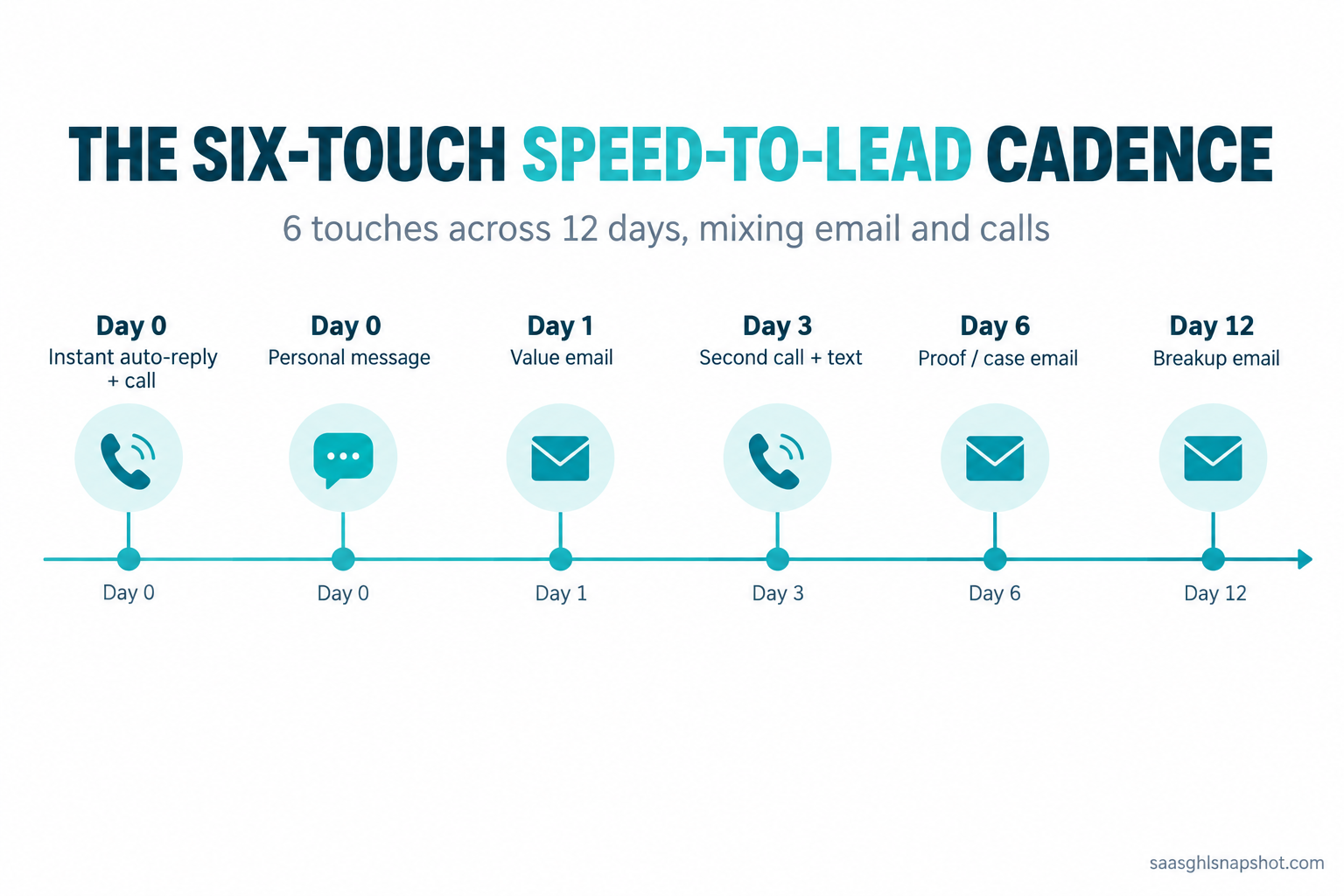
The breakup email is the quiet workhorse. It routinely pulls more replies than any touch except the first: loss aversion kicks in, and people who were ignoring you answer when you offer to leave. Keep it low-pressure; it only works if it is not a bluff.
How it breaks: the cadence that never stops, or is seven identical “just checking in” emails. Both get you blocked. Each touch needs a reason to exist. And when touch six says you will stop, stop, or you earn a spam complaint, with the deliverability cost covered below.
Step 6: Measure first-response time and tighten
The metric that governs this whole system is first-response time, the gap between the lead arriving and a human reaching them. Track it for every lead, review the median and worst cases weekly, and treat the target like an SLA: a human reply within five minutes in working hours, auto-reply plus booking link covering the rest. Where reality misses it, it is usually one thing: the alert goes to a channel you do not watch, or the “human reply” is really you three hours later. Fix that one input and the median drops. It is the same discipline that makes a founder-led sales pipeline trustworthy: measure the step.
Three scenarios by motion and size
The six steps are the same. What changes is who does the human parts.
Bootstrapped solo founder, under $1M ARR. You are the only human in the loop, so automation carries more weight. The auto-reply and booking link do the heavy lifting when you are heads-down. If you cannot hit five minutes while coding, set the auto-reply to promise a same-day follow-up: a kept two-hour promise beats a broken five-minute one. Your win is responding at all while most competitors do not.
Founder plus one closer, $1M to $3M ARR. Now you can hold a real five-minute SLA by splitting coverage. Round-robin new leads, or route by segment so you take the enterprise-shaped ones and your closer takes volume. Score first-response time by person, because the moment two people share a queue, one gets slow.
Product-led trial-first motion. If people start a trial before they talk to you, speed-to-lead becomes speed-to-signal. You watch for the product-qualified moment, a second seat invited or an integration connected, and reach out fast when it fires. If a trial signs up then goes silent, that is a different leak, covered in why free trials sign up and never activate.
Staying compliant when you automate outreach
The moment you automate messages, you are in compliance territory, and the rules have teeth in 2026.
US email outreach falls under CAN-SPAM, which requires a real physical address and a working, honored unsubscribe in every commercial message (FTC CAN-SPAM guide). Since February 2024, Google and Yahoo also require bulk senders to authenticate with SPF, DKIM, and DMARC, keep spam complaints under 0.30 percent, and offer one-click unsubscribe (Google bulk sender guidelines). A cadence that generates complaints degrades deliverability for every email, including the auto-reply.
If you text leads, you need A2P 10DLC registration, clear prior consent before the first message, and an easy STOP. If an EU trial signup lands in your funnel, GDPR applies the instant their data does. The short version: automate the speed, never the consent.
Objections
“Won’t an instant auto-reply feel robotic and cheapen the lead?” Only if you write it like a robot. A short note that names a real person and offers a specific next step reads as responsiveness. The alternative is not a warmer human reply, it is silence for four hours, which is far colder.
“I already pay for HubSpot. Doesn’t it do this?” Most CRMs can fire an auto-reply and a notification. The question is whether yours is wired to do it on every trigger, alert the channel you really watch, and run the full cadence without per-seat or per-lead fees stacking up. Many setups have the capability sitting dormant; the system matters more than the logo.
“My deals are high-touch and six figures. Five-minute speed feels spammy.” Speed is not pressure. A fast, thoughtful first reply signals you are organized and serious, exactly what a bigger buyer wants. You still run the consultative process after, you just start it first.
“I am a solo founder. I cannot reply in five minutes and build.” You are not supposed to do it by hand, that is the point of Steps 1, 2, and 4. The machine answers and offers a slot in seconds; you just show up to the booked call. If you cannot touch leads for hours, set the auto-reply to promise what you can keep.
Frequently asked questions
Speed-to-lead questions founders ask
What is a good lead response time for B2B SaaS?
A human reply within five minutes in working hours is the benchmark worth aiming for, because an older but never-overturned study found leads called within five minutes were far more likely to qualify than those called at 30. Outside working hours, an instant auto-reply with a booking link plus a same-day follow-up is realistic and still competitive.
Does speed-to-lead matter if I run a product-led trial motion?
Yes, but it shifts from speed-to-reply to speed-to-signal. Instead of answering every form, you watch for the product-qualified moment, like a second seat invited, and reach out fast when it fires. The same six-step system applies, triggered by behavior instead of a form.
How many follow-up touches should I send before giving up?
Around six across roughly twelve days, mixing email and calls or texts, is the sweet spot for a founder-led motion. Each touch needs its own reason to exist: a question, proof, or a genuine out. The sixth, a breakup, often pulls the most replies by triggering loss aversion.
Will automated follow-up get me flagged as spam?
It can if the cadence is relentless, generic, or sent to people who did not consent. Keep complaints under the 0.30 percent threshold Google and Yahoo enforce, authenticate with SPF, DKIM, and DMARC, honor unsubscribes, and stop when your breakup email says you will. Done right, it stays well inside the rules.
Do I need an expensive tool to respond to leads instantly?
No. You need something that fires an auto-reply on every inbound trigger, alerts the channel you actually watch, offers a booking link, and runs a multi-touch cadence. Many CRMs do this already. The common failure is not missing software, it is that the alert goes somewhere nobody looks.
The bottom line
Go back to that 9:50am demo request. You lose it when a form sits unseen for four hours while a faster competitor books the call. You win it for nothing extra: an auto-reply in sixty seconds, an alert to the phone in your pocket, a five-minute human touch, a booked slot before interest cools, and a cadence that catches the quiet ones. None of it needs more leads or a new hire, just that you stop letting leads you already paid for die between “they raised a hand” and “you reached back.” Build the machine once, measure first-response time weekly, and that gap closes for good.