
A paying customer almost never cancels out of nowhere. They go quiet first. The logins thin out, a power user stops showing up, five active seats drop to one, and six weeks later a cancellation email lands and you are surprised. You should not be. Silent churn is the gap between the day a customer mentally checks out and the day they tell your billing system, and for most early-stage SaaS that gap is where the recoverable revenue sits. Here is the early-warning system that catches a drifting account in time, with no data team and no CS hire: six stages, the copy to steal, and the ways each stage quietly breaks.
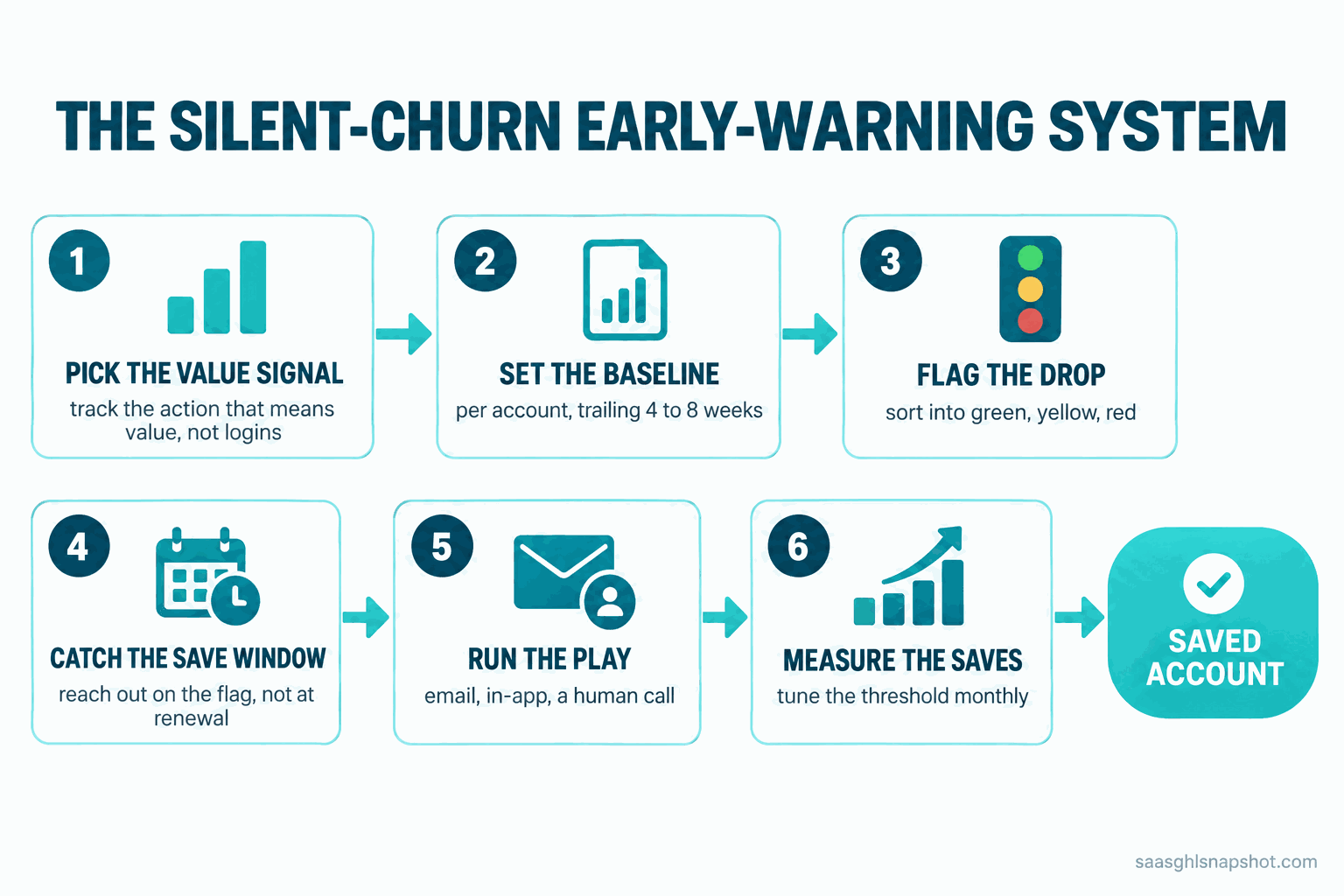
Table of contents
- The short answer: usage is the early warning
- What silent churn actually costs you
- The silent-churn early-warning system
- Stage 1: Pick the signal that predicts leaving
- Stage 2: Baseline each account, not globally
- Stage 3: Turn the drop into a risk flag
- Stage 4: Catch it in the save window
- Stage 5: Run the re-engagement play
- Stage 6: Measure the saves and tune the threshold
- The copy to steal
- Three scenarios: solo, five-person, fifteen-person
- Catching silent churn without breaking the law
- Objections
- FAQ
- Sources
The short answer: usage is the early warning
Your churn rate is a receipt. By the time it prints, the decision is weeks old. The useful signal is what happened before the cancellation, and for software that is almost always usage. A customer getting value logs in, runs the core action, adds a teammate. A customer leaving does the opposite, in slow motion, and the pattern is visible if you watch for it.
Most teams measure only the cancellation, not the fade before it. The fix is a cheap, repeatable system: name one usage signal, learn what normal looks like per account, flag the drop early, and nudge while the account can still be saved. One honest caveat: for some accounts the drop leads the decision, for others it lags. Either way you are buying a conversation before the renewal, which a usage drop earns more reliably than anything else you can measure cheaply.
What silent churn actually costs you
Churn is the most expensive line on your dashboard because replacing a lost account dwarfs the cost of keeping it. Acquiring a new customer runs five to twenty-five times more than retaining one, per Harvard Business Review, which also cites Frederick Reichheld’s Bain research that lifting retention five percent raises profits twenty-five to ninety-five percent. And the leak compounds: median monthly churn for B2B SaaS stabilizes at three to four percent after product-market fit, top-quartile at one to two percent, per ChartMogul’s SaaS Benchmarks Report, 2023 edition; companies under roughly $300K ARR often run closer to six percent.
Customers still subscribed after 12 months at each monthly churn rate. Math: retention = (1 − monthly churn) ^ 12. Churn bands per ChartMogul SaaS Benchmarks, 2023.
Growth depends on which side of that gap you land: SaaS Capital’s 2026 benchmarks put median private B2B SaaS growth at just 22 percent (20 percent bootstrapped), and Benchmarkit’s 2025 report shows median net revenue retention at 101 percent. When new logos are hard to win, the churn you prevent is worth more than the churn you replace.
The real enemy is silence. Only about one in twenty-six unhappy customers complains, roughly 96 percent say nothing and simply leave, per former Gartner analyst Esteban Kolsky. It is a general CX statistic, not SaaS-specific, but it matches what every founder sees. The quiet fade, not the angry email, is the norm.
The silent-churn early-warning system
Each stage feeds the next, so build in order.
| # | Stage | What it answers | Where it lives |
|---|---|---|---|
| 1 | Pick the value signal | What usage means “getting value” | Product events |
| 2 | Set the baseline | What normal looks like per account | Spreadsheet or CRM |
| 3 | Flag the drop | Which accounts have gone quiet | A simple rule |
| 4 | Catch the save window | How early you get the alert | Trigger timing |
| 5 | Run the play | What you say, on which channel | Email, in-app, SMS, a call |
| 6 | Measure the saves | Whether the intervention worked | A monthly review |
Stage 1: Pick the signal that predicts leaving
Do not track everything. Track the one action that means a customer is getting value, your “aha” event. For a scheduling tool it is meetings booked, for analytics it is dashboards viewed by more than one person, for billing it is invoices sent. Pick the event that, when it stops, makes the product pointless to keep paying for.
Avoid vanity signals. Raw logins are the trap, because a login is a door, not value, which is why the platforms that score customer health, like Gainsight, build on value events and feature adoption, not sessions. Start with three events: the core value event, a team-expansion event (a second active seat), and a breadth event (more than one feature used).
How it breaks: teams track logins because they are easy to pull, then wonder why the score predicts nothing. Logins measure presence, not value.
Stage 2: Baseline each account, not globally
A global threshold (“under 10 actions a week is risky”) punishes small accounts and lets big ones coast. The account that always ran 80 a week and is now at 30 is in free fall, even though 30 clears any global bar. Risk is relative to each account’s own normal.
So baseline per account: take a trailing average of the value event over four to eight weeks, and define the drop as a percentage off that baseline. A sustained fall of fifty percent or more, held two weeks so one quiet week does not trip it, is a reliable starting line. Two patterns get their own flags: a seat reduction (five active users to one) is louder than a volume dip, and a hard stop (the value event at zero for a week) jumps straight to high risk.
How it breaks: you set one global number, enterprise accounts never trip it, and the biggest churns sail through undetected.
Stage 3: Turn the drop into a risk flag
No machine learning required. You need a rule that sorts accounts into three buckets and a place to see them. Green is at or near baseline. Yellow is a sustained drop or a single missed week. Red is a hard stop, a big seat reduction, or a drop that has not recovered after a yellow nudge.
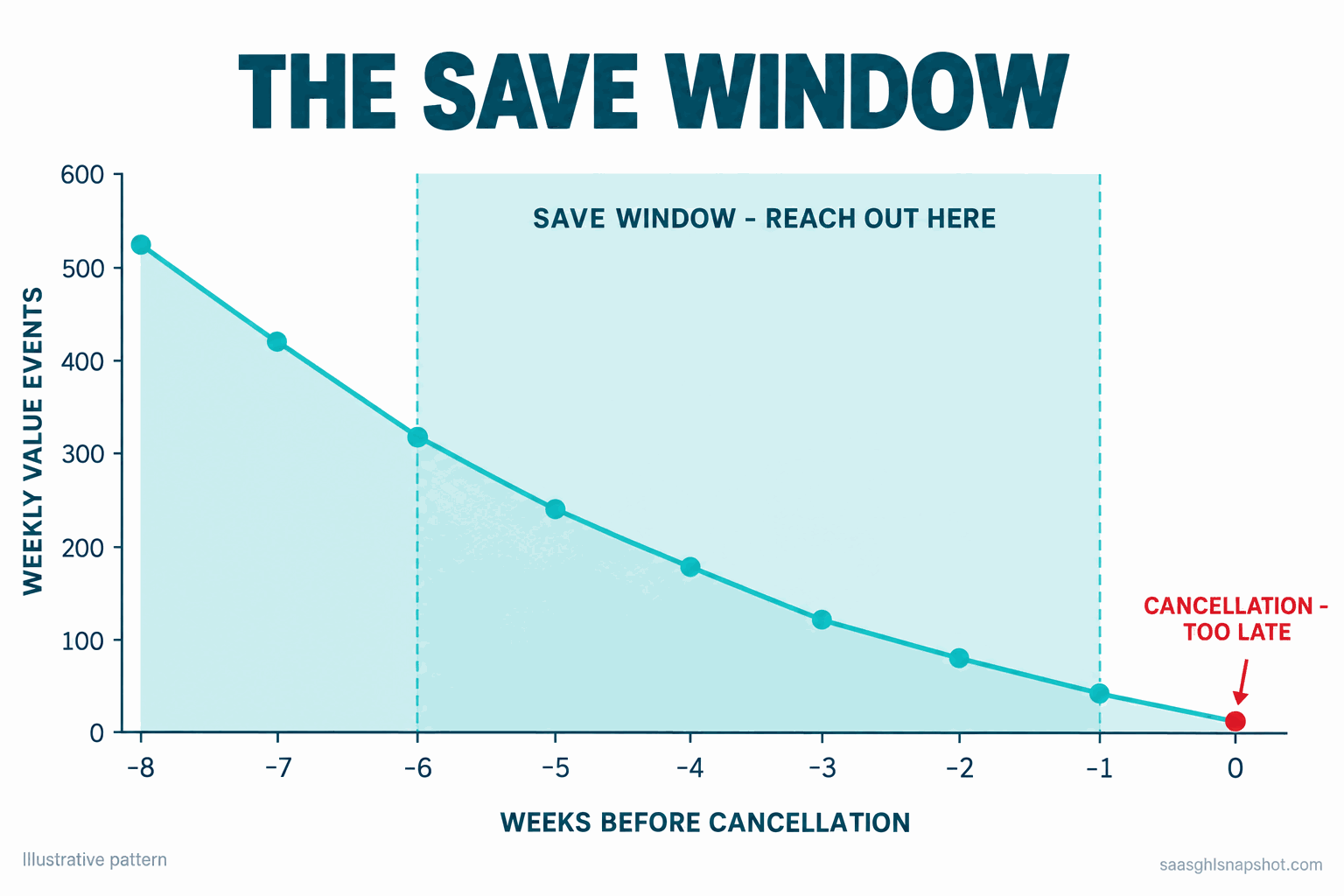
A solo founder exports the value event weekly into a spreadsheet, one row per account, with a formula comparing this week to the trailing average. A small team pipes product events into the CRM and lets a workflow set the flag. Either way, someone reads the red and yellow list every week, in under ten minutes. Keep the schema tiny: account, plan, MRR, baseline, current, percent change, flag, last touch. The shape to watch is a slow slide over six to eight weeks, not a cliff.
How it breaks: the flag exists but nobody owns the list, so it fills with red accounts nobody called. A flag with no owner is worse than no flag.
Stage 4: Catch it in the save window
The save window is the stretch between the first real usage drop and the renewal. Most teams act only at renewal, when the customer has already decided and a reminder reads as a bill. Watching usage moves outreach weeks earlier, while the decision is still open.
So trigger on the flag, not the calendar. The moment an account turns yellow the clock starts, and a first-touch nudge goes out within days. For annual contracts the window can be months; a drop in month three of a twelve-month term gives you nine months to re-earn the renewal. Tie urgency to money: a red flag on a high-MRR account is a same-day human call, a yellow flag on a small self-serve account is an automated email.
How it breaks: the alert lands in the same inbox as everything else and gets triaged to “later,” which for a drifting account means “after they cancel.” Give red flags a channel that interrupts, a Slack alert or a dated task.
A flag is worthless without a play: a short, escalating sequence that matches channel to risk and plan size. Keep it human, because a drifting customer can smell a mass email, and what moves them is knowing a real person noticed.
Self-serve accounts get an automated but personal email, then an in-app message if they log in. Mid and high-MRR accounts skip to a human: a short email from a named person, a text if you have consent, then an ask for fifteen minutes. Every touch has one goal, not to pitch but to find out what changed: did a champion leave, did a workflow break, did they solve it elsewhere. Lead with value, not the renewal, and save the offer (a pause, a downgrade, a short discount) for when the conversation reveals a reason an offer actually fixes.
How it breaks: the sequence is about you (“we miss you, here is 20 percent off”) instead of them, so it converts nobody and trains customers to wait for the discount. Diagnose first, offer last.
Stage 6: Measure the saves and tune the threshold
You cannot improve a system you do not score. Each month, ask two questions. Of the flagged accounts you reached, how many are back at baseline or renewed? Of the accounts that churned, how many did your flag catch versus miss? Those numbers tell you whether the threshold is right.
Catching everything but drowning in false alarms means tighten it. Accounts churning without ever tripping a flag means loosen it, or revisit Stage 1. Then route by cause: silent churn from accounts that never really activated is an onboarding and time to value problem; churn from failed cards is involuntary churn for a dunning sequence, not a win-back.
How it breaks: nobody reviews the saves, the threshold never gets tuned, and the team stops trusting the flags. A monthly review keeps it honest.
The copy to steal
Steal this outreach, built to diagnose, not pitch. Swap the nouns and ship it.
Three scenarios: solo, five-person, fifteen-person
The system is the same shape at every size. What changes is how much a human does by hand.
Solo founder, pre-$1M ARR. You are the health score. Export your value event into a spreadsheet weekly, color the accounts that dropped against their own baseline, and personally email or call the top three by MRR. Twenty minutes a week, and those calls double as the best product research you will get.
Five-person team, $1-3M ARR. Automate the boring parts. Product events flow into the CRM, a workflow sets the flag, yellow flags trigger the automated email, and red flags create a task with a due date. One person reviews the list every Monday. This is where a done-for-you GoHighLevel build earns its keep, since wiring usage to the customer record by hand costs a developer week you do not have. Pair it with a proper health score setup once the flag is reliable.
Fifteen-person team. The pipeline runs itself and you are into segmentation. Bootstrapped and venture-backed accounts behave differently, so route them differently and start instrumenting why they leave, not just that they went quiet. The risk flips: so much signal that people stop reading it, so keep the weekly list short and owned.
Catching silent churn without breaking the law
Watching usage and sending re-engagement messages puts you inside a few rules, so build them in from the start.
If any customers are in the EU or UK, GDPR applies the moment their data lands, so usage tracking needs a lawful basis and a line in your privacy policy, and CCPA and CPRA give California users rights to know and delete the usage data you store. Noticing that a paying account stopped using what it pays for is fine, you just disclose it.
Re-engagement emails are commercial messages, so CAN-SPAM applies: accurate subject lines, a physical address, and a working unsubscribe you honor fast. At volume, the Google and Yahoo bulk sender rules from February 1, 2024 require SPF, DKIM, and DMARC, a spam rate under 0.30 percent, and one-click unsubscribe for anyone sending 5,000-plus messages a day. If the play uses SMS, US carriers require A2P 10DLC registration and prior consent with a clear opt-out (“Reply STOP” is not optional).
Objections
“We are too small to build a health system.” It is a spreadsheet and twenty minutes a week, not a CS platform. Three saved accounts a quarter can be the difference between growth and flat, and the calls teach you more than any survey.
“Our product is not used daily, so usage signals do not apply.” They apply more. For a low-frequency product, define the signal around the natural cadence (the monthly report, the quarterly review) and watch for the cycle that gets skipped.
“Won’t customers find it creepy that we watch usage?” You are noticing that an account you bill stopped using what they pay for, and reaching out to help. That is duty of care, not surveillance, as long as you track value events on accounts you already bill and disclose it. Customers react well to “I noticed you’ve been quiet, is everything okay,” because almost no vendor ever does it.
“We already have a churn number in Stripe or ChartMogul.” That is the receipt, not the warning. A churn rate tells you how many left last month, never which accounts are about to. This system runs in front of that number, on the accounts still paying you. The quiet account you call this week is the renewal you keep next quarter, and the surprise cancellation stops being a surprise.
Frequently asked questions
What is silent churn?
Silent churn is when a paying customer disengages (logging in less, using the core feature less, dropping active seats) and then cancels weeks later without ever complaining. The cancellation is the lagging event; the usage decline is the early warning. Most churn is silent, because only about 1 in 26 unhappy customers actually complains.
How do you predict SaaS churn before it happens?
Watch the usage that signals value, not vanity logins. Pick your core value event, set a baseline per account over a trailing 4 to 8 weeks, and flag any account whose usage drops roughly 50 percent or more from its own baseline for two straight weeks, plus any seat reduction or hard stop. Those flags buy you a save window before the renewal.
What usage signals best predict churn?
The frequency of your product's core value event, a team-expansion event like a second active seat, and feature breadth. A sustained drop, a seat reduction, or the value event going to zero are the strongest cheap signals. Raw login count is weak, because a login is presence, not value.
Is declining usage always a sign a customer will churn?
No. For some accounts the drop is a leading signal; for others the decision came first and the quiet is a symptom, and some dips are just a busy month. The point is not to predict perfectly but to earn a conversation before the renewal, which a usage drop does more reliably than any other cheap signal.
Do I need a data warehouse to catch silent churn?
No. A solo founder can run it with a weekly export of one value event into a spreadsheet and a formula comparing this week to the trailing average. A small team can automate the flag and first-touch outreach inside one platform like GoHighLevel. You only need a warehouse when segmenting across thousands of accounts.
When should I reach out to a drifting account?
The moment it turns yellow, not at renewal. Renewal is the worst time, because the decision is already made and a reminder reads like a bill. Trigger outreach on the flag within a few days, size the response to the MRR, and lead with diagnosis, not a discount.
Related reading
- Churn prediction with health scores: the SaaS founder’s setup guide
- How to instrument SaaS churn so you know why customers leave
- SaaS cancellation flow: how to save churn at the moment of cancel
- SaaS win-back campaigns: how to reactivate churned customers
- Failed-payment dunning: recover the revenue you are already owed
Sources
- Harvard Business Review, the value of keeping the right customers (Gallo, 2014)
- ChartMogul, SaaS Benchmarks Report (2023 edition)
- SaaS Capital, 2026 Private B2B SaaS Company Growth Rate Benchmarks
- Benchmarkit, 2025 B2B SaaS Performance Metrics Benchmarks
- Gainsight, customer success and customer health
- FTC, CAN-SPAM Act compliance guide for business
- Google, email sender guidelines (bulk sender rules)
- GDPR.eu, what is GDPR
- California Attorney General, California Consumer Privacy Act (CCPA)