

Intercom’s Fin AI agent bills $0.99 for every conversation it resolves. That number is real, and it is the most misleading price in support software, because it is the one cost on your P&L that goes up every time you win a customer. Add $0.99 per resolution to $29 to $132 per human seat, then watch what happens as your volume climbs from a founder handling 500 conversations a month to a desk handling 10,000. The unit price never changes; the bill triples, then triples again. This teardown walks the real 2026 Fin math, how a “resolution” gets counted, the exact monthly cost at three volumes, how each cheaper option compares, and the five ways the bill quietly breaks your budget.
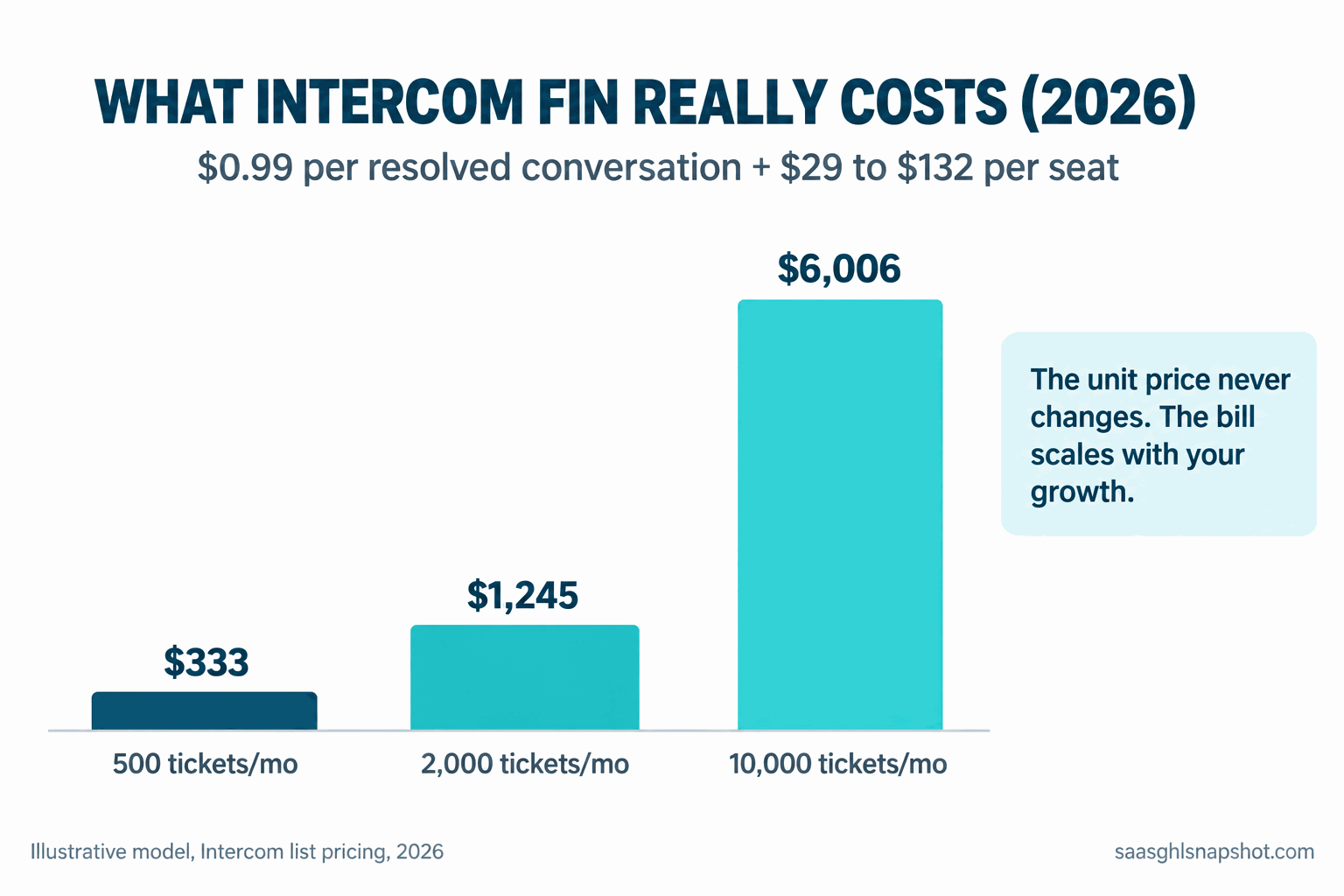
Table of contents
- The short answer
- How Fin billing actually works
- The real monthly cost at 500, 2,000 and 10,000 tickets
- Fin vs the other AI support options
- The five ways the Fin bill breaks
- Steal this: the Fin cost worksheet
- The flat-rate alternative
- Objections
- One compliance trap
- FAQ
- Sources
The short answer: $0.99 is not the price
You read “$0.99 per resolution” and did the math: a thousand tickets, a thousand dollars, cheaper than a support hire. That math is right, and it is a trap. Fin is a variable cost bolted on top of a per-seat cost, and both move in the wrong direction as you grow.
Here is the honest framing. A resolution is a billable event, not free work Fin does for you. So the better Fin performs, the more events you generate, and the bigger the invoice. Most founders do not notice until the second or third month, when the “cheap” line item has quietly become one of the top three costs in the stack.
For a bootstrapped team this is not academic. Median growth for private B2B SaaS ran about 22% in 2026, down from 25% in 2024, with only 7.3% of companies reporting flat or negative growth (SaaS Capital, 2026 Private B2B SaaS Growth Rate Benchmarks). If you are growing, your ticket volume is growing too, and a per-resolution cost turns that growth into a bill. So the real question is not “what does Fin cost per ticket,” it is “what does Fin cost my business at the volume I will actually hit next year.”
How Fin billing actually works in 2026
Three things stack, and quotes rarely show all three.
1. Human seats. Intercom charges per seat, billed annually: Essential $29, Advanced $85, Expert $132 per seat a month (Intercom pricing). Monthly billing runs higher. These are the people who handle everything Fin does not.
2. Fin outcomes at $0.99. Intercom bills $0.99 per billable “outcome,” and an outcome is a resolution, a procedure handoff, or a disqualification (Intercom, Fin AI Agent outcomes). Point Fin at lead qualification instead of support and that outcome jumps to $9.99, ten times higher, so where you aim Fin matters enormously.
3. The resolution definition. Fin counts a “confirmed resolution” when the customer affirms the answer helped, and an “assumed resolution” when the customer disengages and does not reply for roughly 24 hours. You are billed once per conversation, however many messages it took. That assumed rule matters: a customer who gives up and closes the tab still generates a $0.99 charge.
One more line shows up on bigger accounts: Copilot, the agent-assist tool that drafts answers for your reps, is a separate per-seat add-on with no clean published price. Treat it as an unknown extra and get the number in writing before you count on it.
The real monthly cost at 500, 2,000 and 10,000 tickets
Here is the model. Assume Fin resolves half of inbound conversations, roughly its own headline claim (Intercom markets “up to 50%,” and real-world case studies land near 42 to 50%, so treat 50% as optimistic). Seats scale with volume. Everything below is an illustrative model from list prices, not a quote.
| Scenario | Conversations/mo | Seats | Fin resolutions (50%) | Modeled monthly cost |
|---|---|---|---|---|
| Solo founder | 500 | 1 Advanced ($85) | 250 × $0.99 = $248 | $333 |
| Growth ($1–3M ARR) | 2,000 | 3 Advanced ($255) | 1,000 × $0.99 = $990 | $1,245 |
| Scaling ($3–10M ARR) | 10,000 | 8 Expert ($1,056) | 5,000 × $0.99 = $4,950 | $6,006 |
Modeled total monthly cost (seats plus Fin at 50% resolution). Illustrative model from Intercom list pricing, September 2026.
The scaling desk pays about $72,000 a year, and more than two-thirds of that is Fin, not people. Now flip the assumption that feels like good news. Say Fin resolves 60% instead of 50%: at 2,000 conversations that is 1,200 resolutions, so $1,188 in Fin plus $255 in seats, about $17,300 a year. You improved deflection by ten points and your bill went up $200 a month. That is the success tax, baked into every per-resolution model, not just Intercom’s.
Fin vs the other AI support options
Per-resolution AI is now the default pricing shape across support software, but the rate and the fine print vary a lot. Here is the real per-resolution price on each, for the same job.
| Tool | AI resolution price | Human seats (annual) | Notes |
|---|---|---|---|
| HubSpot Breeze | ~$0.50/resolution | Free tier; $15–150/seat | Outcome-based since April 2026; bundled credits per tier (HubSpot) |
| Help Scout | $0.75/resolution | $25–75/user | Simple, flat, AI Answers priced separately (Help Scout) |
| Gorgias Automate | $0.90/resolution (annual) | Varies | Strong for ecommerce, $1.00 on monthly (Gorgias) |
| Intercom Fin | $0.99/outcome | $29–132/seat | Most polished; lead-qual outcomes cost $9.99 (Intercom) |
| Zendesk AI | ~$1.50–2.00/resolution | $55–115/agent | Outcome-based, no published flat rate (Zendesk) |
| Chatwoot | Self-hosted, no per-unit fee | Free CE, or $19/agent | Open source, you run the AI cost yourself (Chatwoot) |
Published AI price per automated resolution, US dollars. Sources: vendor pricing pages, September 2026.
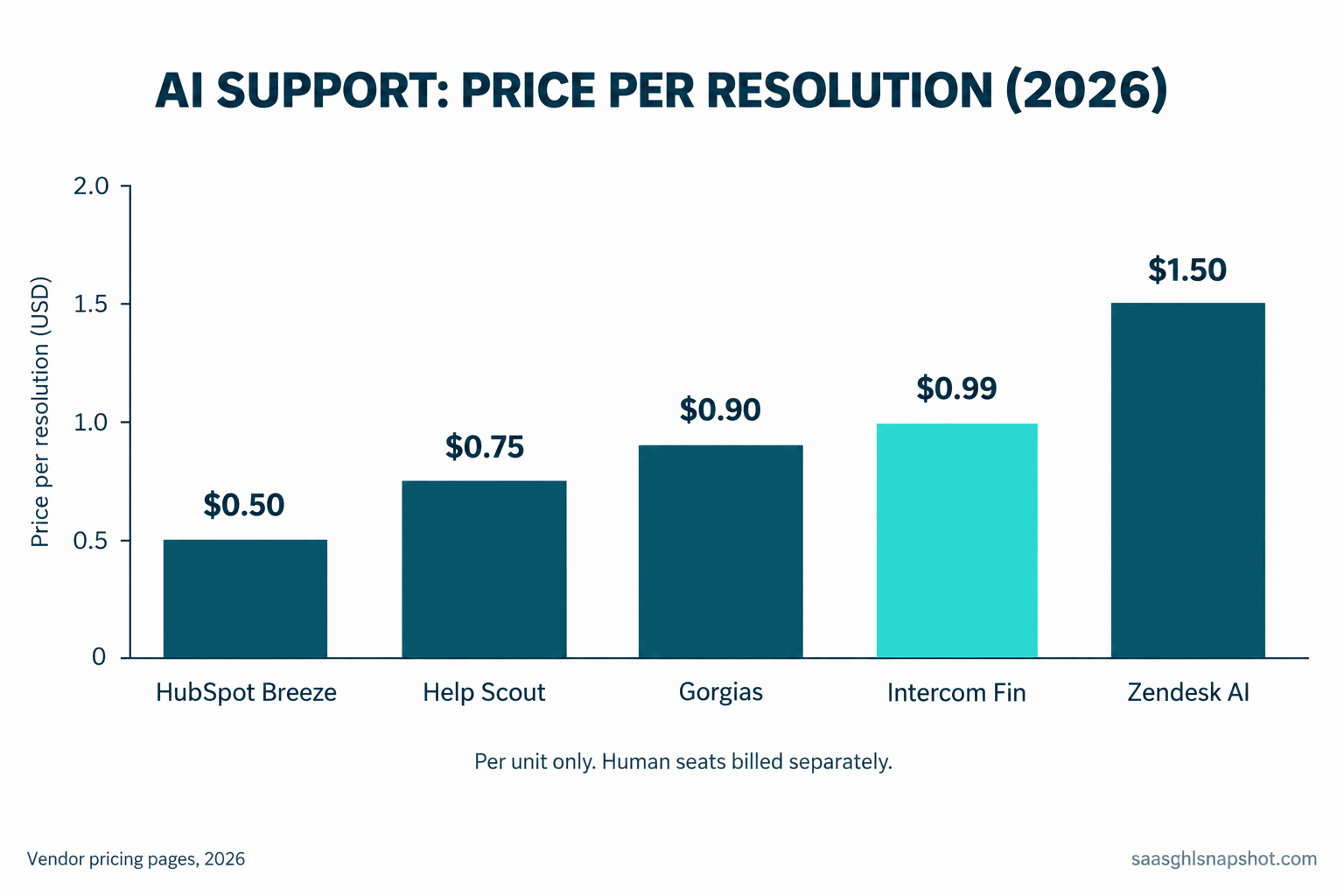
Who each one is actually right for. Help Scout is the pick for the cheapest published rate with the least billing drama. HubSpot Breeze wins if you already live in HubSpot and can burn the bundled credits. Fin is the most capable agent of the group, so you pay a small premium for quality, which is fine once you have modeled the volume. Zendesk AI is the most expensive per resolution and only makes sense if you are already deep in Zendesk. Chatwoot is the escape hatch for a technical team that would rather self-host than rent a meter. And a flat-rate platform, below, stops charging you more as you grow.
One caveat the table cannot show: every rate assumes the AI actually resolves the ticket, and none include the human seats that handle the half the bot cannot solve. So compare all-in, seats plus resolutions at your real volume, not the headline unit price. The cheapest unit price with the worst deflection can lose to a pricier one that clears more tickets.
The five ways the Fin bill breaks
This is the part no vendor page writes, and it is where the money leaks. For each, the trigger and the fix.
1. The assumed-resolution charge. Fin bills you when a customer disengages for 24 hours, even if they left frustrated and unresolved. At volume, a meaningful share of your “resolutions” are abandonments you paid for. The fix: watch your confirmed-versus-assumed ratio monthly. If assumed resolutions climb, your content or bot flow is failing, and you are being billed for the failure.
2. The success tax. Better deflection means more billable outcomes means a bigger invoice. The fix: budget Fin as a percentage of ticket volume, not a fixed line, and re-forecast every time your signups jump. Tie it to your growth rate, not last month’s bill.
3. No spend cap by default. Per-resolution billing is uncapped. A traffic spike, a launch, or a misconfigured bot answering the same loop can balloon the outcome count in a week. The fix: set an internal monthly outcome ceiling and confirm with Intercom whether a hard cap or usage alert exists on your plan before you turn Fin loose.
4. Double-paying on the hard half. Fin resolves the easy tickets; the complex ones still route to humans you pay per seat for, and the two costs do not offset. The fix: measure cost per total conversation (seats plus Fin divided by all conversations), not cost per resolution.
5. Pointing Fin at sales. The moment you use Fin for lead qualification, each outcome jumps from $0.99 to $9.99 (Intercom outcomes). A team that quietly repurposes the support bot to qualify trial signups can see a 10x per-outcome cost without touching a setting they think of as “billing.” The fix: keep support Fin and sales Fin as separate, budgeted decisions.
Affiliate disclosure: the link above is a GoHighLevel affiliate link. We may earn a commission at no extra cost to you. See our affiliate disclosure.
Steal this: the Fin cost worksheet
Fill this in before you sign anything. Ten minutes, and it is the difference between a budgeted cost and a surprise.
The monthly cost formula.
Monthly Fin cost = (monthly conversations × resolution rate × $0.99)
                 + (support seats × seat price)

Blended cost per conversation = total monthly cost ÷ total conversations
Run it at your current volume, then again at the volume you expect in twelve months. The second number decides whether per-resolution pricing works.
The six questions to ask Intercom sales, in writing:
- What is my committed-usage rate per outcome at X resolutions a month?
- Is there a hard spend cap or usage alert, and at what threshold?
- Can I see my confirmed-versus-assumed split in reporting?
- What exactly triggers a procedure-handoff or disqualification charge?
- What does Copilot cost per seat, and is it required for anything I need?
- If I outgrow this, what does migrating my conversation history off Intercom look like?
The internal spending policy line to adopt:
“Fin outcomes are forecast monthly as (projected conversations × 50% × $0.99). Any month projected to exceed $[cap] requires sign-off before we raise volume or repoint Fin at new use cases.”
That one sentence, pinned in your ops doc, keeps a per-resolution tool from becoming a per-resolution surprise. The tool-sprawl migration playbook and the CAC payback breakdown apply the same discipline to the rest of your stack.
The flat-rate alternative to per-resolution billing
Per-resolution pricing feels unfair because it is: you pay more for the same software the more successful you get. The structural fix is a platform that charges a flat rate no matter how many conversations, resolutions, or seats you run.
Support quality is a revenue lever, not a cost center: median NRR sits at 101% and median GRR at 88% (Benchmarkit, 2025 B2B SaaS Benchmarks), and fast answers are how you hold those numbers. But you do not have to buy that quality on a meter. A GoHighLevel build handles the repetitive lifecycle and support-adjacent messaging, the trial nudges, the failed-payment follow-ups, the FAQ auto-replies, at a flat platform cost. It will not deflect complex tickets the way Fin does, so be honest about the mix, but it stops your everyday automation from carrying a per-unit price tag. The GHL AI employee for SaaS walkthrough and our AI customer support agent build show it in practice.
Objections
“But I only pay when Fin actually works. Isn’t that the fairest pricing?” It is fair per unit and brutal at scale. Pricing that scales linearly with your growth still eats your margin exactly as you are trying to build it. The fairness of the unit price is not the affordability of the bill. Model the bill, not the unit.
“We already pay for Intercom seats, so Fin is just a little extra.” Look at the growth scenario: $255 in seats, $990 in Fin. The “little extra” is four times your seat cost, and two-thirds of a $72,000-a-year line on the scaling desk. It stopped being an add-on the moment your volume crossed a few hundred a month.
“Per resolution is still cheaper than hiring a support rep.” Sometimes, and it depends on volume. A rep is a fixed cost; Fin is variable. Below a few hundred tickets a month, Fin usually wins. Above a few thousand, the variable cost can pass the cost of a hire while you still need the hire for the hard tickets. That crossover is the whole decision, and the worksheet above is how you find yours.
“Do I need to be technical to figure this out?” No. The whole model is one multiplication: conversations times resolution rate times $0.99, plus seats. If you can run that in a spreadsheet, you can budget Fin. The mistake is never doing the math before switching it on. It matters because customers who quietly stop getting good answers are the ones who quietly stop paying, the same pattern in churn prediction and health scores.
One compliance trap: when support turns into lifecycle email
Most teams that rethink support also rethink the lifecycle messaging around it: the onboarding nudges, the win-back notes, the failed-payment reminders. The moment you send those at volume from a new domain, deliverability rules apply. Since 1 February 2024, Google and Yahoo require any sender pushing 5,000 or more messages a day to authenticate with SPF, DKIM, and DMARC, keep the spam rate under 0.30%, and support one-click unsubscribe via the List-Unsubscribe-Post header (Google email sender guidelines).
CAN-SPAM governs every lifecycle email regardless of volume, so honor unsubscribes fast and keep a real physical address in the footer. GDPR applies the instant an EU trial signup lands, and CCPA and CPRA cover California contacts. Add SMS and US carriers require A2P 10DLC registration first. SOC 2 is not a law, but for a B2B SaaS selling upmarket it is a sales blocker. All of it wants doing before you send, not after a domain gets flagged. The full setup is in the CAN-SPAM and TCPA guide for SaaS lifecycle messaging.
Frequently asked questions
How much does Intercom Fin actually cost in 2026?
Fin bills $0.99 per resolved conversation, on top of Intercom seats at $29 to $132 per seat per month (annual). There is a 50-outcome monthly minimum and no free tier, and lead qualification costs $9.99 per outcome instead of $0.99. A modeled growth-stage desk at 2,000 conversations a month, with three seats and 50% resolution, runs about $1,245 a month, roughly $14,940 a year.
What counts as a resolution for Fin billing?
Two things. A 'confirmed resolution' is when the customer affirms the answer helped. An 'assumed resolution' is when the customer disengages and does not reply for about 24 hours after Fin's last message. You are billed $0.99 once per conversation either way, no matter how many messages it took, which means you can be charged for a customer who gave up unresolved. Watch your confirmed-versus-assumed ratio to catch this.
Is Fin cheaper than a support rep?
Below a few hundred tickets a month, usually yes, because a rep is a fixed cost and Fin is variable. Above a few thousand a month, the variable Fin cost can pass the cost of a hire, and you often still need the rep for complex tickets Fin cannot resolve. The crossover depends entirely on your volume and resolution rate, so run the numbers for your own desk before deciding.
What are the cheapest AI support alternatives to Intercom Fin?
On published per-resolution price: HubSpot Breeze is about $0.50, Help Scout AI Answers $0.75, and Gorgias Automate $0.90 on annual billing, all cheaper per unit than Fin's $0.99. Zendesk AI is pricier at roughly $1.50 to $2.00 committed. Chatwoot is open source and self-hosted with no per-resolution fee, and a flat-rate platform like GoHighLevel charges one price regardless of volume. Compare all-in, seats plus resolutions at your real volume.
Can I use Fin without paying for full Intercom seats?
Yes. Standalone Fin runs on non-Intercom helpdesks like Zendesk, Salesforce, HubSpot, Freshworks and Zoho at the same $0.99 per outcome with no Intercom seat cost. That can be cheaper than migrating your whole team onto Intercom just to use the agent, especially if your reps already live in another tool.
How do I stop the Fin bill from spiking?
Per-resolution billing is uncapped by default, so a launch, a traffic spike, or a looping bot can balloon the outcome count in a week. Set an internal monthly outcome ceiling, ask Intercom whether a hard cap or usage alert exists on your plan, keep support Fin and the pricier $9.99 sales Fin as separate budgeted decisions, and re-forecast every time your signups jump.
Sources
- Intercom pricing and Fin AI Agent outcomes
- HubSpot Service Hub and Breeze pricing
- Zendesk pricing and Zendesk CX Trends 2026
- Help Scout pricing, Gorgias pricing, Chatwoot self-hosted pricing
- SaaS Capital 2026 Private B2B SaaS Growth Rate Benchmarks
- Benchmarkit 2025 B2B SaaS Performance Benchmarks
- ChartMogul SaaS Benchmarks Report (2023 benchmark data)
- Google email sender guidelines (bulk-sender rules)
About the author
Devon Asante is a GHL Automation Architect based in Denver, CO. A former agency operator who resold GoHighLevel to software clients, he now designs systems that drop in clean and fire on day one, and is happiest documenting a workflow, or a pricing model, so clearly a non-technical founder can act on it before lunch.
Want your support and lifecycle stack costed and consolidated for you? Get the SaaS Snapshot or book a walkthrough. Related: what HubSpot Sales Hub really costs, the 2026 SaaS benchmarks, and lifecycle marketing for SaaS.