
If you run a SaaS company or a GoHighLevel agency serving software clients in Dallas, tool sprawl is quietly draining your P&L: the average company now runs 371 SaaS apps, wastes an estimated $18M a year on licenses nobody opens, and loses roughly 9% of every workday to employees toggling between disconnected tools. Your marketing lives in HubSpot, lifecycle messaging in Customer.io, support in Intercom, billing in Stripe, and the glue is a founder’s spreadsheet and three broken Zapier zaps. Migrating that fragmented stack onto one GoHighLevel platform doesn’t just tidy the toolbox — it recovers wasted spend, kills the toggling tax, and stops the leads and revenue that leak in the gaps between systems.
This is the operator’s-eye view of what tool sprawl actually costs a Dallas software company, using real, sourced numbers — and what changes when the stack becomes one system instead of twelve.
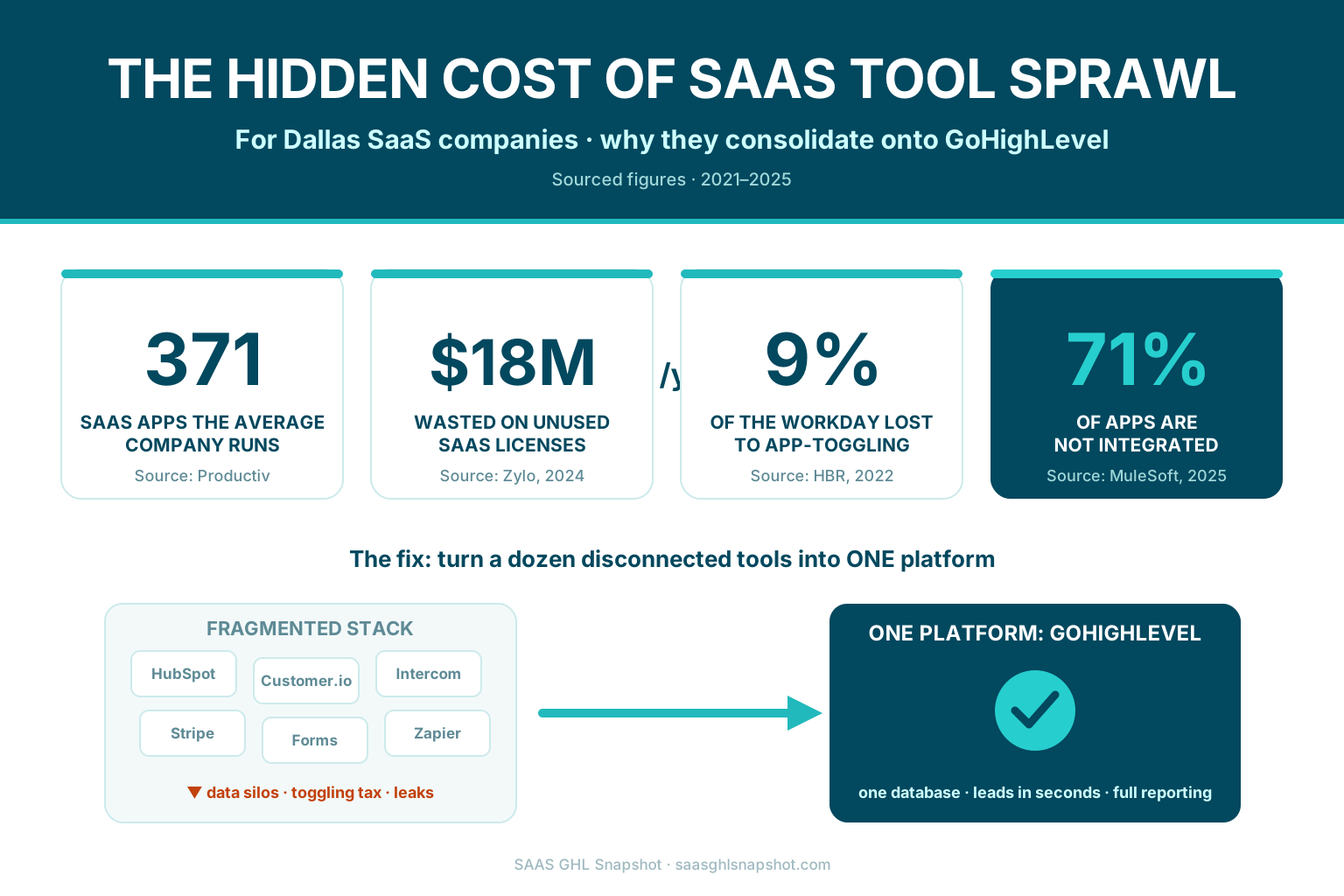
Table of contents
- The short answer
- What SaaS tool sprawl actually costs
- The revenue leaking between your disconnected tools
- Why tool sprawl hits Dallas SaaS companies harder
- The fix: consolidate the stack onto GoHighLevel
- Fragmented stack vs one platform: the head-to-head
- How a GoHighLevel migration actually works
- Frequently asked questions
- Sources
- About the author
The short answer
For most Dallas SaaS founders and the agencies serving them, a sprawling stack of point tools is a false economy. Each app looked cheap and necessary the day you bought it. Added up, they cost you three ways at once: direct waste on licenses and overlapping subscriptions you barely use, an operational tax as your team burns hours switching between systems that don’t share data, and leaked revenue where leads, trials, and renewals fall through the cracks between tools that were never designed to talk to each other.
The average company runs 371 SaaS applications (Productiv, State of SaaS) and wastes an average of $18 million a year on unused licenses, using only about half of what it provisions (Zylo, 2024 SaaS Management Index). Consolidating the marketing, CRM, messaging, booking, and lifecycle layer onto a single platform — GoHighLevel — is the move that turns twelve line items into one, ends the toggling, and reconnects the data. That’s why a growing number of Dallas software companies are running a full migration onto GoHighLevel instead of renewing another year of tool sprawl.
What SaaS tool sprawl actually costs
You’re paying for software nobody opens
Start with the invoice you can see. Zylo’s 2024 index — built on 30 million SaaS licenses and $34B in spend under management — found the average organization wastes $18M a year on unused licenses, and that companies actively use only about 49% of the licenses they pay for (Zylo, 2024). Half your seats are dead weight.
Sprawl compounds the waste through duplication. When every team buys its own tool, you end up paying for the same capability three times: a marketing team on Customer.io, a product team on a separate in-app messaging tool, and a support team on Intercom — three subscriptions, three data models, one job. For a Dallas SaaS company running lean, that overlap is pure margin erosion that never shows up as a single scary number, because it’s spread across a dozen small invoices.
The toggling tax: 9% of the workday, gone
The bigger cost doesn’t appear on any invoice — it’s the time your team loses moving between disconnected tools. A Harvard Business Review study of 137 users across three Fortune 500 companies found employees toggle between applications roughly 1,200 times a day, adding up to just under four hours a week reorienting themselves — about 9% of their total time at work, or roughly five work-weeks a year (Harvard Business Review, 2022). In one consumer-goods org, completing a single supply-chain transaction meant switching between 22 different applications about 350 times.
For a SaaS team, that’s the rep copying a lead from a form tool into the CRM, then into the email platform, then checking Stripe to see if they paid — a hundred times a day. Every switch is a two-second tax plus the cognitive cost of losing your place. Multiply 9% across a payroll and the “cheap” extra tool suddenly has a five-figure annual cost in lost productivity that no one line-items.
The revenue leaking between your disconnected tools
License waste and lost hours are the costs you can, in theory, measure. The most expensive cost of sprawl is the revenue that leaks precisely because your tools don’t share data — and this is where consolidation pays for itself several times over.
Leads die in the handoff between systems
Speed to lead is the single most under-priced lever in a software funnel, and a fragmented stack destroys it. When a form tool, a CRM, and an inbox don’t sync in real time, the new lead sits unseen while someone manually moves it downstream. The canonical MIT / InsideSales Lead Response Management study found that contacting a web lead within 5 minutes makes you 21x more likely to qualify it than waiting just 30 minutes (MIT / InsideSales, Dr. James Oldroyd).
Most companies never get close. A Harvard Business Review audit of 2,241 US companies found the average first response to a web lead took 42 hours, and 23% of companies never responded at all (Harvard Business Review, 2011). A 42-hour response time isn’t a sales problem — it’s a plumbing problem. The lead arrived; your disconnected tools just didn’t route it to a human fast enough. On one platform, the form, the CRM, the pipeline, and the SMS/email follow-up are the same system, so the response can fire in seconds.
Disconnected tools mean disconnected — and expensive — data
The deeper issue is that sprawl fractures your data. MuleSoft’s 2025 Connectivity Benchmark Report, surveying 1,050 IT leaders, found the average enterprise runs 897 applications but has only 29% of them integrated — meaning 71% of apps are disconnected islands — and that 80% of organizations name data silos as the single biggest barrier to their automation and AI goals (MuleSoft, 2025).
Those silos have a price tag. Gartner estimates poor data quality costs organizations an average of $12.9 million a year (Gartner, Data Quality). When your MRR lives in Stripe, your churn signals in one tool, your usage in another, and your CRM has none of it, you can’t see which accounts are at risk — so you can’t act. The report you need to run the business simply can’t be built from tools that don’t share a database.
The failed-payment problem is the sharpest example of a silo leak: when billing and lifecycle messaging live in separate tools, involuntary churn goes unrecovered because nothing automatically fires a dunning sequence off a Stripe event. We break down the recoverable side of that in the failed-payment dunning playbook — but it only works when billing and messaging are on one platform.
Why tool sprawl hits Dallas SaaS companies harder
Dallas–Fort Worth has become one of the fastest-growing tech markets in North America, which raises the stakes on every one of these leaks. CBRE’s Scoring Tech Talent 2025 report found DFW’s tech workforce grew about 26% since 2021 — among the fastest of any large market on the continent (CBRE, 2025), and the region is now home to 24 Fortune 500 headquarters (Dallas Regional Chamber).
Two consequences for a Dallas SaaS operator:
- Talent is expensive, so wasted hours cost more. In a fast-growing, competitive tech market, every hour your team loses to the toggling tax is an hour of comparatively pricey Dallas engineering and go-to-market labor. Sprawl’s 9% productivity drag is more expensive here than in a cheaper market.
- Buyers are sophisticated and fast-moving. With 24 Fortune 500 HQs and a dense startup scene, Dallas SaaS prospects are evaluating multiple vendors at once. A 42-hour lead response — the kind a disconnected stack produces — hands the deal to whichever competitor’s unified system answered in five minutes.
Dallas’s growth is an advantage only if your operations can actually catch the demand it creates. That’s an infrastructure question, not a marketing one — and a sprawling stack answers it badly.
The fix: consolidate the stack onto GoHighLevel
The strategic answer to sprawl isn’t a better spreadsheet to track your tools — it’s fewer tools. GoHighLevel consolidates the layers where SaaS companies sprawl most: CRM and pipelines, email and SMS, forms and funnels, calendars and booking, reputation and reviews, chat and AI agents, and lifecycle automation — into one platform with one shared database. Connect Stripe and your product analytics to it, and the leads, payments, and usage signals that used to live in separate silos finally sit in one place where a workflow can act on them.
That’s the difference between owning eleven tools and owning one system. When a trial signs up, the same platform captures the lead, starts the onboarding sequence, watches for the activation milestone, fires the dunning retry if a payment fails, and flags the account for a churn-save — with no data handoff between vendors, because there’s only one vendor. Our SaaS Snapshot ships that entire lifecycle engine pre-built; the 11 modules are the consolidation, installed.
The migration itself is where teams get nervous — “our contacts, pipelines, and history are trapped in HubSpot.” That’s exactly the work our GoHighLevel development and migration team handles: mapping every field, moving contacts, pipelines, custom fields, automations, and history across cleanly, and standing up the Stripe and analytics integrations so reporting keeps working through the cutover. For anything GoHighLevel can’t do natively — usage-based billing logic, a customer portal, a bespoke analytics dashboard — our custom software team builds the piece that closes the gap.
Fragmented stack vs one platform: the head-to-head
Here’s the comparison the way we walk Dallas founders through it.
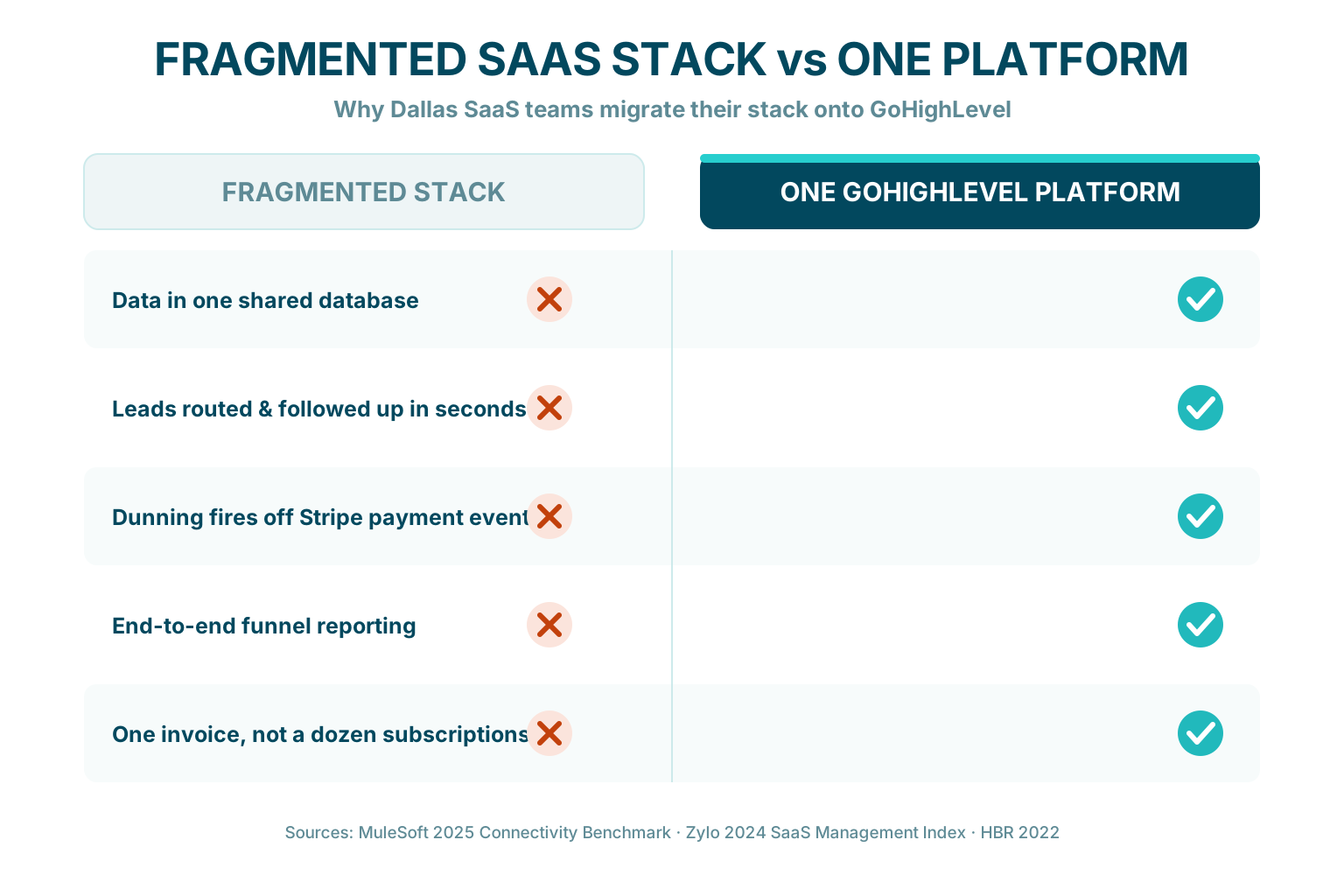
| Plan | One GoHighLevel Platform recommended | Fragmented Tool Stack |
|---|---|---|
| Price | One system · one database | 12+ subscriptions · no shared data |
| Feature 1 | CRM, email, SMS, funnels, calendars, reviews, AI in one place | HubSpot + Customer.io + Intercom + point tools that don't sync |
| Feature 2 | Leads routed and followed up in seconds, automatically | Leads sit unseen for hours in the handoff between systems |
| Feature 3 | Dunning fires off Stripe events — recover involuntary churn | Failed payments churn silently — billing ≠ messaging |
| Feature 4 | One shared database — full end-to-end funnel reporting | Data siloed across tools — no single view of the funnel |
| Feature 5 | No toggling tax; no manual copy-paste between tools | 9% of the workday lost toggling between apps |
| Feature 6 | One invoice instead of a dozen overlapping subscriptions | $18M/yr industry-average waste on unused licenses |
| Feature 7 | Migration + integrations built and run for you | You own the integration duct tape when it breaks |
| Migrate to GoHighLevel | See the snapshot |
How a GoHighLevel migration actually works
A migration onto GoHighLevel is a scoped project, not a leap of faith. The version we run for Dallas SaaS companies looks like this:
- Audit and map. We inventory your current stack — HubSpot, Customer.io, Intercom, Stripe, your form tools — and map every field, pipeline stage, and automation to its home in GoHighLevel. This is also where the duplicate-tool waste gets identified and cut.
- Test migration. We move a sample of contacts, pipelines, custom fields, and history into a staging environment so you can verify nothing is lost before the real cutover.
- Integrations. We wire Stripe (for billing and dunning triggers), your product analytics, and anything else that needs to keep talking to the platform — so payments, usage, and lifecycle events land in one database.
- Cutover with zero data loss. We run the full migration, keep a one-way sync live during the transition so reporting never goes dark, and switch you over cleanly.
- Operate. Once it’s live, the lifecycle workflows run on rails. If you’d rather not touch the builder, a dedicated GoHighLevel VA can own and tune the account day to day.
The point isn’t “GoHighLevel is magic.” It’s that one platform with one database removes the seams where sprawl costs you money — and a clean migration is what gets you there without losing a decade of CRM history. For the broader picture of how these lifecycle motions fit together once you’re consolidated, the SaaS lifecycle marketing guide maps the full trial-to-retain sequence, and our snapshot vs DIY breakdown covers the build-vs-buy math.
Frequently asked questions
What is SaaS tool sprawl and why is it expensive?
Tool sprawl is the accumulation of overlapping SaaS apps a company buys over time — the average company now runs 371 of them (Productiv). It's expensive in three ways: direct waste on unused and duplicate licenses (an average of $18M a year, with only about 49% of licenses actually used, per Zylo 2024), an operational tax as staff lose roughly 9% of the workday toggling between disconnected tools (HBR 2022), and leaked revenue when leads and renewals fall through the gaps between systems that don't share data.
Why migrate a SaaS stack to GoHighLevel instead of keeping best-of-breed tools?
Because 'best of breed' only works if the tools are integrated, and most aren't — MuleSoft found only 29% of enterprise apps are connected, leaving 71% as data silos. GoHighLevel consolidates CRM, email, SMS, funnels, calendars, reviews, chat, AI, and lifecycle automation into one platform with one shared database, so leads route in seconds, dunning fires off Stripe events, and you finally get end-to-end funnel reporting. You trade a dozen invoices and the integration duct tape for one system.
Will we lose our contacts and history migrating off HubSpot or Customer.io?
No — a proper migration moves contacts, pipelines, custom fields, automations, and history across with zero data loss. We map every field, run a test migration into staging so you can verify it, and keep a one-way sync live during cutover so reporting never goes dark. That controlled process is exactly what our GoHighLevel development and migration team handles.
How does consolidating tools help our lead response time?
On a fragmented stack, a new lead sits in a form tool until someone manually moves it into the CRM and then into an email platform — which is why the average company takes 42 hours to respond and 23% never do (HBR 2011). On one platform, the form, CRM, pipeline, and SMS/email follow-up are the same system, so a response can fire in seconds. Responding within 5 minutes instead of 30 makes you 21x more likely to qualify the lead (MIT/InsideSales).
Is a GoHighLevel migration a good fit for a Dallas SaaS company specifically?
Yes. Dallas–Fort Worth's tech workforce grew about 26% since 2021 (CBRE 2025) and the region has 24 Fortune 500 HQs, so labor is expensive — making the toggling tax pricier — and buyers move fast, so a slow, disconnected funnel loses deals. Consolidating onto one platform lets a Dallas SaaS company catch demand with sub-five-minute follow-up and run leaner without a dozen overlapping subscriptions.
What if GoHighLevel can't do something our SaaS needs?
That's what custom development is for. Our GHL team builds the integrations, AI agents, and connectors that extend GoHighLevel — Stripe billing logic, usage-based triggers, data-warehouse syncs — and our custom software team builds standalone pieces like customer portals or bespoke analytics dashboards when the need lives outside GHL. The platform is the core; we build whatever closes the last gap.
Sources
- Productiv — State of SaaS (Less Than Half of SaaS Apps Are Regularly Used), BusinessWire, 2021
- Zylo — 2024 SaaS Management Index ($18M average annual license waste)
- Harvard Business Review — How Much Time and Energy Do We Waste Toggling Between Applications? (2022)
- MuleSoft (Salesforce) — 2025 Connectivity Benchmark Report (897 apps, 29% integrated, 80% cite data silos)
- MIT / InsideSales — Lead Response Management Study (Dr. James Oldroyd)
- Harvard Business Review — The Short Life of Online Sales Leads (2011)
- Gartner — Data Quality (poor data quality costs an average of $12.9M/year)
- CBRE — Scoring Tech Talent 2025 (Dallas–Fort Worth tech-workforce growth)
- Dallas Regional Chamber — DFW Facts (Fortune 500 headquarters)
About the author
Priya Venkatesan is a SaaS Growth & Revenue Analyst based in Seattle, WA. She translates SaaS metrics into decisions founders can act on — LTV/CAC, net revenue retention, cohort churn, and the operational costs, like tool sprawl, that quietly erode margin. She writes about where consolidation and automation move the line on a P&L, pairing hard numbers with plain-language next steps.
Related reading: Failed-Payment Dunning for SaaS · SaaS Lifecycle Marketing · SaaS Snapshot vs DIY Build · The Real Cost of Running GoHighLevel Yourself · Astro vs GoHighLevel Websites for SaaS