

If you’re a SaaS founder or GoHighLevel agency operator in Austin running your own GHL account, the honest math is uncomfortable: the hours you pour into building workflows, chasing leads, and babysitting automations are the most expensive hours in your business — and a dedicated GoHighLevel VA runs that same work for a fraction of what an in-house hire costs. The problem isn’t that GoHighLevel is hard. It’s that the person best positioned to grow an Austin software company — the founder — is the one stuck inside the builder while high-intent trials go cold, failed payments churn silently, and demo requests sit unanswered for hours.
This is the operator’s-eye view of what “doing it yourself” actually costs, using real, sourced numbers — and what changes when you hand the GoHighLevel engine to someone whose only job is to run it.
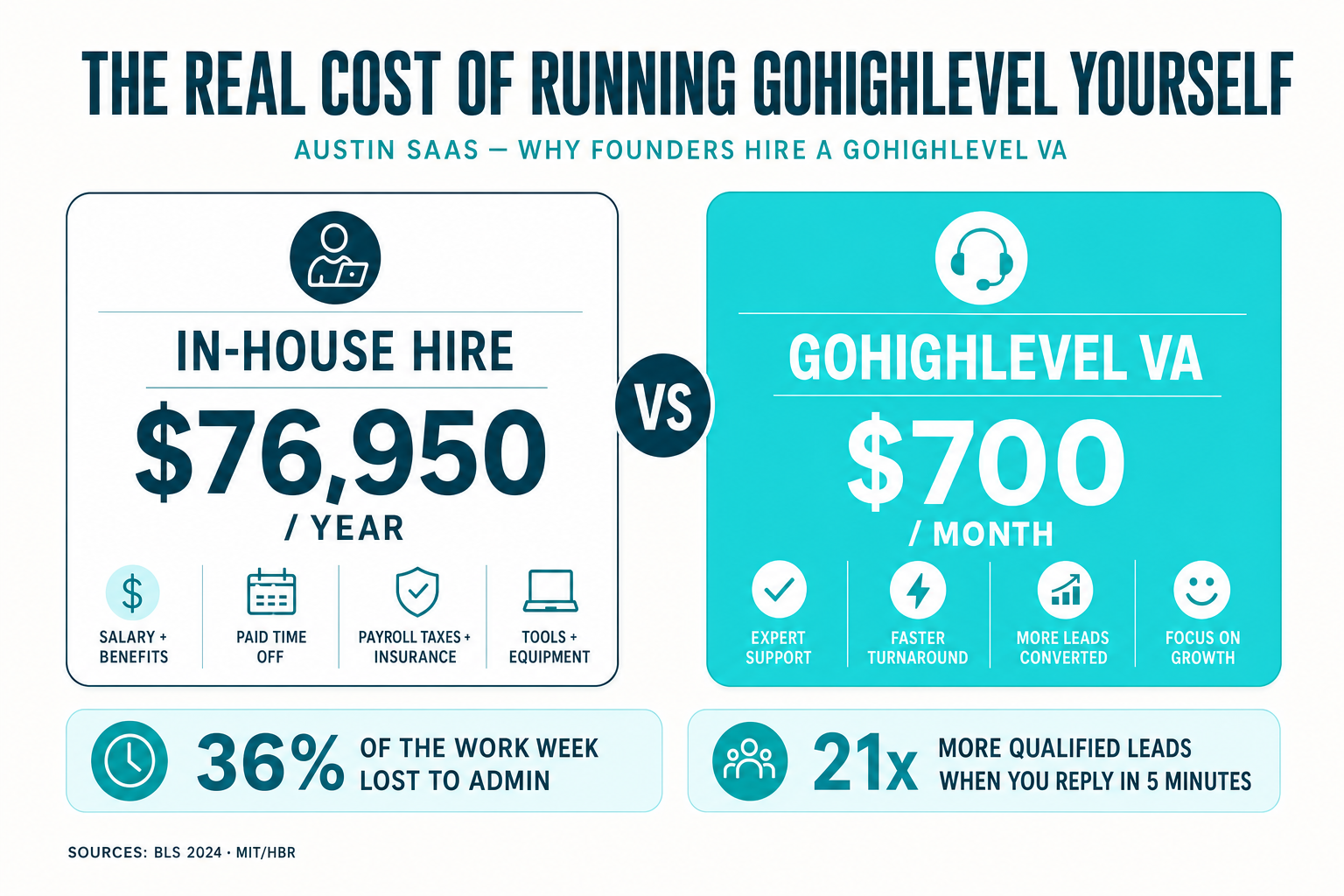
Table of contents
- The short answer
- The real cost of running GoHighLevel yourself
- The revenue leaking while you’re in the builder
- Why this hits Austin SaaS companies harder
- What a GoHighLevel VA actually does
- DIY vs a dedicated GHL VA: the head-to-head
- What it costs versus what it saves
- Frequently asked questions
- Sources
- About the author
The short answer
For most Austin SaaS founders and the agencies serving them, running GoHighLevel yourself is a false economy. You’re not saving money — you’re spending your highest-value hours on operational work and paying for it twice: once in the growth you don’t ship because you’re in the builder, and again in the pipeline that leaks while nobody is watching the automations.
A dedicated GoHighLevel VA starts at $700/month. A comparable in-house marketing operations hire in the US earns a median of $76,950 a year before payroll taxes, benefits, and equipment (U.S. Bureau of Labor Statistics, May 2024). That’s the headline gap. But the bigger cost is invisible: the trials that never activate, the demo requests that go cold, and the failed payments that churn — all things a person whose entire job is your GHL account catches, and a distracted founder does not.
The real cost of running GoHighLevel yourself
You’re the most expensive employee doing the cheapest work
The average entrepreneur spends more than a third of the work week — about 36%, roughly 16 hours — on small administrative tasks rather than on growth (Time etc survey of 251 US business owners, reported by Forbes, 2023; note Time etc is a VA company reporting its own survey). For a software founder, that’s 16 hours a week not spent on product, positioning, partnerships, or closing — the things only you can do — and instead spent renaming pipeline stages and rewiring a trigger that broke when Stripe changed a webhook.
The reason this matters is opportunity cost, not effort. Every hour you spend inside GoHighLevel is an hour valued at your marginal revenue, not at a VA’s hourly rate. When you do the tenth-of-a-cent work yourself, you pay founder wages for it.
The salary math nobody runs
Founders who “keep GHL in-house to save money” rarely compare the real numbers. A US market research analyst / marketing specialist — the closest BLS category to a marketing-ops person — earns a median of $76,950 per year, with the top 10% above $144,610 (BLS Occupational Outlook Handbook, May 2024). Load in employer payroll taxes, benefits, software seats, and equipment, and a full-time in-house hire realistically runs six figures.
A dedicated GoHighLevel VA on our Growth plan is $700/month — about $8,400 a year. That’s roughly a ninth of the median in-house salary alone, before you count benefits. The math is self-evident: you are not comparing a VA to nothing, you’re comparing it to either your own founder-hours or a six-figure headcount.
DIY GHL is a second job you didn’t hire for
GoHighLevel is a deep platform — pipelines, calendars, email and SMS automation, Stripe billing logic, A2P registration, conversational AI, snapshots. Running it well is a full-time skill, not a weekend setting. The founders who insist on doing it themselves usually end up with half-built workflows: the onboarding sequence that stops at day 3, the dunning retry that was never turned on, the review-request automation that fires to the wrong tag. It works until it quietly doesn’t — and the failure is invisible because nobody owns it.
The revenue leaking while you’re in the builder
The salary gap is the cost you can see. The bigger number is the revenue that leaks while your attention is split — and this is where a dedicated operator pays for themselves several times over.
Slow lead follow-up is the most expensive leak in SaaS
Speed to lead is the single most under-priced lever in a software funnel. The canonical Lead Response Management study out of MIT found that firms contacting a web lead within 5 minutes are 100x more likely to connect and 21x more likely to qualify that lead than firms that wait just 30 minutes (MIT / InsideSales Lead Response Management Study, Dr. James Oldroyd).
Most companies get nowhere near that. In a Harvard Business Review audit of 2,241 US companies, the average first response to a web lead took 42 hours, and 23% of companies never responded at all (Harvard Business Review, “The Short Life of Online Sales Leads,” 2011). Firms that responded within an hour were 7x more likely to qualify the lead than those that waited just one hour longer, and 60x more likely than those that waited 24 hours or more.
Here’s the operator’s point: a founder cannot answer a demo request in five minutes while shipping a release or in a customer call. An always-on system can — and a VA who owns that system makes sure it’s actually firing, that the AI receptionist is booking, and that no lead sits in a “new” stage overnight. The reduce demo no-shows playbook covers the reminder side of this; the follow-up side is pure speed.
Trials that never activate are revenue you already paid to acquire
Product-led SaaS lives and dies on activation. The median opt-in free trial converts to paid at just ~8% (ChartMogul SaaS Conversion Report) — which means the trials that never reach their first “aha” are where most of your acquisition spend evaporates. The fix is a disciplined onboarding and activation sequence that nudges the right users at the right milestone. That sequence has to be built, monitored, and tuned every week. When the founder owns it “in their spare time,” it’s the first thing that goes stale. Our time-to-value playbook breaks down the sequence; someone has to run it.
Failed payments churn silently — and most of it is recoverable
Involuntary churn is the leak founders never see because it doesn’t send an angry email. Failed payments drive an estimated 20–40% of total SaaS churn, yet roughly 70% of it is recoverable with automated dunning — smart card retries plus email and SMS (Churnkey, State of Retention 2025). That recovery only happens if the dunning workflow is live, correctly sequenced, and monitored. We wrote the full failed-payment dunning playbook — but a playbook sitting in a builder nobody watches recovers exactly nothing.
Why this hits Austin SaaS companies harder
Austin is one of the most competitive software markets in the country, which raises the stakes on every one of these leaks. CBRE ranked Austin a top-5 North American tech-talent market in its 2024 Scoring Tech Talent report (CBRE, 2024), and the Austin Chamber reports tech makes up about 16.3% of all local jobs — nearly double the ~9% national share (Austin Chamber High Tech Industry Report).
Two consequences for an Austin SaaS operator:
- Talent is expensive and contested. Hiring an in-house marketing-ops person in a top-5 tech market means competing on salary with funded startups and enterprise tech. The BLS median understates what you’ll actually pay in Austin — which makes the VA gap even wider.
- Buyers are sophisticated and fast-moving. In a dense software market, prospects are evaluating multiple tools at once. A 42-hour response time doesn’t just lower your odds — it hands the deal to the competitor who answered in five minutes.
Austin’s density is an advantage only if your funnel can actually catch the demand it generates. That’s an operational question, not a marketing one.
What a GoHighLevel VA actually does
A dedicated GoHighLevel VA is not a task-taker who waits for tickets. Done right, they’re a system operator who owns your account end to end. Concretely, that means:
- Building and maintaining the lifecycle workflows — trial onboarding, activation nudges, dunning retries, churn-save sequences, expansion prompts — and fixing them the day a webhook or trigger breaks.
- Owning speed to lead — configuring the AI receptionist, demo-booking bots, and instant SMS/email follow-up so no inbound sits idle, then watching the numbers to keep response times low.
- Running the boring, revenue-critical ops — pipeline hygiene, A2P and deliverability, calendar and reminder logic, review harvesting, reporting — so the metrics that hit your P&L are actually being managed.
- Knowing the SaaS motion natively — a VA who already understands PLG, NRR, activation milestones, and trial-to-paid math doesn’t need you to explain why day-7 drop-off matters. That’s the difference between an operator and a button-pusher.
If you’d rather your whole GoHighLevel stack ship pre-built and then be run for you, that’s exactly the combination of our SaaS Snapshot plus a dedicated VA: the eleven-module system installed, then operated day to day. For custom builds beyond the snapshot — Stripe webhooks, usage-based billing logic, bespoke integrations — our GHL development team picks up where the VA’s scope ends.
DIY vs a dedicated GHL VA: the head-to-head
Here’s the comparison the way we walk Austin founders through it.
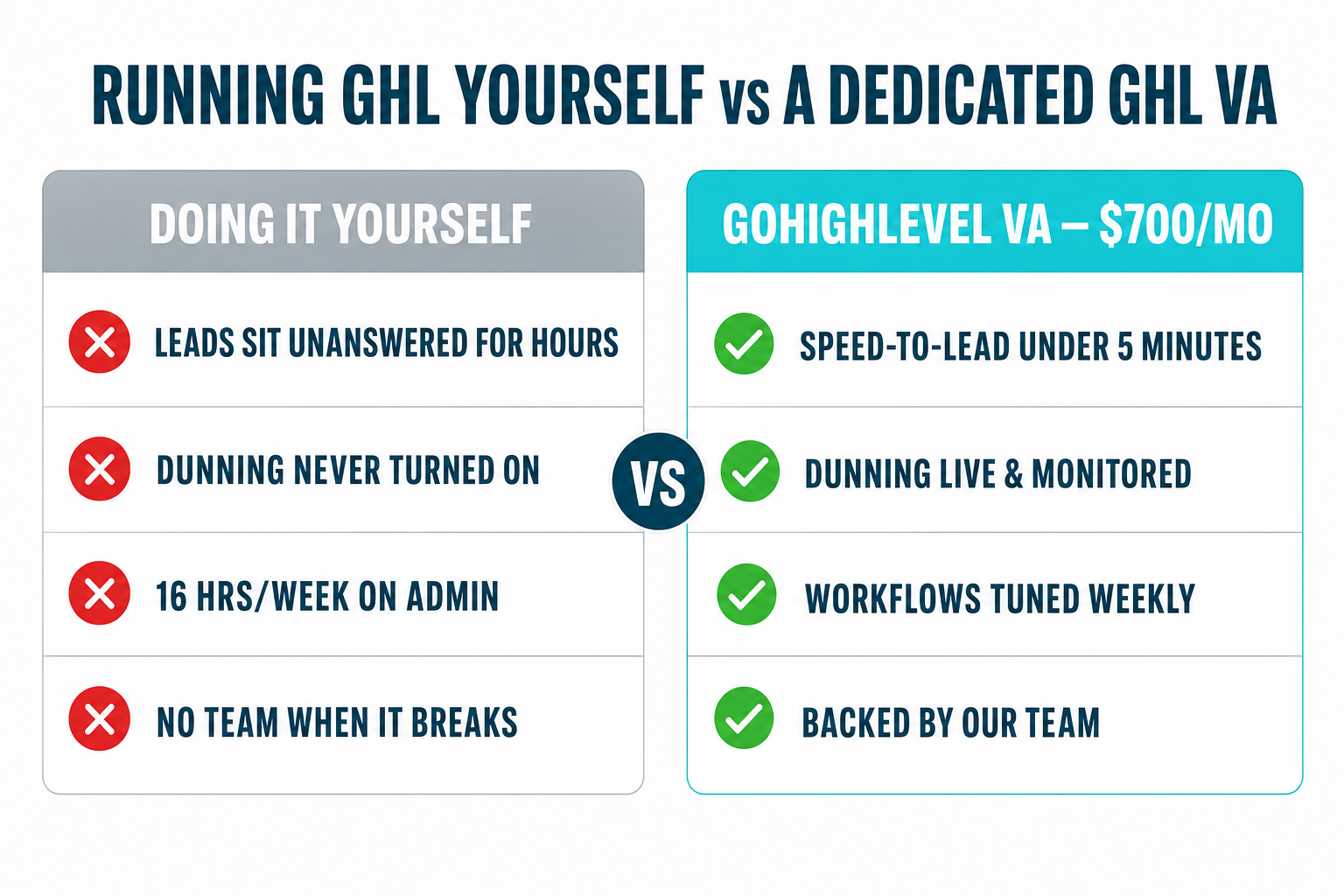
| Plan | Dedicated GoHighLevel VA recommended | Running GoHighLevel Yourself |
|---|---|---|
| Price | $700/mo (Growth · ~80 hrs) | Founder hours (your most expensive) |
| Feature 1 | Someone owns your GHL account full stop | You own it — on top of running the company |
| Feature 2 | Speed-to-lead configured and monitored daily | Leads sit in 'new' while you're heads-down |
| Feature 3 | Lifecycle workflows built, tuned, and fixed weekly | Workflows half-built; breaks go unnoticed |
| Feature 4 | Dunning + churn-save actually live and watched | Dunning often never switched on |
| Feature 5 | Knows SaaS motion — PLG, NRR, activation, trials | Learning the platform on your own dime |
| Feature 6 | Backed by our workflow, voice-AI, and A2P team | No team behind you when a webhook breaks |
| Feature 7 | Frees the founder to do founder-level work | 16 hrs/week of admin instead of growth |
| Feature 8 | ~1/9th the cost of a median in-house salary | 'Free' — but paid in growth you don't ship |
| Hire a GHL VA | See the snapshot |
What it costs versus what it saves
Run the numbers against your own funnel. If a dedicated VA keeps even a handful of high-intent trials from going cold, recovers a slice of the 20–40% of churn that’s involuntary, and gets your lead response under five minutes, the $700/month is recovered many times over — usually inside the first month for any SaaS with real trial volume.
The deeper saving is the one that doesn’t show up on an invoice: the founder hours you get back. Sixteen hours a week returned to product, sales, and strategy is the highest-leverage trade in the business — you’re moving your most valuable time off the cheapest work and onto the work that only you can do.
Frequently asked questions
How much does a GoHighLevel VA cost compared to hiring in-house?
A dedicated GoHighLevel VA starts at $700/month on our Growth plan (about $8,400 a year for roughly 80 hours a month). A comparable in-house US marketing-operations hire earns a median of $76,950 a year before payroll taxes, benefits, and equipment, according to the Bureau of Labor Statistics — so a VA runs roughly a ninth of the salary alone. In a top-5 tech market like Austin, the in-house cost is typically even higher.
Why not just run GoHighLevel myself to save money?
Because you don't save money — you shift the cost somewhere invisible. Founders spend about 36% of the work week on admin, and the workflows they build in spare time tend to go stale: onboarding stops at day 3, dunning never gets turned on, leads sit unanswered. The result is slower lead response, dead trials, and silent involuntary churn — all revenue leaks that dwarf the $700/month a dedicated operator costs.
What does a GoHighLevel VA actually do day to day?
They own your GHL account: building and fixing lifecycle workflows (onboarding, activation, dunning, churn-save, expansion), configuring and monitoring speed-to-lead (AI receptionist, demo booking, instant follow-up), and running the revenue-critical ops — pipeline hygiene, A2P and deliverability, reminders, review harvesting, and reporting. Ours also understand SaaS metrics natively, so there's no onboarding tax explaining PLG or NRR.
Is a GoHighLevel VA a good fit for an Austin SaaS company specifically?
Yes. Austin is a top-5 North American tech-talent market where tech is about 16.3% of all jobs, so in-house ops talent is expensive and contested, and buyers move fast. A dedicated VA lets an Austin SaaS company catch high-intent demand with sub-five-minute follow-up and keep its lifecycle automations live, without competing for a six-figure in-house hire.
How fast can I get a GoHighLevel VA, and how does it work?
The moment you complete checkout we open the search and typically match you to a VA within about 5–7 business days. A project manager is added to your Slack (or ClickUp/Asana/Trello) to monitor quality, and your VA sits inside our wider team of workflow, voice-AI, and A2P specialists, so they get unstuck fast. Plans are $700/month (Growth) up to higher tiers for full-time hours.
Can a VA run the SaaS Snapshot for me too?
That's the ideal setup. Install the SaaS Snapshot to get all eleven lifecycle modules pre-built, then have a dedicated VA operate and tune them day to day. You get a system that's live on day one and actually managed after that — instead of a powerful account nobody has time to run.
Sources
- U.S. Bureau of Labor Statistics — Market Research Analysts (Occupational Outlook Handbook, May 2024)
- Forbes — New Survey Reveals Productivity Blind Spot for Entrepreneurs (Time etc, 2023)
- MIT / InsideSales — Lead Response Management Study (Dr. James Oldroyd)
- Harvard Business Review — The Short Life of Online Sales Leads (2011)
- ChartMogul — SaaS Conversion Report
- Churnkey — State of Retention 2025
- CBRE — Austin Climbs Into Top Five North American Tech Markets (Scoring Tech Talent, 2024)
- Austin Chamber of Commerce — High Tech Industry Report
About the author
Devon Asante is a GHL Automation Architect based in Denver, CO. A former agency operator who resold GoHighLevel to software clients, he now designs snapshot systems and trains the VAs who run them — pairing a done-for-you GoHighLevel build with a dedicated operator so SaaS founders ship on rails instead of living in the builder. He writes about CRM plumbing, multi-channel messaging, and the unglamorous operational details that quietly compound MRR.
Related reading: Failed-Payment Dunning for SaaS · Time-to-Value: The SaaS Activation Playbook · Reduce SaaS Demo No-Shows · Astro vs GoHighLevel Websites for SaaS