
If you run a SaaS company in Charlotte — or you’re a GoHighLevel agency serving one — no-code and off-the-shelf tools got you off the ground, but there’s a predictable point where they stop scaling with you. The signal isn’t “no-code is bad.” It’s that your team is now spending more time gluing tools together, working around a rigid data model, and apologizing for what the platform can’t do than you’d spend owning the piece outright. When a customer portal, an internal admin panel, a billing dashboard, or a compliance-grade workflow becomes core to how your product makes money, that’s the moment to build custom — and, thanks to AI-assisted development, building it is faster and cheaper than the last time you priced it out.
This is the operator’s-eye view of when a Charlotte software company has genuinely outgrown no-code, what to build custom first, and how to de-risk the build with real, sourced numbers — not a pitch to rewrite everything from scratch.
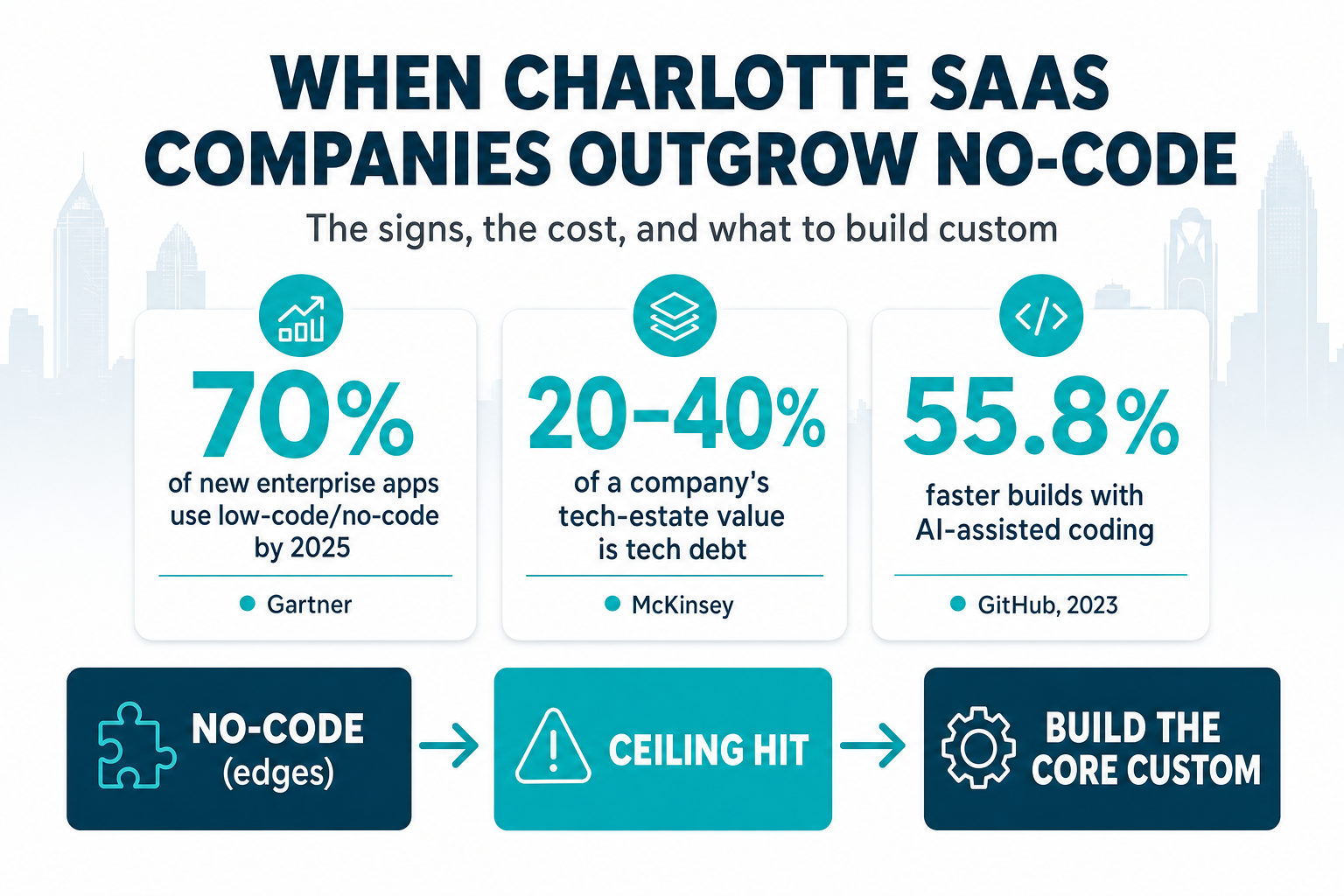
Table of contents
- The short answer
- Five signs your SaaS has outgrown no-code
- What off-the-shelf tools actually cost once you scale
- What Charlotte SaaS companies should build custom first
- Build vs buy — and how to de-risk a custom build
- Why this matters for Charlotte specifically
- No-code vs custom software: the head-to-head
- Frequently asked questions
- Sources
- About the author
The short answer
You’ve outgrown no-code when the platform’s limits start costing you revenue or credibility, not just convenience. Early on, tools like GoHighLevel, Airtable, Zapier, and off-the-shelf SaaS point solutions are exactly right — they let a Charlotte software company ship a funnel, a CRM, and a billing flow in days instead of quarters. The ceiling appears later, and it’s specific: a data model you can’t shape to your product, a customer-facing experience you can’t fully brand or control, integrations held together by brittle glue, and a growing list of “we can’t do that on our current stack” answers to customer and investor questions.
That ceiling isn’t hypothetical. Gartner forecasts that 70% of new applications enterprises develop will use low-code or no-code technologies by 2025, up from less than 25% in 2020 (Gartner, 2021) — so the question is no longer whether you start on no-code, it’s when the strategic pieces graduate off it. The good news for Charlotte operators: AI-assisted development has collapsed the cost of that graduation. In a controlled GitHub study, developers using an AI pair-programmer completed a coding task 55.8% faster than those without one (GitHub / Microsoft Research, 2023). Custom software you shelved two years ago as “too expensive” is now a fixed-scope project, not a moonshot — which is exactly the work our custom software team scopes and builds.
Five signs your SaaS has outgrown no-code
You don’t need to guess. These five signals show up in almost every Charlotte SaaS company that’s ready to build a strategic piece custom:
- You’re paying an “integration tax” every week. Your team spends real hours maintaining Zapier zaps, patching webhook failures, and reconciling data that lives in three tools with three different definitions of “customer.” That maintenance time is the tell — it’s dead weight that compounds.
- The data model fights your product. You want to store a field, relate two records, or run a report the platform simply won’t let you shape. You’re bending your business to the tool instead of the tool to your business.
- The customer-facing experience is capped. You can’t fully brand the portal, control the UX, or ship the self-service feature customers keep asking for — and that gap is now visible to buyers, not just to you.
- “We can’t do that” is a recurring answer. Sales loses deals, or support absorbs tickets, because the platform can’t do something core to your value. When the ceiling costs you revenue, it’s no longer a convenience problem.
- Compliance and control matter now. You’ve moved upmarket — a bank, a hospital system, an enterprise buyer — and they want data residency, audit logs, SSO, and controls that a generic SaaS tool won’t give you. In a banking town like Charlotte, this one arrives early.
What off-the-shelf tools actually cost once you scale
The invoice you can see — a stack of SaaS subscriptions — is rarely the real cost. The expensive part is the engineering time that quietly disappears into keeping a stitched-together stack alive.
The glue-code and tech-debt tax
McKinsey’s research on technical debt, based on a survey of CIOs at large firms, found that tech debt amounts to roughly 20–40% of the entire value of a company’s technology estate before depreciation, and that CIOs reported diverting 10–20% of the budget earmarked for new products just to resolving debt instead (McKinsey, 2020). For a SaaS company, “tech debt” isn’t abstract — it’s the pile of workarounds, brittle integrations, and one-off scripts you accumulate every time the platform can’t do something natively.
Stripe’s foundational Developer Coefficient study quantified where that time goes: developers spend an average of 13.5 hours a week dealing with technical debt and another 3.8 hours on “bad code” — roughly 17 hours a week, nearly half a developer’s time, not building anything new (Stripe / Harris Poll, 2018). Every hour your team spends babysitting a workaround is an hour not spent on the product your customers pay for.
When brittle systems break, the cost is non-linear
There’s a second, sharper cost: reliability. When your revenue-critical workflow is a chain of third-party tools and webhooks, an outage anywhere in the chain is your outage. ITIC’s 2024 survey found that 97% of large enterprises say a single hour of downtime costs more than $100,000, and 41% put the cost between $1 million and $5 million per hour (ITIC, 2024). You don’t need to be an enterprise to feel the principle: the more your money flows through systems you don’t control, the more your uptime depends on vendors who don’t share your incentives. Owning the core piece means owning its reliability.
This is the same math we walk through in the SaaS tool-sprawl breakdown for Dallas software companies — except there the fix is consolidation, and here the fix is building the one piece that no platform will ever do for you.
What Charlotte SaaS companies should build custom first
“Build custom” doesn’t mean “rewrite your whole stack.” It means picking the one or two pieces where ownership pays off, and leaving everything else on no-code. In order of how often they justify a custom build:
- A customer portal / self-service layer. Buyers increasingly expect to solve things themselves. Gartner projects that digital-first channels like self-service and knowledge management will overtake phone and email as the most valuable customer-service technologies by 2027 (Gartner, 2025). A branded portal where customers manage their account, billing, and data is usually the highest-ROI first custom build.
- An internal admin panel / operations CRM. The system your own team runs the business on — onboarding, account management, support context — is where a rigid off-the-shelf data model hurts most. A custom admin panel wrapped around your real data model removes the daily friction.
- A billing / usage dashboard. If you have usage-based or seat-based pricing, the logic for metering, invoicing, and showing customers their usage rarely fits a generic tool. This is often the piece that graduates off no-code first.
- A custom AI agent. Support triage, lead qualification, or an in-product assistant that reads your data and knowledge base — built on modern agent frameworks — is now a weeks-long build, not a research project.
- Integrations no platform offers. The connector between your product, your CRM, Stripe, and your data warehouse. When it involves GoHighLevel specifically — extending it, syncing to it, or migrating onto it — that’s the sweet spot for our GoHighLevel development team; when the build lives outside GHL, it’s custom software.
Build vs buy — and how to de-risk a custom build
The reason “build custom” makes founders flinch is history: custom software projects have a reputation for running late, over budget, and occasionally failing outright. That reputation is earned. The Standish Group’s CHAOS research has long found that only about 31% of software projects succeed, roughly half are “challenged” (late, over budget, or under-scoped), and about 19% fail outright — and critically, large projects succeed less than 10% of the time, while small projects succeed around 90% of the time (The Standish Group, CHAOS).
Read that last stat again, because it’s the whole playbook: the single biggest predictor of a custom build’s success is keeping it small. You de-risk custom software not by avoiding it, but by scoping it into a tight first version — one portal, one dashboard, one agent — shipping it, and iterating.
The second thing that changed the build-vs-buy math is AI-assisted development. Because a modern team building with AI tooling ships roughly 55.8% faster on coding tasks (GitHub, 2023), the cost floor for a well-scoped custom build has dropped dramatically. That’s the model our team runs on: fixed scope, a written quote, and AI-assisted delivery so a portal or dashboard ships in weeks, not the multi-quarter death march the CHAOS numbers warn about. The honest build-vs-buy tradeoff — and when the done-for-you SaaS Snapshot is simply the better buy — is the same calculus we lay out in our snapshot vs DIY build breakdown.
Why this matters for Charlotte specifically
Charlotte isn’t a generic tech market — it’s the second-largest banking center in the United States, home to Bank of America’s headquarters and a major Truist presence (Charlotte Regional Business Alliance). North Carolina overall employs more than 293,000 tech workers (CompTIA, State of the Tech Workforce 2024), giving a Charlotte SaaS company both a deep engineering talent pool and a customer base steeped in financial services.
That combination has two consequences for the build-vs-buy decision:
- Your buyers demand control early. Selling into banks, insurers, and fintechs means data residency, audit trails, SSO, and security reviews arrive in the sales cycle far sooner than they would for a consumer app. Generic no-code tools rarely clear those bars — which pushes the “build the core custom” decision forward for Charlotte SaaS companies specifically.
- The talent to maintain it is local and deep. A frequent objection to custom software is “who maintains it after launch?” In a market with 293,000+ NC tech workers, that’s a solvable problem — and if you’d rather not staff it in-house, a dedicated engineer or GHL VA from $700/month can own maintenance and iteration for you.
Charlotte’s financial-services gravity is an advantage only if your product can actually meet enterprise expectations. That’s an infrastructure decision, and past a certain scale, no-code answers it badly.
No-code vs custom software: the head-to-head
Here’s the comparison the way we walk Charlotte founders through it — not “one is better,” but “each wins a different job.”
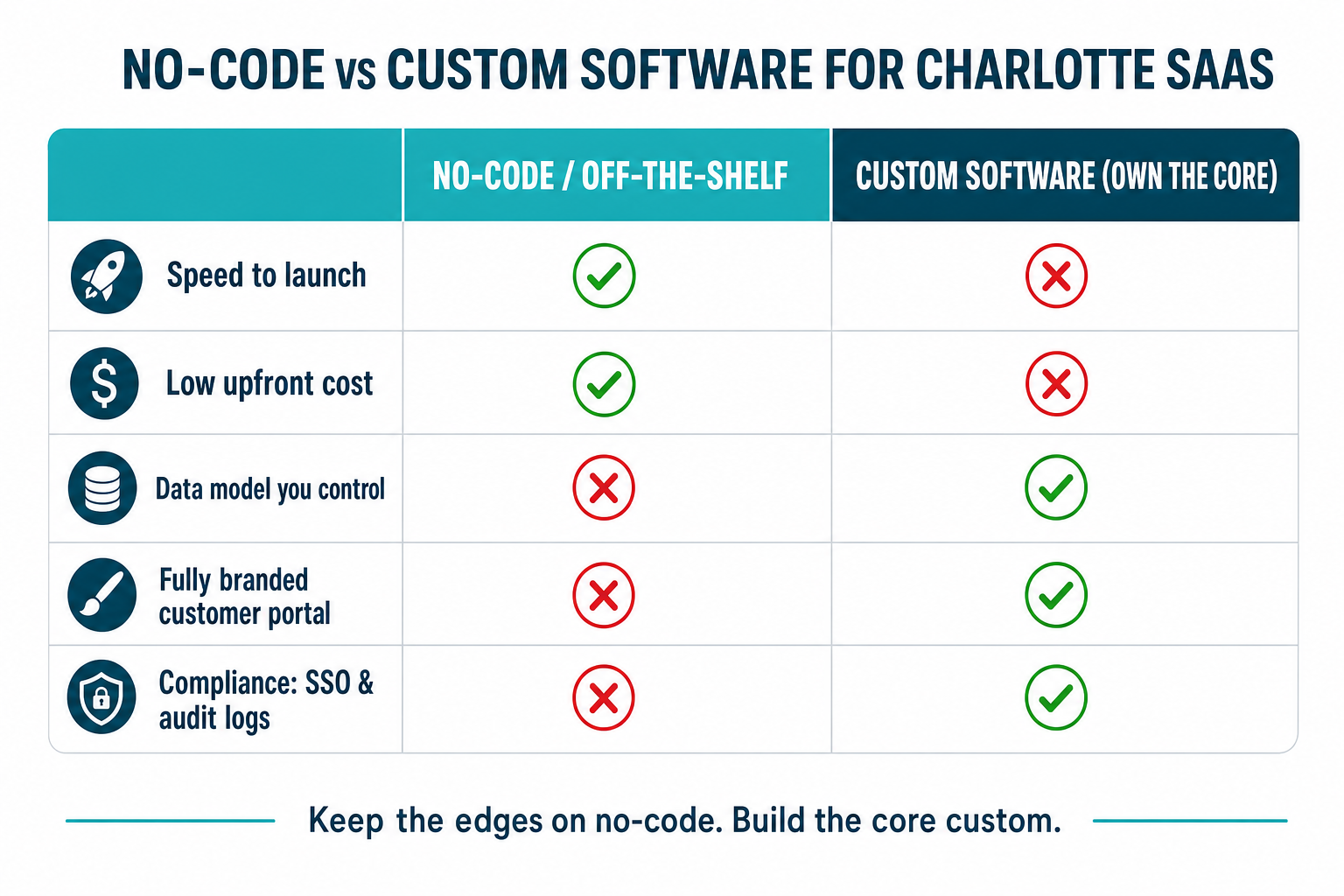
| Plan | Custom Software (own the core) recommended | No-Code / Off-the-Shelf |
|---|---|---|
| Price | Fixed-scope build · you own it | Fast · cheap · rented |
| Feature 1 | A data model shaped to your product, not the tool | Ship a funnel, CRM, or booking flow in days |
| Feature 2 | Fully branded, controllable customer portal & UX | Low upfront cost, non-technical edits |
| Feature 3 | Compliance-grade controls: SSO, audit logs, data residency | Rigid data model you bend your business around |
| Feature 4 | Own your reliability — no vendor's outage is your outage | Capped, hard-to-brand customer experience |
| Feature 5 | AI-assisted delivery ships a scoped v1 in weeks | Reliability depends on vendors and brittle glue code |
| Feature 6 | Best for: the portal, dashboard, or system that IS your value | Best for: the edges — funnels, reminders, notifications |
| Feature 7 | Maintained in-house or by a dedicated engineer from $700/mo | Integration tax grows as you scale |
| Scope a custom build | See the SaaS Snapshot |
The winning setup for most Charlotte SaaS companies is both: keep the marketing, review, and reminder edges on a fast no-code platform like GoHighLevel, and build the customer-facing core custom. If your website itself is the piece that feels slow and capped, that’s a related — and cheaper — graduation we cover in Astro vs GoHighLevel websites for SaaS.
Frequently asked questions
When should a SaaS company move off no-code to custom software?
When the platform's limits start costing you revenue or credibility rather than just convenience. The clearest signals are a growing 'integration tax' (hours spent maintaining zaps and webhooks), a data model you have to bend your business around, a customer-facing experience you can't fully brand or control, recurring 'we can't do that' answers that lose deals, and enterprise buyers demanding compliance controls like SSO and audit logs. No-code stays right for the edges of your business; you graduate the strategic core.
What should a Charlotte SaaS company build custom first?
Usually a customer portal or self-service layer, since Gartner projects digital-first self-service will overtake phone and email as the most valuable service channel by 2027. After that: an internal admin panel or operations CRM built around your real data model, a billing/usage dashboard for usage-based pricing, a custom AI agent for support or lead qualification, and integrations no off-the-shelf platform offers. Build one piece at a time, not everything at once.
Isn't custom software risky, expensive, and slow to build?
It can be — if you build big. The Standish Group's CHAOS research found large software projects succeed less than 10% of the time, while small, tightly-scoped projects succeed around 90% of the time. You de-risk by scoping a first version small enough to ship in weeks. AI-assisted development also cut the cost floor: a GitHub study measured developers completing coding tasks 55.8% faster with an AI pair-programmer, so a well-scoped portal or dashboard is now a fixed-price project, not a multi-quarter gamble.
How much does custom software cost, and who maintains it after launch?
It depends on scope, which is why we quote a fixed price against a written scope document rather than an open-ended hourly estimate — most SaaS builds land in the fixed-price project range with milestones. Every fixed-price build includes a 30-day bug-fix warranty; after that you can maintain it in-house (North Carolina has 293,000+ tech workers to hire from), hire a dedicated engineer or GHL VA from $700/month, or stay on an hourly retainer for feature additions.
Can we keep GoHighLevel and still build custom pieces?
Yes — that's the recommended setup. Keep your marketing funnels, review requests, appointment reminders, and internal notifications on a fast no-code platform like GoHighLevel, and build only the customer-facing core custom. When the custom piece needs to extend, sync to, or migrate onto GoHighLevel, that's GHL development work; when it lives outside GHL — a standalone portal or dashboard — it's custom software. Both are things our team builds.
Why does the build-vs-buy decision hit Charlotte SaaS companies sooner?
Because Charlotte is the second-largest banking center in the US, so many local SaaS companies sell into financial services, where buyers demand data residency, SSO, audit logs, and security reviews early in the sales cycle. Generic no-code tools rarely clear those bars, which pushes the 'build the core custom' decision forward. The upside is a deep local talent pool — 293,000+ NC tech workers — to build and maintain it.
Sources
- Gartner — Low-Code Development Technologies Market Forecast (70% of new apps by 2025), 2021
- McKinsey — Tech Debt: Reclaiming Tech Equity (tech debt = 20–40% of the tech estate), 2020
- Stripe — The Developer Coefficient (developers lose ~17 hrs/week to debt and bad code), 2018
- GitHub / Microsoft Research — The Impact of AI on Developer Productivity (55.8% faster), 2023
- ITIC — 2024 Hourly Cost of Downtime Survey
- Gartner — Customer Service Self-Service to Overtake Phone/Email by 2027, 2025
- Zylo — SaaS Management stats (1 in 3 apps unknown to IT; 70% of spend outside IT), 2025
- The Standish Group — CHAOS Report (project success by size)
- CompTIA — State of the Tech Workforce 2024 (293,000+ NC tech workers)
- Charlotte Regional Business Alliance — Financial Services (2nd-largest US banking center)
About the author
Devon Asante is a GHL Automation Architect based in Denver, CO. A former agency operator who resold GoHighLevel to software clients, he now designs snapshot systems and custom builds that drop in clean and fire on day one. He writes about the plumbing behind SaaS growth — the pipelines, integrations, and the honest engineering tradeoffs that decide when to automate on no-code and when to own the core in custom code.
Related reading: The Hidden Cost of SaaS Tool Sprawl (Dallas) · SaaS Snapshot vs DIY Build · The Real Cost of Running GoHighLevel Yourself (Austin) · Astro vs GoHighLevel Websites for SaaS (San Francisco) · SaaS Lifecycle Marketing