
If you run a SaaS company in Phoenix — or you’re a GoHighLevel agency serving one — an inconsistent social presence isn’t a branding problem, it’s a pipeline leak. Buyers now check your feed before they book a call, most of your B2B demand lives on LinkedIn, and every unanswered comment or DM is a warm trial that signs up with a competitor instead. Going quiet on social feels free. It isn’t. It quietly costs you shortlist spots, reach, and booked demos every single week — and in a tech market growing as fast as metro Phoenix, that gap compounds.
This is the operator’s version of the argument: the five real costs of going dark, the data behind each one, why it bites harder in Phoenix specifically, the honest build-vs-buy math, and how to run a consistent, multi-channel presence without hiring a four-person team.
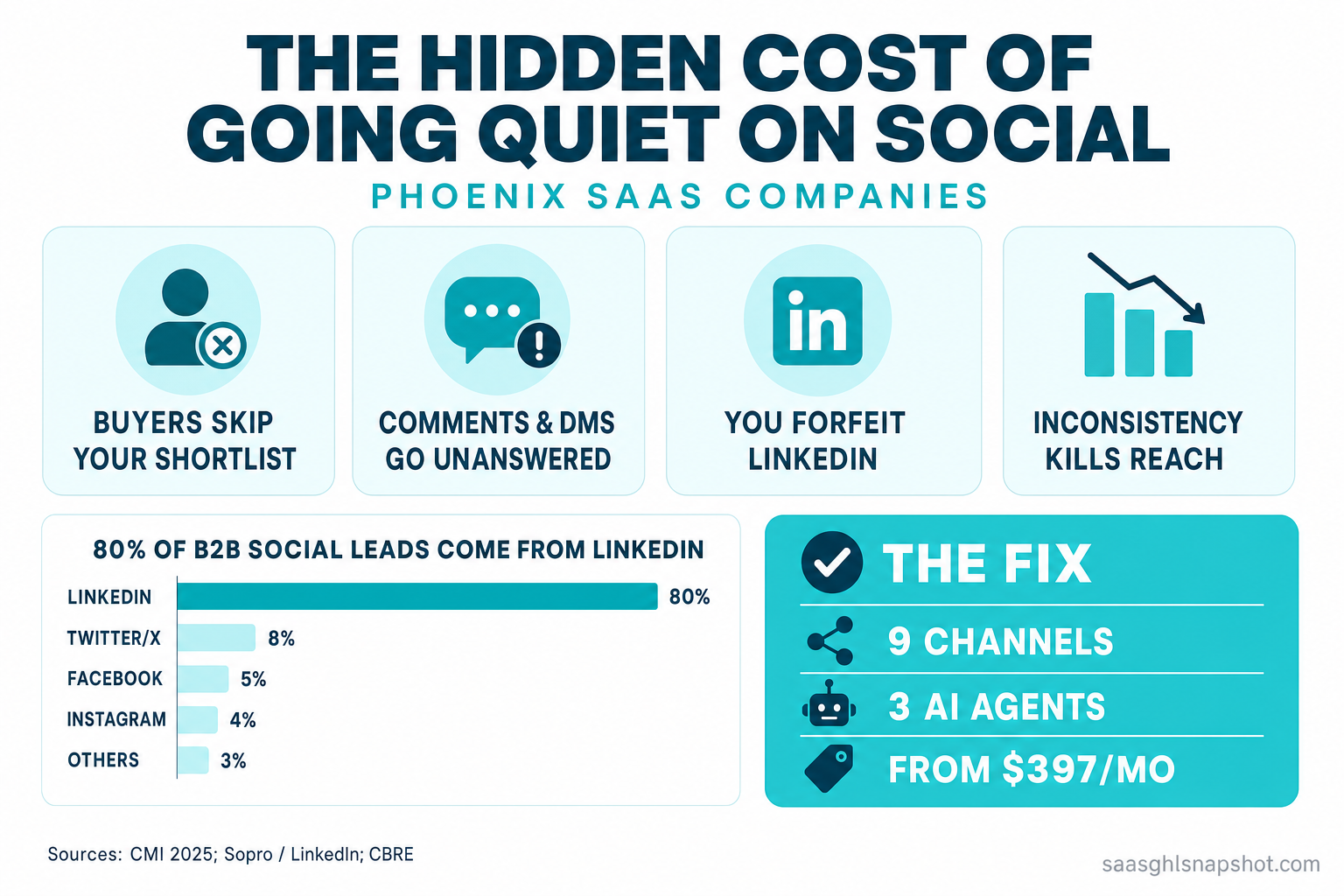
Table of contents
- The short answer
- The 5 hidden costs of going quiet on social
- Why the cost is higher in Phoenix
- What a consistent presence actually requires
- The build-vs-buy math for a Phoenix SaaS team
- What “good” looks like after 90 days
- Frequently asked questions
- Sources
- About the author
The short answer
For a Phoenix SaaS company, the most expensive social media strategy is the accidental one — posting in bursts when someone has time, then going silent for three weeks. It’s expensive because B2B buyers now treat your social presence as a due-diligence signal: an active, responsive feed says “this product is real and supported,” while a stale one raises doubt at the exact moment a prospect is building a shortlist.
The fix isn’t “post more.” It’s a consistent, multi-channel engine: a steady weekly cadence of the right content formats, published across the nine channels where software buyers actually are, with every comment, DM, and website chat answered fast so the demand you create never leaks. You either staff that engine — realistically a strategist, a designer, a video editor, and a community manager — or you hand it to a done-for-you team built for SaaS. What you can’t afford is the silent middle: a logo nobody sees and questions nobody answers.
The 5 hidden costs of going quiet on social
None of these show up as a line item. That’s exactly why they’re dangerous — they drain pipeline without ever appearing on the P&L.
Cost 1 — Buyers shortlist you by your feed (or skip you)
Software buying is now a self-serve research sprint long before anyone talks to sales, and social is part of that research. Roughly 75% of B2B buyers use social media to support their buying decisions, and the majority of decision-makers vet a vendor’s presence before agreeing to a first conversation (Sopro, B2B Buyer Statistics). When a Phoenix prospect lands on a stale profile — last post six weeks ago, unanswered questions in the comments — they don’t email you for clarification. They quietly move to the competitor whose feed looks alive. You never see the loss; it’s an email that never arrives.
Cost 2 — Comments and DMs die on the vine
Every “does this integrate with Stripe?” comment and every “what’s your pricing for 20 seats?” DM is a warm, high-intent lead raising its hand. In SaaS, speed-to-reply is speed-to-activation — the same speed-to-lead discipline that reduces demo no-shows. Yet on a burst-posting account, those messages sit for days. A prospect who asked a buying question under your post has a short window of interest; miss it and the warm lead cools to nothing. Sustained, fast engagement is also exactly what platform algorithms reward with more reach — so ignoring replies costs you twice.
Cost 3 — You forfeit LinkedIn, where B2B actually buys
For software, LinkedIn isn’t one channel among many — it’s the channel. 84% of B2B marketers say LinkedIn delivers the best value of any social platform (Content Marketing Institute, B2B Content Marketing 2025), and an estimated 80% of B2B leads sourced from social media come from LinkedIn (Sopro, LinkedIn Lead Generation Statistics). There’s a second lever most SaaS teams miss: posts from an individual founder or operator profile earn roughly 8x the engagement of the same content from a company page (Sopro). Going quiet on LinkedIn — or posting only from a faceless company page — leaves your single highest-intent demand channel on the table.
Cost 4 — Inconsistency starves the algorithm
Reach is not a reward for one great post; it’s a function of consistent, categorizable output. Every platform’s ranking system needs regular signals to learn who to show you to. When you post five times in a week, then nothing for a month, the algorithm effectively forgets you and reach resets toward zero each time you return. B2B brands that post on a steady weekly cadence consistently see better reach and lead quality than those that don’t. Consistency, not intensity, is the variable that compounds — and it’s the one a burst schedule structurally can’t deliver.
Cost 5 — The DIY founder tax
The most common Phoenix fix is the worst one: the founder or a single overloaded marketer does it all “for now.” That’s a hidden tax paid in two currencies. First, opportunity cost — every hour spent resizing a graphic for nine platforms is an hour not spent on product, sales, or customers. Second, quality — one person doing strategy, design, video, and community management does four jobs at replacement level, and the cadence collapses the first busy release week. The work looks free because no invoice changes hands. It isn’t; it’s just billed to your roadmap.
Why the cost is higher in Phoenix
Metro Phoenix is one of the fastest-climbing tech markets in the country, which raises both the opportunity and the stakes. In CBRE’s 2025 Scoring Tech Talent report, Phoenix ranks among the top 20 North American tech markets (#20), having grown its tech-talent labor pool by 5.6% to 102,540 people, while producing more than 6,000 tech-degree graduates a year and holding an AI-specific talent pool of about 5,600 (CBRE, Scoring Tech Talent 2025). Add the gravity of TSMC, Intel, and a deep Arizona State University pipeline, and you have a dense, local, software-literate audience of buyers, hires, and referral partners.
For a SaaS operator, that density cuts two ways:
- The buyer pool is large and reachable — but contested. Phoenix software teams, agencies, and founders are on LinkedIn and Instagram daily. That’s a warm local audience for product-led content — but it also means your competitors are courting the same people. In a growing market, the visible, responsive brand wins the shortlist; the quiet one is invisible precisely when demand is highest.
- Talent to run this in-house is expensive and scarce. The same report that makes Phoenix attractive also shows how competitive its talent market is. Staffing a full content-and-community team against funded competitors is slow and costly — which is why most Phoenix SaaS teams are better served by an engine that runs reliably whether they staff it or outsource it.
The takeaway: the demand is here and it’s local, but so is the competition for attention and for the talent needed to capture it. A consistent social engine is how a Phoenix SaaS company turns that density into booked demos instead of missed ones. If organic search is your other pillar, pair this with our SaaS SEO in 2026 playbook.
What a consistent presence actually requires
“Just post more” hides the real scope. A presence that actually moves pipeline is a repeatable weekly system, not a burst of inspiration:
- A defined content mix, weekly. Not random posts — a fixed rotation that earns different outcomes: a founder-voice text Q&A (the format that earns saves and DMs from serious buyers), an image post, two carousels that teach, and a short-form reel demoing one workflow. That mix mirrors what we ship on the done-for-you plan, and it’s the same engine behind our short-form video playbook.
- Nine channels, one voice. Produce once, then crop and re-caption for LinkedIn, Instagram, Facebook, TikTok, YouTube, Google Business Profile, Pinterest, Threads, and Bluesky. One asset becomes nine touchpoints — that’s the leverage.
- Instant replies to every comment and DM. This is where most burst schedules fail. You need coverage that answers buying questions in minutes, qualifies the prospect, and books the demo — the discipline behind DM automation.
- A next step on every post. A trial link in bio, a pinned comment, a demo-booking link, a web-chat agent on the site. Content without a path to signup is entertainment, not marketing.
- Monthly measurement. Track the chain — reach → profile visits → link clicks → demos booked → paid — not vanity likes. The number that matters is demos attributed to social.
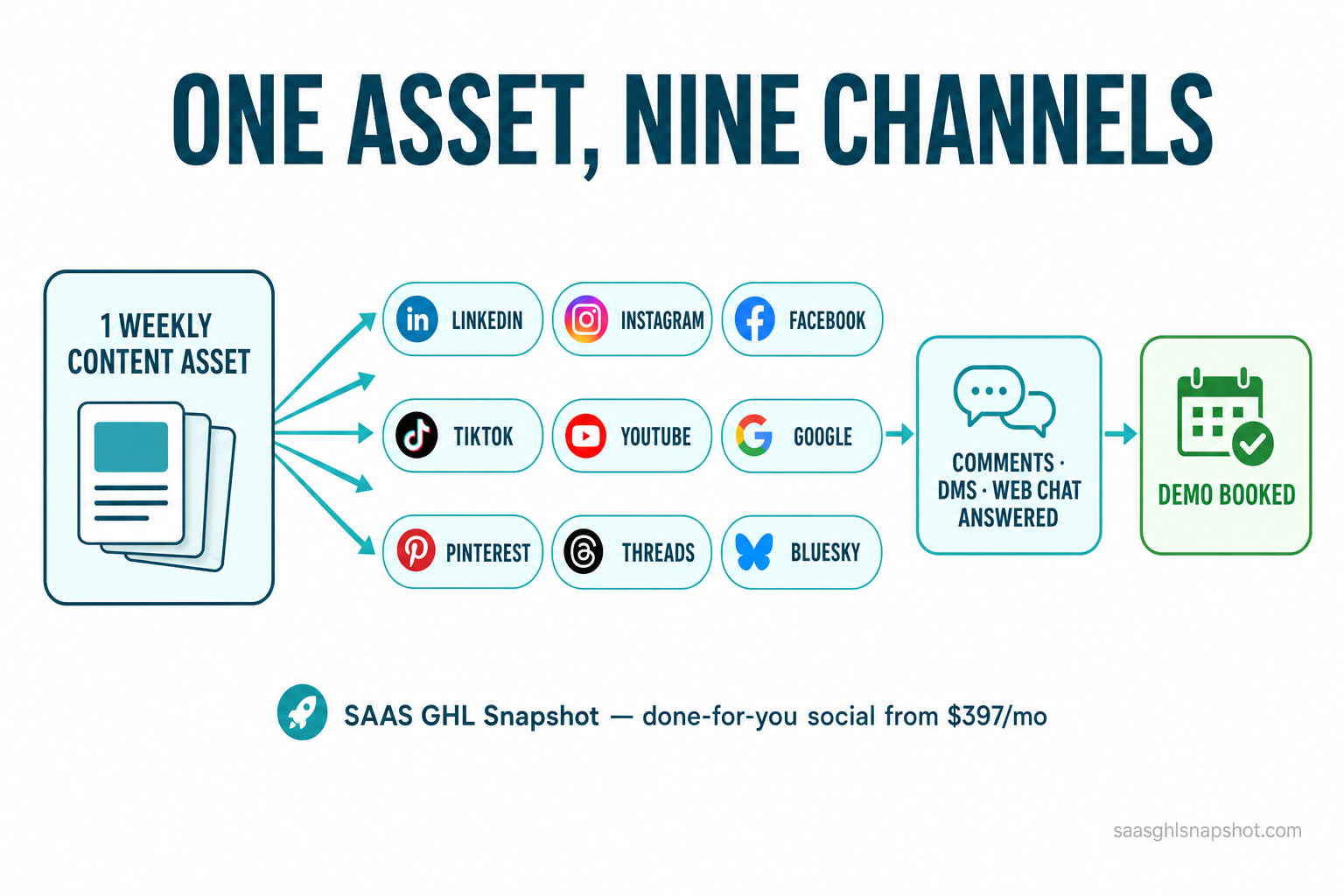
Done by hand, that’s four distinct skill sets running every week without a gap. That’s why the honest question isn’t “should we post more?” — it’s “who runs this engine, and what does it really cost?”
The build-vs-buy math for a Phoenix SaaS team
Running this in-house means, realistically, four roles: a content strategist, a designer, a video editor, and a community manager — or one overloaded marketer doing all four badly. Even a single adjacent seat isn’t cheap: U.S. public relations specialists earn a median of $69,780 a year, with the top tier above $129,480 (U.S. Bureau of Labor Statistics, May 2024) — and that’s one of four roles, before Phoenix’s contested talent market pushes those numbers up. Staffed properly, a real in-house social function runs $5,000–$9,000 a month in salaries alone.
Here’s the honest comparison we walk Phoenix founders through:
| Plan | Done-for-you SaaS social recommended | Build the team in-house |
|---|---|---|
| Price | $397/mo (1 brand · 9 channels) | $5,000–$9,000/mo in salaries alone |
| Feature 1 | Weekly mix: 1 Q&A, 1 image, 2 carousels, 1 reel | Four roles: strategist, designer, editor, community mgr |
| Feature 2 | Published 5 days a week across all 9 channels | PR/social specialist median alone is $69,780/yr (BLS) |
| Feature 3 | Written in your product's voice, SaaS-specific | Competing for talent in a top-20 tech market |
| Feature 4 | AI Comment + DM + Web-Chat agents included | Cadence slips the first busy release week |
| Feature 5 | Cropped & captioned per platform automatically | You manage the people and the calendar |
| Feature 6 | Monthly per-channel performance report | Reply speed depends on someone being online |
| Feature 7 | No hiring, no management overhead | Ramp time before output is consistent |
| Feature 8 | White-label · cancel with 15 days' notice | Payroll, benefits, tools, and turnover risk |
| See the social plan | Compare pricing |
The point isn’t that in-house is wrong — a well-funded team can absolutely build this. It’s that for most Phoenix SaaS companies and the agencies serving them, a done-for-you engine at $397/month ships more consistent, multi-channel output than a single hire ever will, at a fraction of one salary — and it includes the three AI agents that catch the leads your content creates. If you’d rather also hand off the GoHighLevel operation behind it, that pairs naturally with a dedicated GHL VA.
What “good” looks like after 90 days
Social is a compounding channel, not a slot machine — set expectations accordingly. In the first 30–60 days you’re building the content base and teaching each platform who you reach. Meaningful, steady inbound typically shows up around months three to five as the algorithms start surfacing your content to new buyers — while, because you’re shipping across nine channels every week, a single breakout reel can flood you with demos much sooner. Anyone promising overnight results is selling, not measuring.
By day 90 a healthy engine looks like: a reliable weekly content mix in fixed formats, rising profile visits and link clicks, an active feed where no buying question sits unanswered overnight, and — the number that pays the bills — a measurable count of demos and trials attributed to social. That’s the difference between “we post sometimes” and a demand channel you can forecast. To make sure those signups convert once they arrive, wire them into a SaaS lifecycle and a tight time-to-value activation plan.
Frequently asked questions
How often should a Phoenix SaaS company post on social media?
Aim for a fixed weekly mix published five days a week, not occasional bursts. Consistency matters more than volume: platform algorithms need regular, categorizable signals to learn who to surface you to, and B2B brands that post on a steady weekly cadence see better reach and lead quality than those that don't. A sustainable baseline is one founder-voice Q&A, one image, two carousels, and one short-form reel each week, distributed across all nine channels.
Which social channels matter most for B2B SaaS?
LinkedIn is the highest-value channel for software — 84% of B2B marketers say it delivers the best value of any platform (Content Marketing Institute), and an estimated 80% of B2B leads from social come from LinkedIn. Follow it with Instagram, YouTube Shorts, and TikTok for reach. The leverage comes from producing one asset and distributing it, cropped and captioned, across all nine channels (Facebook, Instagram, Google Business Profile, LinkedIn, TikTok, YouTube, Pinterest, Threads, and Bluesky).
What does going quiet on social actually cost a SaaS business?
It costs shortlist spots and warm leads. Around 75% of B2B buyers use social media to support buying decisions, so a stale feed raises doubt exactly when a prospect is evaluating you. Unanswered comments and DMs are warm, high-intent leads that cool within hours. And inconsistency resets your reach each time you return, because the algorithm effectively forgets accounts that post in bursts. None of it shows on the P&L, which is why it goes unnoticed.
Should I hire in-house or use a done-for-you service?
A real in-house social function is four roles — strategist, designer, video editor, and community manager — running $5,000–$9,000 a month in salaries alone; even one adjacent role, a PR/social specialist, has a median salary of $69,780 (BLS, May 2024). A done-for-you SaaS plan runs $397/month for one brand across nine channels, including three AI agents that answer comments, DMs, and web chat. For most Phoenix SaaS teams, outsourcing ships more consistent output at a fraction of one salary.
How fast will we see results from social media in Phoenix?
Expect the content base and platform learning in the first 30–60 days, with meaningful, steady inbound usually compounding around months three to five as algorithms surface your content to new buyers. Because you're posting across nine channels every week, a single reel can break out and drive demos sooner — but a reliable engine, not one viral hit, is what makes social a forecastable demand channel.
Do the AI agents actually book demos, or just reply?
They book. The AI Comment Agent answers questions under your TikTok, Instagram, and Facebook posts; the AI DM Agent replies to Facebook and Instagram messages, qualifies the prospect, and books a call to your calendar; and the AI Web Chat Agent on your website captures name, email, and use-case and books the demo. Everything lands in your CRM with a login, and appointments can sync to your Google Calendar.
Sources
- Content Marketing Institute — B2B Content Marketing Benchmarks, Budgets & Trends 2025
- Sopro — LinkedIn Lead Generation Statistics (2025)
- Sopro — B2B Buyer Statistics and Insights (2025)
- CBRE — Scoring Tech Talent 2025 (Phoenix)
- U.S. Bureau of Labor Statistics — Public Relations Specialists (Occupational Outlook Handbook, May 2024)
- Sprout Social — Social Media Statistics
About the author
Devon Asante is a GHL Automation Architect based in Denver, CO. A former agency operator who resold GoHighLevel to software clients, he now designs snapshot systems and multi-channel content engines that drop in clean and fire on day one. He’s happiest documenting a workflow so clearly a non-technical founder can ship it before lunch.
Related reading: Short-Form Video for SaaS · Social DM Automation for SaaS · Reduce SaaS Demo No-Shows · SaaS SEO in 2026 · SaaS Lifecycle Marketing