
If you run a SaaS company in New York — or you’re a GoHighLevel agency serving one — the most expensive leak in your funnel is probably a message you never answered. A prospect comments “does this integrate with Stripe?” under your reel, or DMs your Instagram at 9pm, and by the time someone sees it, they’ve already started a trial with a competitor. In a market as fast and crowded as New York, speed-to-reply is speed-to-trial. The fix isn’t “check the inbox more often” — it’s a comment and DM automation system that answers in seconds, qualifies the prospect, and books the demo before the lead cools.
This is the operator’s version of the problem: the sourced data on what a slow reply actually costs, why social DMs are now a primary SaaS sales channel, why it hits harder in New York, and the exact system that turns a cold inbox into booked demos.
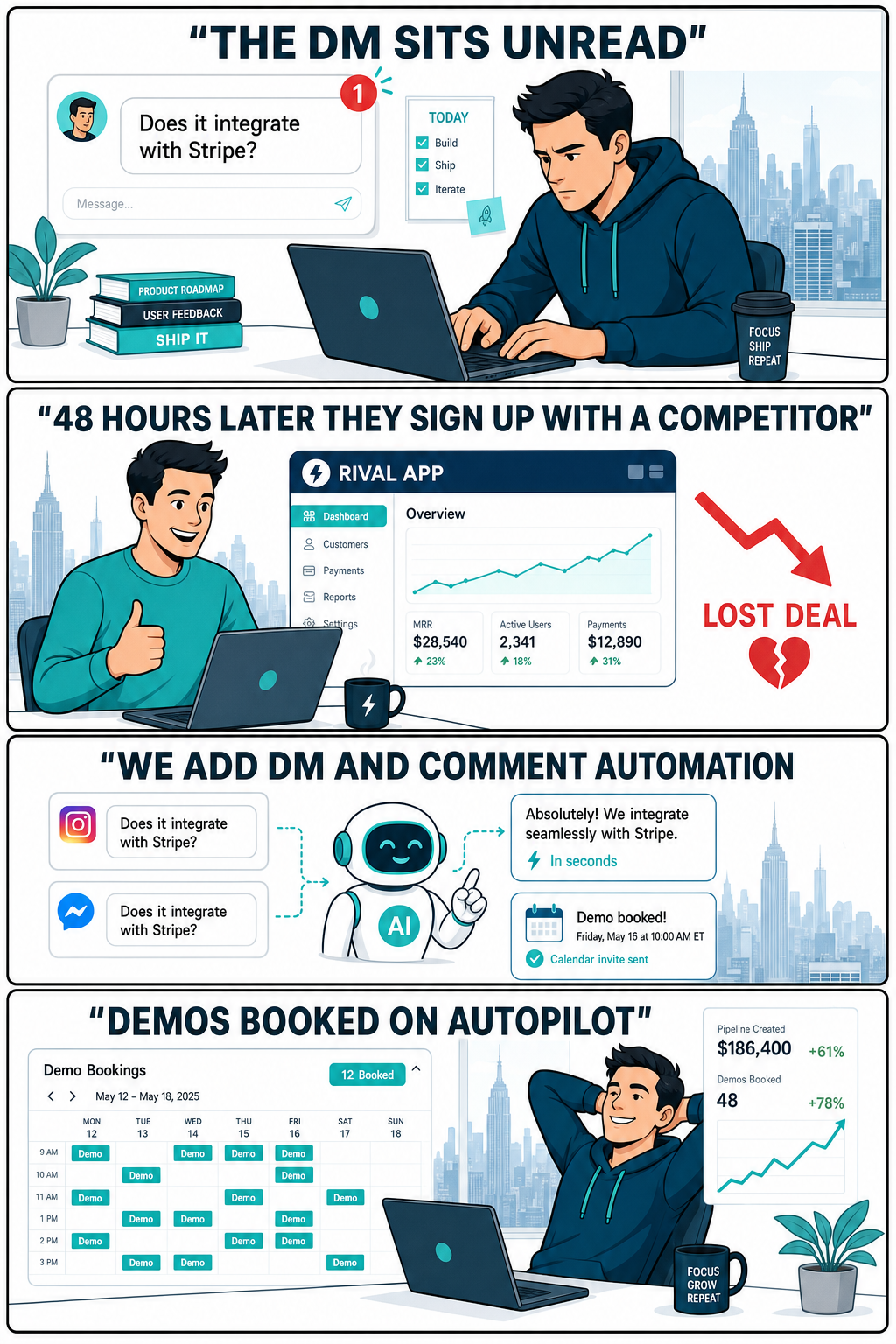
Table of contents
- The short answer
- The hidden leak: why SaaS DMs and comments go cold
- What a slow reply actually costs you
- Why social DMs are now a primary SaaS sales channel
- Why this hits harder in New York
- The fix: a comment + DM automation system
- Build vs. buy for a New York SaaS team
- What “good” looks like after 90 days
- Frequently asked questions
- Sources
- About the author
The short answer
For a New York SaaS company, the fastest way to recover trials you’re already losing is to automate the first reply to every comment and DM. The data on lead response is unambiguous: the odds of qualifying a lead are 21× higher when you respond within five minutes instead of thirty (MIT / InsideSales Lead Response Management study), and firms that contact a web lead within an hour are nearly 7× more likely to have a meaningful conversation with a decision-maker than those who wait even 60 minutes longer (Harvard Business Review). Yet most companies are nowhere close — when Drift mystery-shopped 433 B2B companies, only 7% replied within five minutes and 55% never replied within five business days (Drift Lead Response Report).
A comment and DM automation system closes that gap: an AI agent answers the question in your product’s voice within seconds, captures the prospect’s details, and books a demo onto your calendar — 24/7, without a human refreshing an inbox. That’s the difference between a reel that gets likes and a reel that fills your pipeline.
The hidden leak: why SaaS DMs and comments go cold
Every SaaS founder knows they should “do more on social.” Fewer notice the leak on the other side of the post. You publish a demo clip, it gets reach, and the warm buyers it produces raise their hands in exactly the two places nobody is watching: the comments (“wait, does this replace Intercom?”) and the DMs (“hey, can I get a trial extension?”).
Those are not idle questions. A prospect who publicly asks about an integration under your post is a lead with a five-minute half-life — they’re comparing you against two other tabs right now. When that comment sits for a day, three things happen, all bad:
- The buyer moves on. They get an answer somewhere else, usually from the competitor who replied first.
- The algorithm punishes you. Comments answered quickly signal an active, engaging account; ignored comments tell the platform your post isn’t worth pushing to more people. Slow replies quietly shrink your future reach.
- The next buyer sees the silence. A prospect scrolling your profile reads an unanswered “is this GDPR compliant?” as a red flag about your support — no matter how good the product is.
This is the same speed-to-lead discipline that decides whether your paid demos even show up. If instant follow-up isn’t wired in, you leak trials at every stage — which is exactly why we treat it as one system alongside reducing SaaS demo no-shows and trial-to-paid activation.
What a slow reply actually costs you
The lead-response research is some of the most replicated data in B2B, and it all points the same direction: minutes matter enormously, and almost nobody moves fast enough.
The foundational study, run by Dr. James Oldroyd with MIT and InsideSales across more than 15,000 leads and 100,000 call attempts, found that waiting just 30 minutes instead of 5 makes you 100× less likely to reach the lead and 21× less likely to qualify it (Lead Response Management study). Harvard Business Review’s audit of 2,241 U.S. companies reached a parallel conclusion: contacting a lead within an hour made firms 7× more likely to qualify it — yet only 37% responded within an hour, and 23% never responded at all (HBR, “The Short Life of Online Sales Leads”).
The uncomfortable part is the gap between what the data demands and what teams actually do. Drift’s mystery-shopping report is the clearest picture: after submitting genuine demo requests to 433 B2B companies, they found only 7% responded within five minutes, 55% had not responded within five business days, and the average time to a first reply was 42 hours (Drift Lead Response Report). In a category where the buyer is actively evaluating alternatives, 42 hours isn’t a follow-up — it’s a condolence card.
Why social DMs are now a primary SaaS sales channel
A decade ago, “lead response” meant a form fill and an SDR’s call queue. Today, a huge share of buying conversations start in a DM. Meta reports that more than 1 billion people message a business account every week across Instagram, Messenger, and WhatsApp (Meta for Business) — messaging has quietly become one of the largest commercial surfaces on the internet, and B2B software buyers are on it just like everyone else.
Buyers also expect that surface to be fast. In Sprout Social’s research, roughly three in four consumers expect a brand to respond on social within 24 hours, and a similar share say they’ll take their money to a competitor if a brand ignores them on social (Sprout Social Index). HubSpot’s data is even blunter on urgency: 90% of consumers rate an “immediate” response as important when they have a question, and most define “immediate” as ten minutes or less (HubSpot Research). Software buyers apply the same reflex — the account that answers first feels the most trustworthy, and often wins the trial by default.
Why this hits harder in New York
New York is one of the largest and fastest technology markets in the country, which means both the opportunity and the competition are unusually intense. NYC’s tech sector reached a record 172,570 jobs, up 33.6% between 2016 and 2021, according to the New York State Comptroller (Office of the NY State Comptroller). CBRE’s Scoring Tech Talent research ranks the New York metro the #3 tech-talent market in North America, and it added more tech-talent jobs than any other market in the country in recent years (CBRE, Scoring Tech Talent). The city is home to 25,000+ tech-enabled startups and remains a top global hub for venture funding (Tech:NYC).
For a SaaS operator, that density cuts two ways:
- The buyer pool is enormous and reachable. New York founders, operators, and agencies live on LinkedIn, Instagram, and YouTube. A single well-answered DM thread can turn a scroll into a signed annual contract — the demand is right there.
- You are one of many tabs open. In a market this crowded, buyers evaluate three or four vendors at once and reward the one who answers first. When a New York prospect DMs two competing tools at midnight, the one whose AI agent replies in ten seconds — not the one who reads it at 10am — books the demo.
The takeaway: New York’s density is a gift only if you can catch the demand it produces. A comment and DM automation layer is how a NYC SaaS company converts a high-volume, high-competition feed into booked demos instead of missed messages. (If short-form video is your top-of-funnel engine, pair this with the short-form video playbook so every view has somewhere fast to land.)
The fix: a comment + DM automation system
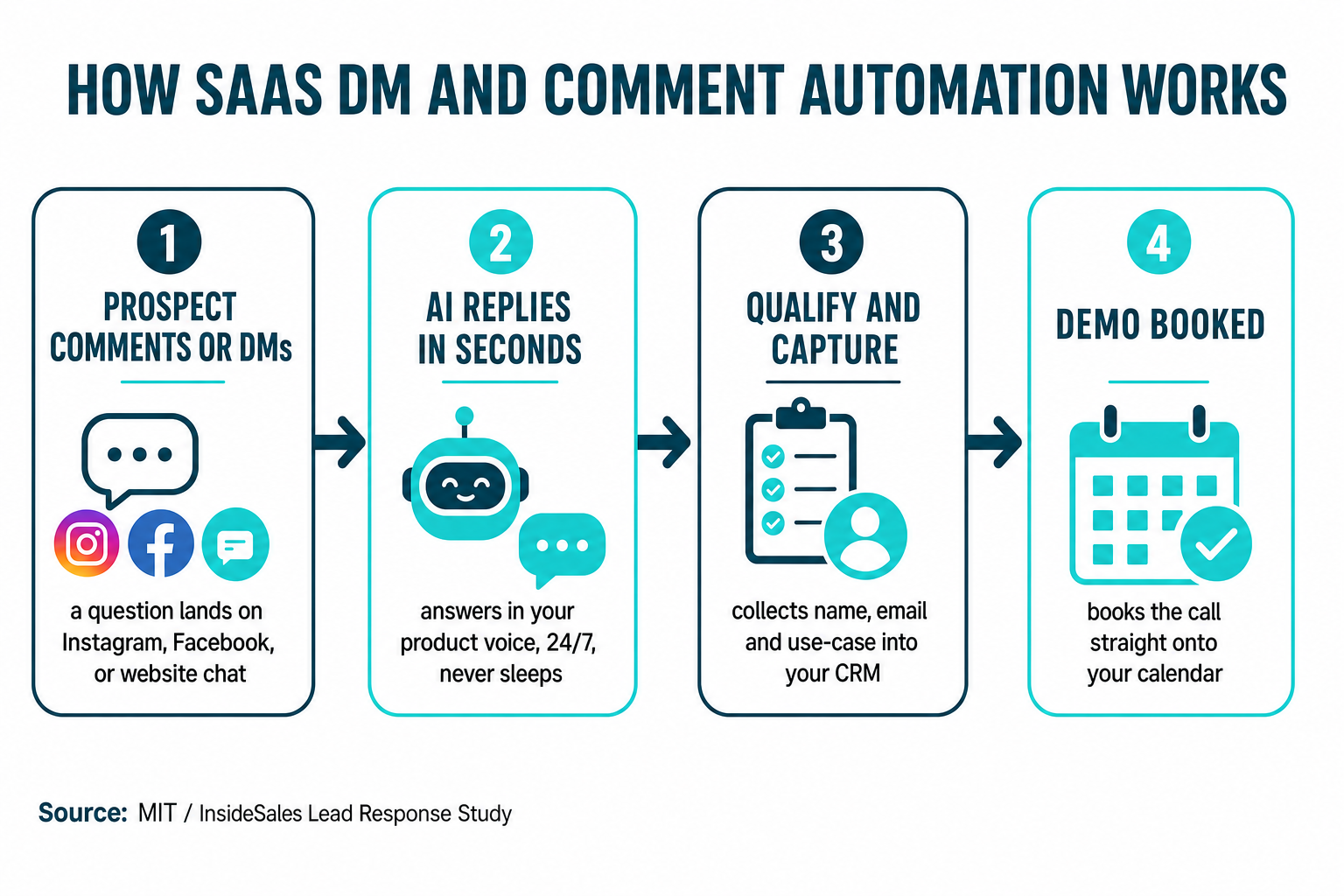
The solution isn’t “hire someone to watch the inbox” — a human can’t cover Instagram, Facebook, and your website chat 24/7, and the moment they sleep or take a busy release week, the leak reopens. The durable fix is an automation system that handles the first reply everywhere a buyer might raise a hand, then hands warm, qualified leads to you. Here’s how the engine works.
1. Catch every surface, not just the DM
Warm questions arrive in three places, so the system covers all three: an AI comment agent replies to questions under your posts on Instagram, Facebook, and TikTok; an AI DM agent answers Facebook and Instagram direct messages; and an AI web-chat agent on your site catches anonymous visitors. Miss any one and you’ve re-opened the leak.
2. Answer in seconds, in your product’s voice
Speed is the whole point — the agent replies immediately, day or night, so no “does this integrate with Stripe?” ever sits overnight. Because it’s trained on your product, positioning, and objections, it answers like a knowledgeable teammate, not a canned auto-responder. This is the same instant-reply muscle behind an AI trial-qualification chatbot.
3. Qualify and capture into your CRM
A reply isn’t the finish line — a captured lead is. The agent asks the qualifying questions (team size, use case, current stack), collects name and email, and drops the whole conversation into your CRM so nothing lives and dies inside a social platform you don’t own.
4. Book the demo automatically
The best time to book a call is the moment interest peaks — inside the conversation. The agent offers real calendar slots and books the demo directly, syncing to the calendar you already use. The prospect goes from “quick question” to “booked call” without a human touching it.
Build vs. buy for a New York SaaS team
You can staff this in-house — but doing it well means a community manager covering every channel, plus the tooling and the always-on coverage that DMs actually require. In a market where you’re competing for talent against funded startups, that’s an expensive, fragile way to answer a comment at 11pm. Here’s the honest comparison we walk New York founders through.
| Plan | Done-for-you social + AI agents recommended | Staff it in-house |
|---|---|---|
| Price | $397/mo (1 brand · 9 channels) | One+ full-time hire + tools |
| Feature 1 | AI comment agent (Instagram, Facebook, TikTok) | A community manager is only online part of the day |
| Feature 2 | AI DM agent (Facebook & Instagram messages) | No coverage for nights, weekends, or release weeks |
| Feature 3 | AI web-chat agent on your website | Separate tools for comments, DMs, chat & CRM |
| Feature 4 | Replies in seconds, 24/7, in your product voice | Ramp time before replies are consistent |
| Feature 5 | Qualifies, captures & books demos to your CRM | Competing for talent in a top-3 tech market |
| Feature 6 | Content published 5 days a week across 9 channels | Manual routing of leads into the CRM |
| Feature 7 | Monthly per-channel performance report | Reply speed depends on someone being awake |
| Feature 8 | White-label · cancel with 15 days notice | Payroll, benefits, tools & turnover risk |
| See the social plan | Compare pricing |
The point isn’t that in-house is wrong — a well-funded team can absolutely build this. It’s that for most New York SaaS companies and the agencies serving them, a done-for-you engine that includes the three AI agents catches more warm demand, around the clock, than a single hire ever will — at a fraction of one salary. If you’d rather also hand off the GoHighLevel operation behind it, that pairs naturally with a dedicated GHL VA or custom GHL development.
What “good” looks like after 90 days
Comment and DM automation pays off faster than most content plays because it works on demand you’re already generating — you’re plugging a leak, not filling a new bucket. In the first few weeks, the visible change is simple: every comment and DM gets an instant, on-brand reply, and questions stop dying overnight. By day 90, a healthy system looks like a steady flow of qualified conversations captured into your CRM, a rising share of demos booked without a human touching the first reply, and a social presence that reads as responsive and alive to every prospect vetting you.
The compounding benefit is trust. When your account visibly answers fast, buyers extend that impression to your product and your support — and in a crowded New York market, being the vendor who replies first is often the whole ballgame. To make sure those captured leads convert once they arrive, wire them into a full SaaS lifecycle and a tight time-to-value activation motion.
Frequently asked questions
Does responding faster to leads actually increase conversions?
Yes, and it's one of the most replicated findings in B2B sales. The MIT/InsideSales Lead Response Management study found you're 21× more likely to qualify a lead when you respond within 5 minutes instead of 30, and 100× more likely to even reach them. Harvard Business Review found firms that contact a lead within an hour are nearly 7× more likely to have a meaningful conversation. Speed of first reply is one of the highest-leverage variables in your funnel.
Why automate DMs instead of just hiring someone to answer them?
A person can't cover Instagram, Facebook, and website chat 24/7, and the leak reopens the moment they sleep or hit a busy release week. Drift's research found the average B2B first reply takes 42 hours and 55% of companies never reply within five business days — usually because a human is the bottleneck. Automating the first reply guarantees an instant, on-brand response every time, then routes qualified leads to your team for the actual sales conversation.
Will an AI DM agent sound robotic or off-brand?
It shouldn't, because it's trained on your product, positioning, and common objections, and it replies in your product's voice. The goal is a knowledgeable first response — answering the integration or pricing question, qualifying the prospect, and booking a demo — not a generic 'thanks for your message.' You review and refine the voice during onboarding, and humans still handle every actual demo and deal.
Which channels does comment and DM automation cover?
The system covers the three surfaces where warm SaaS questions land: an AI comment agent for Instagram, Facebook, and TikTok comment threads; an AI DM agent for Facebook and Instagram direct messages; and an AI web-chat agent for your website. Every reply qualifies the prospect and books the demo into your CRM, so no lead lives and dies inside a platform you don't control.
Is this relevant for a New York SaaS company specifically?
Especially so. New York is the #3 tech-talent market in North America with a record 172,570 tech jobs and 25,000+ startups, so buyers are plentiful but they're also comparing several vendors at once. In a market that crowded, the tool whose AI agent replies to a midnight DM in seconds books the demo, while the one who reads it at 10am loses it. Fast, automated replies are how you win a high-competition feed.
Where do the leads and booked demos actually go?
Everything lands in a CRM you can log into: each lead's name, email, and full conversation, plus every demo the AI agents book on your calendar. You can sync it to your existing Google Calendar so there's no double-entry, and you can view, filter, and export your contacts anytime. The pipeline of captured leads and booked demos is always visible to you.
Sources
- Harvard Business Review — The Short Life of Online Sales Leads
- MIT / InsideSales — Lead Response Management Study (Dr. James Oldroyd)
- Drift — Lead Response Report (433 B2B companies)
- Sprout Social — Sprout Social Index
- HubSpot — Customer Service Statistics
- Meta for Business — Messaging
- Office of the NY State Comptroller — NYC’s Tech Boom
- CBRE — Scoring Tech Talent (top-ranked markets)
- Tech:NYC
About the author
Devon Asante is a GHL Automation Architect based in Denver, CO. A former agency operator who resold GoHighLevel to software clients, he designs the pipelines, triggers, and multi-channel messaging sequences that make a SaaS run on rails — from the first DM reply to a booked demo. He writes about the unglamorous plumbing that quietly turns social conversations into MRR.
Related reading: Reduce SaaS Demo No-Shows · AI Trial-Qualification Chatbot for SaaS · Short-Form Video for SaaS · Trial-to-Paid Activation Emails