
To connect a SaaS app to GoHighLevel, you send your product’s real events — trial signup, activation milestone, failed payment, plan upgrade, cancellation — into GoHighLevel over webhooks or its API v2, then let GoHighLevel workflows fire the lifecycle automation on each one. That is the whole game. GoHighLevel is a superb CRM, calendar, and messaging engine, but it doesn’t know a Philadelphia founder’s user just hit their fifth failed login or that Stripe just declined a card — unless you tell it. Wire those events in, and your activation nudges, dunning, and churn saves stop depending on someone remembering to export a CSV.
This is the operator-level playbook: which events to pipe in, the four ways to move them, the seven build steps we actually follow, and why the math matters more than it looks — especially for a software company competing in one of the fastest-climbing startup ecosystems in the country.
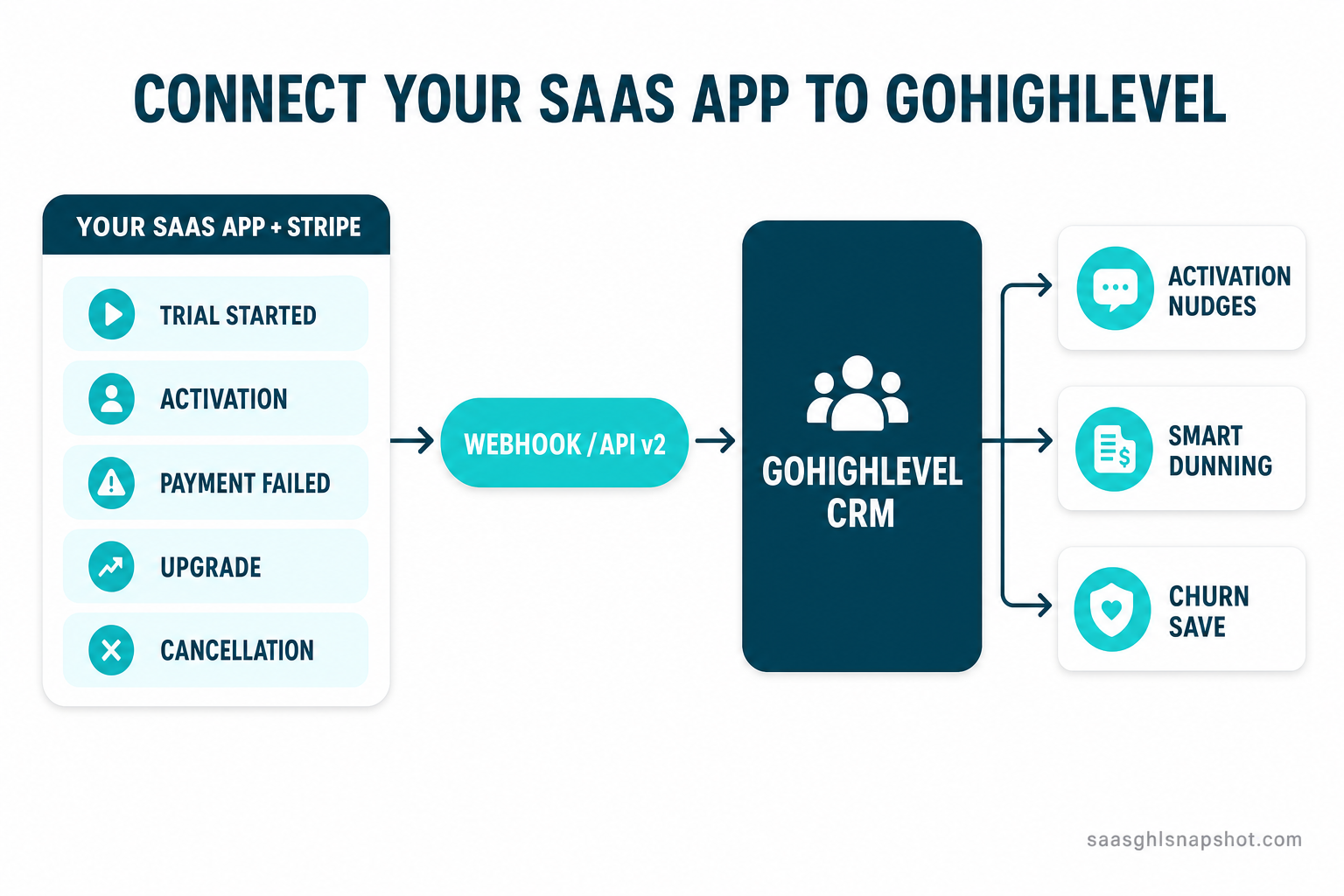
Table of contents
- The short answer
- Why disconnected tools quietly bleed MRR
- The product events worth piping into GoHighLevel
- The failed-payment math that pays for the build
- Four ways to connect your SaaS to GoHighLevel
- The 7-step integration playbook
- Trial model changes what your automation must do
- Why this matters for Philadelphia SaaS companies
- Build it, buy it, or have it done for you
- Frequently asked questions
- Sources
- About the author
The short answer
“Connecting your SaaS to GoHighLevel” means one thing in practice: every meaningful thing a user does inside your product becomes an event that lands on their GoHighLevel contact record in near real time, so a workflow can react.
There are two directions of traffic:
- Product → GoHighLevel (the important one). Your app and Stripe emit events —
trial.started,activation.completed,invoice.payment_failed,subscription.updated,subscription.canceled. Each one updates a custom field or fires a workflow trigger in GoHighLevel. - GoHighLevel → Product (optional). GoHighLevel can call back into your systems — book a demo, tag a plan intent, push a contact to Stripe — using its API v2 and outbound webhooks.
Get the first direction reliable and you’ve solved 90% of the problem. Everything else in this guide is about doing that cleanly, without dropped events or hand-keyed data.
Why disconnected tools quietly bleed MRR
The default state of a SaaS stack is siloed. According to Okta’s Businesses at Work 2025 report, the average company now deploys around 101 apps — the first time that figure has crossed 100 (Okta, 2025). Your billing system, your product database, and your CRM are three of those hundred, and none of them talk to each other unless someone builds the bridge.
When the bridge is a human, two things happen. First, the data rots — and dirty data is expensive: Gartner has pegged the average cost of poor data quality at roughly $12.9 million per year for an organization (Gartner). Second, your team stops selling and retaining, and starts copy-pasting. Salesforce’s State of Sales research found reps spend less than 30% of their time actually selling; the rest disappears into admin and data entry (Salesforce, 2023).
The cost isn’t just wasted hours — it’s latency. A lifecycle nudge that should fire the second a trial user activates instead fires whenever someone next runs a report. And latency destroys conversion. The classic Lead Response Management study led by Dr. James Oldroyd at MIT found that contacting a lead within 5 minutes versus 30 minutes made a team 21x more likely to qualify it (LRM Study). Harvard Business Review’s audit of 2,241 companies reached the same conclusion: firms that responded within an hour were 7x more likely to qualify a lead than those that waited just an hour longer, and 60x more likely than those who waited 24 hours or more (HBR, 2011).
An event-driven GoHighLevel connection collapses that latency to seconds. The workflow fires when the thing happens, not when a human notices it happened.
The product events worth piping into GoHighLevel
You don’t need to stream everything. You need the handful of events that trigger a revenue action. For most SaaS, that’s five:
- Trial started → tag the contact, start the activation sequence, set a “days into trial” field.
- Activation completed (the user hit first value — created a project, sent a campaign, connected an integration) → move them to a “converting” pipeline stage and switch messaging from how-to to upgrade.
- Payment failed → start smart dunning immediately (this one is pure recovered revenue; see the next section).
- Subscription upgraded / downgraded → trigger expansion or save motions and update MRR on the record.
- Cancellation requested → fire the win-back and exit-survey flow.
Each event carries a small payload — the user’s email, the plan, the amount, a timestamp. GoHighLevel matches it to a contact by email, updates fields, and lets a workflow do the rest. If you want the retention logic those workflows should run, we broke it down in failed-payment dunning and churn prediction with health scores.
The failed-payment math that pays for the build
The single most compelling reason to connect Stripe to GoHighLevel is involuntary churn — customers you lose not because they wanted to leave, but because a card expired or a charge was declined. Recurly’s benchmark research finds that involuntary churn typically accounts for 20–40% of total subscription churn (Recurly). That’s revenue leaking out the bottom of the bucket for no strategic reason at all.
Dunning fixes it — and the better the dunning, the more you recover. Recurly reports that a baseline dunning effort recovers about 49% of failed payments, while optimized programs — smart retries, card-updater, and timed recovery emails — reach roughly 71% (Recurly). The difference between 49% and 71% is entirely execution: retrying at the right time and reaching the customer on the right channel, automatically, the moment the charge fails.
The connection is what makes “optimized” possible. When invoice.payment_failed lands in GoHighLevel in real time, a workflow can start SMS + email dunning within seconds and keep firing timed retries — instead of a customer silently dropping off a report your team reviews on Friday.
Four ways to connect your SaaS to GoHighLevel
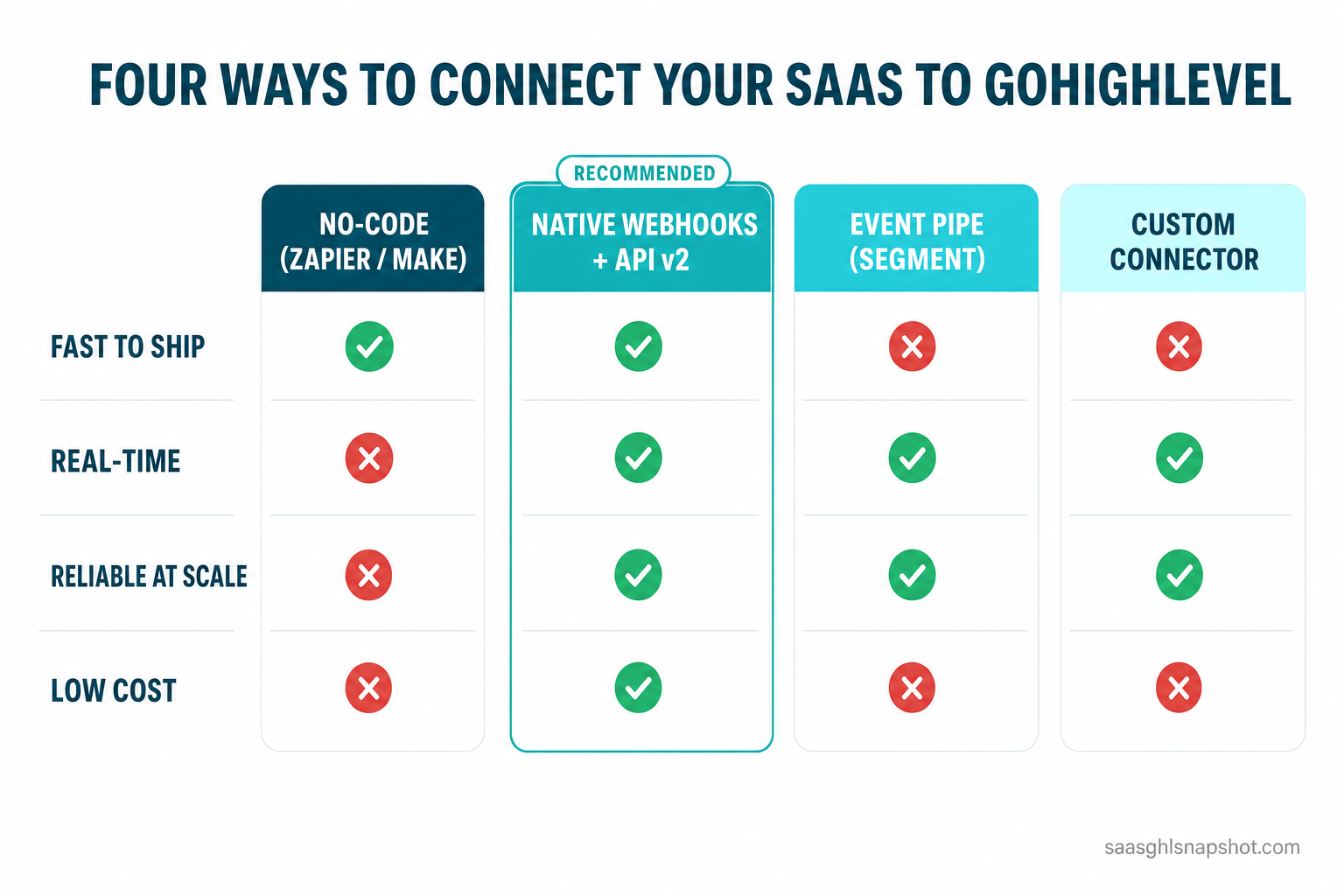
There’s no single “right” method — there’s the right method for your team’s engineering appetite and reliability needs. Here’s how we scope it.
| Plan | No-code (Zapier / Make) | Native GHL webhooks + API v2 recommended | Event pipe (Segment) | Custom connector (done-for-you) |
|---|---|---|---|---|
| Price | Fastest to ship | Best balance | For event-rich products | Most reliable at scale |
| Feature 1 | Point-and-click, no engineers needed | Stripe & app POST straight to GHL | One event stream, many destinations | Idempotency, retries, logging built in |
| Feature 2 | Great for 1–2 low-volume events | Real-time, no middleman fees | Clean schema across your stack | Handles high volume & edge cases |
| Feature 3 | Higher per-task cost at scale | Full control of fields & triggers | Adds a platform cost + setup | Two-way sync when you need it |
| Feature 4 | Limited retry / error handling | Needs a small endpoint you own | Overkill for a two-event start | Owned code, deploys to your infra |
| Feature 5 | Best for validating the idea quickly | Where most SaaS should land | Great once analytics matters too | What we build in /ghl-development |
For most Philadelphia SaaS teams, the honest recommendation is: start no-code to prove the lift, graduate to native webhooks + API v2 for anything you depend on, and commission a custom connector once dropped events would cost you real money. A recovered-payment flow that silently fails is worse than no flow at all — because you’ll think it’s working.
The 7-step integration playbook
Here’s the sequence we run for a SaaS client, start to finish.
Step 1 — Map the events that trigger a revenue action. Write down each product/billing event and the exact GoHighLevel response it should cause. If an event doesn’t change what you say or do to the customer, don’t wire it yet.
Step 2 — Create the receiving fields and workflows in GoHighLevel first. Add custom fields (plan, mrr, trial_day, last_event, health_score) and build the workflows that will consume them, using a manual test contact. Build the destination before you build the pipe.
Step 3 — Pick your transport from the four options above. For Stripe, its native webhooks are the cleanest source of billing events. For product events, emit them from your backend.
Step 4 — Wire Stripe → GoHighLevel. Point a Stripe webhook (or your connector) at an endpoint that transforms invoice.payment_failed, customer.subscription.updated, and customer.subscription.deleted into GoHighLevel contact updates and workflow triggers. This is the highest-ROI wire; ship it first.
Step 5 — Wire product events → GoHighLevel. From your app, POST trial.started and activation.completed (define “activated” as the moment a user hits first value — see time-to-value for SaaS for how tightly that maps to retention). Match on email; update the pipeline stage.
Step 6 — Add reliability: idempotency, retries, and logging. Every event needs a unique ID so a retried webhook doesn’t double-fire a dunning sequence. Add exponential-backoff retries and a log you can audit. This is the step DIY builds skip and later regret.
Step 7 — Test with real payloads, then monitor. Fire test events for every case — including the ugly ones (a payment that fails then succeeds, a user who cancels then reactivates). Then watch the logs for a week. An integration isn’t done when it works once; it’s done when you trust it unattended.
Trial model changes what your automation must do
One nuance the wiring has to respect: your trial model. Free-trial-to-paid conversion varies enormously by whether you ask for a card up front.
Analysis from First Page Sage puts opt-out trials (credit card required) converting to paid at about 48.8%, versus roughly 18.2% for opt-in (no card) trials (First Page Sage, 2025), against an OpenView product benchmark median of roughly 14.7% across SaaS (OpenView, 2022). (Definitions vary between sources, so pin yours down: opt-out = card on file, higher conversion but more failed payments to recover; opt-in = no card, lower conversion but more activation nudging required.)
The integration is what lets you run the right motion for your model. Card-required? The connection powers aggressive dunning on the failed payments that come with higher conversion. No-card? It powers relentless, event-timed activation nudges to close the wider gap. Amplitude’s research is blunt on why this matters: faster time-to-value is directly correlated with higher long-term retention (Amplitude, 2024) — and you can only nudge toward first value in real time if the activation event is flowing into GoHighLevel.
Why this matters for Philadelphia SaaS companies
Philadelphia is no longer a second-tier tech market. In the 2025 Global Startup Ecosystem Report, Philadelphia climbed 12 spots to rank #13 globally, with its ecosystem generating roughly $76 billion in value (Startup Genome / Penn, 2025). And there’s real depth of talent behind it: CompTIA’s State of the Tech Workforce reports Pennsylvania has more than 300,000 tech workers, with roughly 157,000 in the Philadelphia metro (CompTIA, 2025).
That climb cuts two ways for a local software company. The upside is a dense pool of engineers, capital, and customers. The downside is competition — more funded teams chasing the same buyers, which makes every point of trial conversion and every recovered payment worth more. In a market that’s compounding, a leaky lifecycle isn’t just lost revenue this month; it’s lost position against the company across town that wired theirs up. Philadelphia SaaS teams that automate the trial-to-retain motion — rather than run it out of a founder’s inbox — keep more of the growth the ecosystem is generating.
Build it, buy it, or have it done for you
You have three honest paths:
- DIY with no-code. Perfect for validating one event. You’ll outgrow it the moment reliability matters.
- Build it in-house. The right call if you have backend engineers with spare cycles and a taste for maintaining webhooks. Budget for the reliability work in Step 6 — it’s where in-house builds under-invest.
- Have it done for you. This is exactly what our GHL development team does: a Stripe-to-GoHighLevel billing sync, product-event connectors, and customer-success dashboards, built with idempotency and retries from day one. A typical connector runs $3K–$8K (or a $75/hr retainer), ships in 2–4 weeks, includes a 30-day bug-fix warranty, and comes with full IP transfer — the code lives in your repo, on your infrastructure.
If you’d rather not run GoHighLevel at all day-to-day, a dedicated GHL VA can operate the workflows the integration feeds. And if the build goes beyond GoHighLevel into product surfaces — a customer portal, usage-based billing UI, or a standalone app — our custom software team picks it up from there. The integration is the cheapest, highest-leverage plumbing you’ll install: it turns a stack of disconnected tools into one lifecycle that reacts on its own.
Frequently asked questions
How do I connect my SaaS app to GoHighLevel?
Send your product and billing events — trial signup, activation, failed payment, upgrade, cancellation — into GoHighLevel over its inbound webhooks or API v2, matched to a contact by email. Each event updates a custom field or fires a workflow, so your activation, dunning, and churn automations run on real product activity in near real time instead of manual data entry.
Can I connect Stripe to GoHighLevel for failed-payment dunning?
Yes, and it's the highest-ROI wire to build first. Point a Stripe webhook (or a custom connector) at an endpoint that turns invoice.payment_failed and subscription events into GoHighLevel contact updates and workflow triggers. Recurly finds optimized dunning recovers around 71% of failed payments versus about 49% for a baseline effort — the difference is firing timed retries and multi-channel messaging automatically the moment a charge fails.
Do I need engineers, or can I use Zapier or Make?
For one or two low-volume events, Zapier or Make will get you live without engineers — a great way to validate the lift. For anything you depend on for revenue, move to native GHL webhooks plus API v2, or a custom connector, so you get real-time delivery, idempotency, and retry handling that no-code tools handle poorly at scale.
What events should I send into GoHighLevel first?
Start with two: invoice.payment_failed (recovers revenue you've already earned) and trial.started (front-loads activation). Prove the impact, then add activation-completed, subscription upgrade/downgrade, and cancellation. A two-event integration you trust beats a five-event one you're still debugging.
How much does a custom GoHighLevel integration cost?
A Stripe-to-GHL or CRM-to-GHL connector typically runs $3,000–$8,000 as a fixed-price build, or $75/hour on retainer, and ships in about 2–4 weeks with a 30-day bug-fix warranty and full IP transfer. More involved builds — customer-success dashboards or marketplace apps — scope higher. Book a call for an exact quote.
Why does this matter specifically for Philadelphia SaaS companies?
Philadelphia rose to #13 in the 2025 Global Startup Ecosystem Report, with a roughly $76B ecosystem and 150,000-plus tech workers in the metro. That growth means more funded competition for the same buyers, so every point of trial conversion and every recovered payment is worth more. Automating the lifecycle instead of running it manually is how local teams keep more of that growth.
Sources
- Okta — Businesses at Work 2025
- Gartner — Data Quality
- Salesforce — State of Sales research (2023)
- Lead Response Management Study (MIT / James Oldroyd)
- Harvard Business Review — The Short Life of Online Sales Leads (2011)
- Recurly — Churn Rate Benchmarks
- Recurly — Voluntary vs Involuntary Churn & Dunning Recovery
- First Page Sage — SaaS Free Trial Conversion Rate Benchmarks (2025)
- OpenView — 2022 Product Benchmarks
- Amplitude — Time to Value Drives User Retention (2024)
- Startup Genome / Penn Pennovation — Philadelphia #13, GSER 2025
- CompTIA — State of the Tech Workforce 2025
About the author
Mara Castellano is a Lifecycle & Retention Strategist based in Austin, TX. She has spent a decade inside product-led SaaS teams turning trial signups into paying, retained accounts — mapping the full lifecycle from first activation nudge to churn save, and rebuilding it inside GoHighLevel so founders stop losing revenue in the gaps between tools. She writes about activation, dunning, and the unglamorous plumbing that quietly compounds MRR.
Related reading: Failed-Payment Dunning · Churn Prediction & Health Scores · SaaS Lifecycle Marketing · GoHighLevel Migration for Dallas SaaS · Recover Checkout Abandonment